
 No. 146
  No. 145
  No. 143
  No. 142
  No. 141
  No. 140
  No. 139
 by Katharina Flicker (TU Wien, SBA), Ilire Hasani-Mavriqi (TU Graz), Dimitri Prandner (JKU)
As Open Science becomes a structural requirement, developing the right skills goes beyond technical training and requires integrating disciplinary expertise with legal, communicative, and data-related competences.
Over the last two decades, Open Science and open data have evolved from normative ideals into structural requirements for contemporary research systems. Policy frameworks increasingly mandate openness and promote infrastructures to generate public value from scientific work with open data [1]. However, competence development is often narrowly framed as technical training in research data management or FAIR compliance. This perspective has been criticised as insufficient [2], as sustainable Open Science education requires integrating disciplinary expertise with managerial, communicative, legal, and technical competences.
Infrastructure as a Precondition for Open Science Skills
Arguments emphasising the relevance of disciplinary, managerial, communicative and legal skills in open science and open data education are echoed in the findings from the recent quantitative RI:TRAIN PLUS [L1] survey study [2], which included data from 330 operators and managers of selected European research infrastructures (RI). Based on a comprehensive needs assessment across European RIs, the study shows that training demands for infrastructures fostering open science and open data are closely tied to the institutional maturity of infrastructures: if governance, data stewardship, repository services, and policy frameworks are underdeveloped, skills development remains fragmented and inconsistent.
This suggests structural dependencies: open science education presupposes infrastructures that themselves operate according to FAIR principles and transparent governance standards. Researchers cannot be expected to implement FAIR data practices if repositories are unstable, metadata standards are unclear, or long-term preservation strategies are absent. Similarly, training in FAIR and open data stewardship is ineffective without institutional support structures that enable compliance in practice.
In this sense, open data education must follow infrastructural development. Services for open science and open data skills development must therefore be embedded within functioning ecosystems providing operational clarity, stable tools, and harmonised policies. Investments in training without parallel investments in infrastructural maturity risk producing symbolic compliance rather than sustainable transformation and vice versa.
Beyond Technical Skills: Management, Communication, and Legal Competence
The data also indicate that open science competencies extend beyond technical data handling. As illustrated in Figure 1, participants repeatedly emphasised needs related to project management, stakeholder coordination, communication strategies, and legal clarity. These findings challenge a reductionist understanding of open science as a purely technical domain. It also provides deeper insight into the fact that overall actors in the field of open science require structural competences that enable them to bridge normative commitments and organisational realities [2, 3]. FAIR implementation, for instance, is not merely a metadata exercise but a governance question: Who defines and accepts standards? Who ensures compliance? Who bears responsibility for long-term sustainability? Likewise, legal questions regarding data protection, intellectual property, and licensing are central to enabling reuse and trust. Communication plays a similarly crucial role. Open science presupposes dialogue across disciplines, institutions, and national contexts. It requires shared vocabularies, alignment of expectations, and the capacity to translate technical requirements into actionable guidance for diverse stakeholder groups. Without communicative infrastructures, even well-designed technical services remain underutilised. Thus, services for open science education must adopt a broadened competence model. In addition to data literacy and FAIR implementation, they must foster:
- governance and management skills for coordinating open science processes
- legal literacy regarding data protection, copyright, and licensing
- communication capacities to mediate between researchers, infrastructures, and policy actors.
Only by integrating these dimensions can open science move from the uncomfortable place between normative positions and expected policy-based regulations to operational practice.
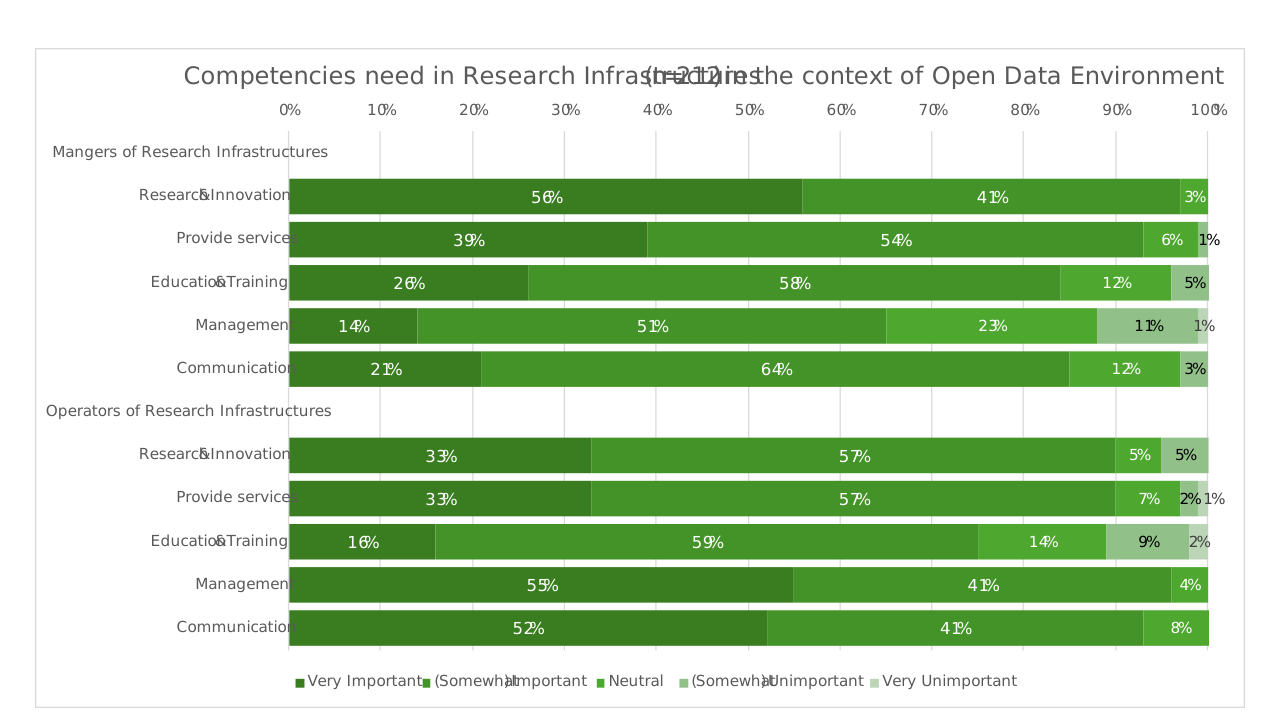
Figure 1: Distribution of competencies required to work in research infrastructures and to support open science. Results from the European RI:train plus survey 2021.
The Role of National Support Structures
National coordination structures play a decisive role in operationalising such integrated competence models. Positioned between European developments and national stakeholders, the EOSC Support Office Austria (SOA) [L2] supports Austrian institutions in aligning with the evolving EOSC Federation [L3], a European network of interoperable data repositories and services intended to advance open science. Services provided by EOSC SOA currently include communication support, structured information dissemination, and the coordination of stakeholder dialogues within the national open science community.
Beyond communication and stakeholder coordination, Austria has invested in complementary ministry-funded initiatives that strengthen the structural foundations of open science. The Shared RDM Services & Infrastructure project [L4], for example, develops interoperable and scalable research data management services across institutions, thereby creating the operational backbone required for effective training uptake. Likewise, the FAIR Data Austria initiative has contributed to the professionalisation of data stewardship by establishing a national strategy and competence framework that outlines data stewardship models and associated training pathways [3].
Together, these initiatives illustrate that national support structures do not merely disseminate information but actively shape the infrastructural and organisational conditions under which open science skills can be sustainably developed. As also highlighted by the RI:TRAIN PLUS findings, competence development depends on infrastructural maturity and coherent governance frameworks and is not solely a matter of individual researcher training. National initiatives thus translate European-level ambitions into nationally embedded service portfolios, governance models, and professional profiles.
From Skills to Systems
Open science education should therefore be conceptualised not as a discrete training activity but as part of a systemic transformation process. Technical FAIR skills remain essential. Yet without mature infrastructures, coherent governance, legal certainty, and communicative coordination, such skills cannot unfold their full potential.
Services for open science education must consequently operate on two levels: they must enhance individual competences while simultaneously strengthening institutional and infrastructural capacities. The data from RI:TRAIN PLUS indicates that these dimensions are interdependent. The example of the EOSC SOA, alongside initiatives such as Shared RDM Services & Infrastructure and FAIR Data Austria, shows how coordinated national support structures can address this interdependence in practice. If open science is to become the default mode of research rather than an additional administrative burden, education and infrastructure must evolve in sync. Only then can openness become operationally sustainable.
Links:
[L1] https://www.aussda.at/en/about-aussda/completed-projects/ritrain-plus/
[L2] https://eosc-austria.at/
[L3] https://eosc.eu/building-the-eosc-federation
[L4] https://forschung-daten.at/en/shared-rdm/
References:
[1] S. Reichmann, et al., “Adopting EOSC on the ground – Integrating (European) research infrastructure into national institutions,” ABI Technik, vol. 45, no. 4, pp. 432–442, 2025, doi: 10.1515/abitech-2025-0059.
[2] D. Prandner and P. Sinner, “Identifying and updating training needs in European research infrastructures and core facilities,” Zenodo, 2022, doi: 10.5281/zenodo.7542429.
[3] A. Bardel, et al., “Data stewardship – Austrian national strategy and alignment,” Zeitschrift für Hochschulentwicklung (Journal for Higher Education Development), vol. 18, Sonderheft Forschung, pp. 65–88, 2023, doi: 10.21240/zfhe/SH-F/05.
Please contact:
Ilire Hasani-Mavriqi
TU Graz, Austria
Dimitri Prandner
JKU, Austria