 No. 146
  No. 145
  No. 143
  No. 142
  No. 141
  No. 140
  No. 139
 Federico Drago (EGI Foundation) and Nicola Fiore (EGI Foundation)
Becoming part of the EOSC Federation is a significant step for any organisation involved in research. The new EOSC Core Innovation Sandbox provides a safe, pre-production environment where providers can test their integration, validate interoperability, and gain confidence before joining the live federation, turning the complexity of Open Science into a manageable, step-by-step process.
The European Open Science Cloud (EOSC) is transitioning from a centralised platform to a federation of autonomous, interoperable Nodes. For national data centres, thematic research infrastructures, and e-infrastructures, this shift presents a major opportunity. However, it also introduces a challenge: how can an organisation rigorously test its services against EOSC standards and ensure interoperability without risking disruption to production systems?
The EOSC Beyond project [L2] directly addresses this issue with the EOSC Core Innovation Sandbox [L1, Figure 1]. Launched operationally in spring 2025, the Sandbox is a comprehensive, pre-production testbed that mirrors the production EOSC environment. It acts as a "Federator Test Node," providing a complete suite of Core Federating Capabilities that any aspiring EOSC Node can use to validate its integration in a safe, controlled, and governed space.
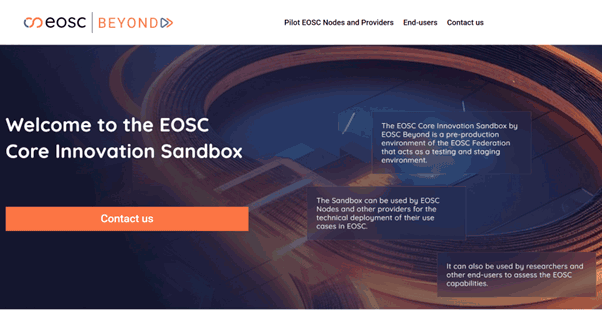
Figure 1: EOSC Core Innovation Sandbox landing page.
A Realistic Environment for Real-World Testing
Unlike static documentation or isolated test harnesses, the Sandbox provides a living ecosystem [1]. It hosts three distinct environments: Development, Integration, and Pre-production, allowing providers to progress from individual component testing to full end-to-end validation. Critically, this infrastructure is distributed; each Core service provider deploys their own instances on their own premises, exactly as they would in the production federation. This approach ensures that tests conducted in the Sandbox accurately reflect the conditions of the live EOSC.
A distinctive feature of the Sandbox is its operational role as a "Federator Test Node" within the EOSC architecture. In the production federation, Federator Nodes provide the shared capabilities (such as AAI, Monitoring, and the Helpdesk) that enable autonomous Nodes to interoperate.
The Innovation Sandbox replicates this function in a pre-production setting, offering a fully functional instance of these Federating Capabilities. This allows candidate Nodes to experience, first-hand, how their local services would connect to and interact with the federation's core infrastructure. By testing against a live Federator Node in a safe environment, providers can validate compliance with interoperability guidelines, refine their integration strategies, and resolve technical issues before they ever impact production systems. This approach transforms federation from an abstract concept into a tangible, testable process.
Lowering Barriers with Core Capabilities
The Sandbox is equipped with a full stack of EOSC Core services, enabling providers to tackle the most common and complex integration challenges head-on. Key capabilities available for validation include:
- Federated AAI: Providers can integrate their existing identity management systems with the EOSC Authentication and Authorisation Infrastructure, enabling Single Sign-On and supporting advanced security features like Multi-Factor Authentication.
- Federated Helpdesk: The Sandbox allows organisations to test the federation of their local ticketing systems with the pan-EOSC Helpdesk, ensuring that users receive coordinated support regardless of which Node they access.
- Federated Monitoring: Providers can validate how their services report operational status and availability to the central EOSC Monitoring framework, a prerequisite for building trust and transparency across the federation.
- Resource Discovery & Onboarding: Through enhanced registries and the EOSC Knowledge Graph, the Sandbox simplifies the process of making datasets, software, and services discoverable and machine-actionable.
These capabilities have already been successfully validated by a network of EOSC Pilot Nodes [3], including CESSDA, LifeWatch ERIC, NFDI, and e-INFRA CZ. Their successes (from enabling cross-domain data fusion to orchestrating "compute close to data" workflows) demonstrate that the Sandbox is not a theoretical exercise, but a proven, practical tool for de-risking federation.
An Open Invitation to the Community
The EOSC Core Innovation Sandbox is now open to external organisations. The process is intentionally lightweight: interested providers submit a brief use case via the project contact form, describing their community, technical requirements, and integration goals. Selected participants receive access credentials, onboarding guidance, and dedicated technical support from EOSC Beyond experts.
For service providers, this is a chance to validate new offerings. For research communities, it is an opportunity to test domain-specific workflows. For infrastructure operators, it is a direct pathway to becoming a functioning EOSC Node.
The success of the EOSC Federation depends not only on its technical design, but on the ease with which diverse organisations can join it [2]. The EOSC Core Innovation Sandbox transforms this complex process into a clear, supported, and low-risk journey. By providing a realistic testing ground and a complete suite of federating capabilities, it enables the next generation of EOSC Nodes to move from aspiration to operation, accelerating the transition toward a truly open and collaborative European research landscape.
Links:
[L1] EOSC Core Innovation Sandbox: https://sandbox.eosc-beyond.eu/
[L2] EOSC Beyond Project: https://eosc-beyond.eu/
References:
[1] EOSC Beyond D5.4: "EOSC Core Innovation Sandbox" https://doi.org/10.5281/zenodo.17292990
[2] EOSC Federation Handbook. https://doi.org/10.5281/zenodo.14999577
[3] EOSC Beyond D15.2: "First report of the technical integration of the EOSC Beyond Pilot Nodes". https://doi.org/10.5281/zenodo.17341191
Please contact:
Nicola Fiore, EGI Foundation, Italy
Federico Dragom EGI Foundation, Italy