
 No. 146
  No. 145
  No. 143
  No. 142
  No. 141
  No. 140
  No. 139
 by Rita Stampfl (University of Applied Sciences Burgenland), Silke Palkovits-Rauter (University of Applied Sciences Burgenland)
Large-scale European research projects increasingly depend on interoperable data spaces and AI-driven services. Yet technical integration alone does not ensure sustainable and trustworthy ecosystems. A structured co-creation model, implemented since 2023 in a European energy data initiative, demonstrates how stakeholder collaboration, governance design and semantic alignment can be embedded directly into project architecture. By formalising participation across iterative development cycles and integrating ethical reflection into technological innovation, the model reframes co-creation as an infrastructural component of Open Science rather than a supplementary engagement activity.
Across Europe, data spaces are being built to support digital transformation in domains such as energy, health and smart cities. Technical interoperability, AI-enabled analytics and governance frameworks are progressing rapidly. Yet many large-scale research consortia encounter a recurring challenge: how to align heterogeneous stakeholders beyond consultation to achieve shared ownership of outcomes? Since 2023, a European energy research initiative has addressed this issue by embedding a structured co-creation process directly into its project architecture. Instead of treating participation as an auxiliary activity, the consortium established a dedicated co-creation process connecting technology development, governance design and domain-specific use cases in the energy sector. The resulting model offers a transferable blueprint for Open Science infrastructures.
The generic co-creation process model (Figure 1) operates across three interdependent dimensions: technology, governance and energy as domain. Within iterative cycles, stakeholders jointly define challenges, analyse data landscapes, harmonise terminology, design services and refine prototypes through structured feedback loops.
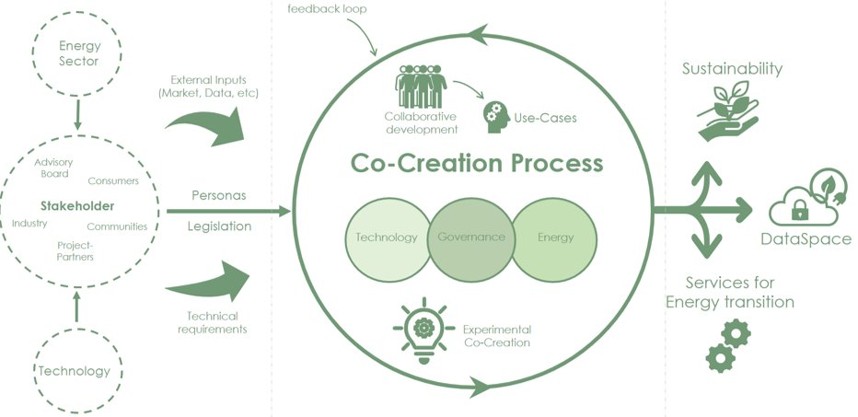
Figure 1: Generic Co-Creation Process Model connecting Technology, Governance and Domain through iterative stakeholder cycles.
A key insight from interdisciplinary research is that participation is often equated with user-centred design, while real decision-making power remains within technical teams [1]. Empirical findings show that users are frequently involved at the beginning (requirements gathering) or at the end (testing), but rarely throughout continuous co-decision processes. The presented model therefore formalises engagement levels ranging from information and consultation to collaboration and empowerment, explicitly clarifying roles and responsibilities.
Methodologically, the process combines structured and creative formats. LEGO Serious Play workshops surface tacit knowledge and build shared mental models. Business Model Canvas sessions clarify value creation and governance implications. World Cafés and Ishikawa diagrams support systemic exploration. Online co-creation is facilitated via shared Miro boards, common data overviews and collaboratively developed use-case visualisations. A jointly maintained terminology wiki ensures semantic interoperability – a foundational requirement for functioning data spaces.
Beyond methodological integration, the model embeds ethical reflection as a structural component. Recent analyses of co-creation in technological contexts emphasise the importance of addressing power imbalances and distinguishing between “co-creating with” and merely “testing on” communities [2]. In data-driven ecosystems, especially when working with sensitive infrastructures, these distinctions are crucial. Governance, regulatory and data sovereignty aspects are therefore discussed directly within the co-creation workshops rather than being addressed retrospectively.
Inclusive participation is a central design principle of the model. Interdisciplinary research consortia often involve institutional stakeholders but unintentionally exclude smaller actors, civil society organisations or less technically specialised participants. The structured co-creation workspace therefore deliberately lowers participation barriers by using visualisation techniques, shared vocabulary development and facilitated dialogue formats. Inclusion is understood not merely as representation but as the capacity to meaningfully influence decisions. By clarifying engagement levels and embedding empowerment mechanisms, the model addresses structural imbalances in knowledge, resources and digital literacy. In doing so, it aligns co-creation with broader European ambitions for equitable, citizen-centred Open Science ecosystems.
The approach has been implemented within the USEFLEDS initiative [L1], which develops an interoperable Energy Data Space to support sector-coupling flexibility in the energy transition. The project brings together Austrian research organisations, technology providers and industry stakeholders to design a data exchange model spanning the value chain of sustainable energy services.
Within this framework, cross-sector services such as flexible energy tariffs, energy flow optimisation and partial automation of ESG reporting have been co-designed. Importantly, these services emerged from structured stakeholder dialogue rather than purely technical specification. The co-creation process acted as a translational layer between AI-based analytics, governance requirements and operational energy practices.
This model contributes to Open Science in three ways. First, it enhances transparency by documenting shared artefacts and decision processes. Second, it supports FAIR-aligned data management principles by aligning terminology and usage conditions early in the development process [3]. Third, it strengthens trust by integrating ethical and legal considerations from the outset.
European initiatives such as GAIA-X [L2] highlight the importance of interoperability and digital sovereignty. However, technical standards alone do not guarantee sustainable ecosystems. The experience since 2023 suggests that co-creation itself must be considered part of the infrastructure: a socio-technical mechanism enabling shared understanding, reproducibility and long-term viability.
Future work focuses on formalising the model as a reusable framework for other domains and linking it with virtual research environments and Open Science infrastructures. Collaboration with additional European partners is planned to refine participatory standards and governance models for data-driven innovation. As Europe advances towards federated, AI-enabled and sovereign data spaces, structured co-creation may become a decisive factor for ensuring that technological interoperability is matched by institutional and societal alignment.
Links:
[L1] https://usefleds.forschung-burgenland.at/645-2/
[L2] https://gaia-x.eu/
[L3] https://www.go-fair.org/fair-principles/
References:
[1] A Osterheider, et al., “Conceptualization of the Understanding of Participation and Co-Creation in Interdisciplinary Research Groups developing Digital Health Technology: An Exploratory Study: Conceptualization of the Understanding of Participation and Co-Creation”, Mensch Und Computer 2023, 534–538, 2023. https://doi.org/10.1145/3603555.3608572
[2] K. Khutsishvili, N. Pavicic, M. Combé, “The challenge of co-creation: How to connect technologies and communities in an ethical way”, in The Leading Role of Smart Ethics in the Digital World, Universidad de La Rioja, 2024.
[3] M. D. Wilkinson, et al., “The FAIR Guiding Principles for scientific data management and stewardship”, Scientific Data, 3, 160018, 2016. https://doi.org/10.1038/sdata.2016.18
Please contact:
Rita Stampfl
University of Applied Sciences Burgenland, Austria