
 No. 146
  No. 145
  No. 143
  No. 142
  No. 141
  No. 140
  No. 139
 by Stefania Amodeo and Zenia Xenou (OpenAIRE AMKE)
OpenAIRE introduces a new approach to researcher profiles, combining open data and narrative CVs to support responsible research assessment beyond traditional metrics.
Research assessment is undergoing a fundamental transformation. For many years, academic evaluation has heavily relied on traditional publication metrics based on journal articles, citation counts, and impact factors. This approach, however, fails to capture the full range of activities that define modern research, including software development, dataset curation, student mentorship, community engagement, and interdisciplinary collaboration. As initiatives like the Coalition for Advancing Research Assessment (CoARA) and the Barcelona Declaration on Open Research Information gain momentum, the research community is increasingly calling for more comprehensive and transparent evaluation practices that rely on open systems rather than proprietary ones.
The OpenAIRE Graph provides the open and transparent data infrastructure underpinning these developments [1].
Until recently, individual researchers remained in the background of research assessment systems, appearing only as identifiers within research output metadata. This represented a significant gap in the implementation of responsible research assessment practices.
OpenAIRE has addressed this gap by integrating researcher identities as distinct entities within the OpenAIRE Graph. This enhancement will be included in the April 2026 Graph release. Researchers with ORCID profiles become first-class entities in the Graph, enabling rich connections that reveal the full scope of their scholarly activities, including:
- organizational connections: employment affiliations based on ORCID profiles
- research output links: direct connections to publications, research software, datasets, and other diverse research contributions
- co-authorship networks: collaboration patterns across multiple publications
- detailed attributions: author roles, affiliations at time of publication, and corresponding author information.
The OpenAIRE Graph currently contains:
- 373 million co-author relationships connecting researchers who have collaborated on publications
- 222 million authorship links between researchers and their research outputs
- 7.5 million organizational affiliations derived from ORCID employment data
- 832,000 project participations linking researchers to funded research initiatives.
The Person entity represents a significant step toward creating a comprehensive, interconnected view of the research ecosystem. The goal is to evolve from basic researcher identification to rich, contextualized attribution that builds a complete research narrative. This means:
- expanding the coverage of author roles to each output, including corresponding author information, the declared affiliations matched from publication metadata, and projects/funding relationships
- moving from static organizational connections to affiliations that capture where researchers produced specific outputs.
Building on the OpenAIRE Graph and its new Person entity foundation, MyResearchFolio [L1] is a pilot service that supports holistic and FAIR-aligned researcher profiles. The service was developed through the Horizon Europe project GraspOS [L2], and based on the results from OPUS project [L3], focused on highlighting researchers’ contributions in the best light possible and on promoting Responsible Research Assessment practices.
MyResearchFolio allows researchers to create comprehensive profiles that combine quantitative indicators from the OpenAIRE Graph with qualitative narrative curriculum vitae (CVs).
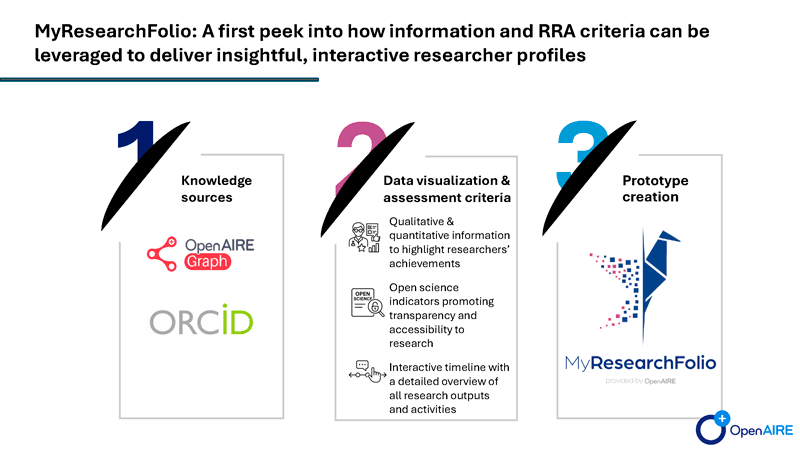
Figure 1: MyResearchFolio concept: researcher profiles are built on OpenAIRE Graph and ORCID data, combining qualitative and quantitative information with responsible research assessment (RRA) criteria, open science indicators, interactive visualizations, and a timeline of research outputs and activities.
The concept is illustrated in Figure 1. Its key features include:
- comprehensive metadata integration: direct access to publications, datasets, software, funding information, institutional affiliations, and collaboration networks from the OpenAIRE Graph
- trusted identity management: bidirectional synchronization with ORCID, ensuring profile portability and reusability across platforms
- narrative flexibility: customizable templates that capture diverse scholarly contributions including leadership roles, interdisciplinary collaboration, mentorship activities, and community engagement
- Open Science alignment: embedded indicators measuring FAIRness, openness, reproducibility, and contributions to Sustainable Development Goals.
By integrating these elements into a single, open framework, MyResearchFolio provides a practical tool for implementing responsible research assessment principles. It enables institutions and researchers to view the research landscape through the lens of individual scholars, revealing their research outputs, career trajectories, collaborative networks, and funding history in a comprehensive and transparent manner.
These developments build on the OpenAIRE Graph infrastructure described in the article on the OpenAIRE Graph by Manghi in this issue.
Links:
[L1] https://researcherprofile.openaire.eu/
[L2] https://graspos.eu/
[L3] https://opusproject.eu/
Reference:
[1] P. Manghi, et al., “OpenAIRE Graph Dataset (10.6.0) [Data set]”, OpenAIRE. https://doi.org/10.5281/zenodo.17725827
Please contact:
Stefania Amodeo
OpenAIRE AMKE, Greece