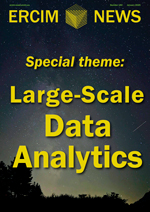
ERCIM News 140
January 2025
Special theme E-values: Large-Scale Data Analytics
Guest editors Andras Benczur (HUN-REN SZTAKI) and Dominik Ślęzak (University of Warsaw)
 No. 146
  No. 145
  No. 144
  No. 143
  No. 142
  No. 141
  No. 139
 Large-Scale Data Analysis – Software Infrastructure and Application Domains - Introduction to the Special Theme
- Details
- Category: Special Theme
- Hits: 3680
by Andras Benczur (HUN-REN SZTAKI) and Dominik Ślęzak (University of Warsaw)
Large-scale data analytics empowers organizations to harness the full potential of the vast amounts of data they generate and collect. By driving innovation, enhancing business operations, personalizing customer experiences, and improving risk management, insights derived from large-scale data analytics are critical for gaining a competitive advantage and making informed, data-driven decisions. With the exponential growth of data generated by businesses, consumers, and connected devices, it is essential to address key challenges in handling Big Data, processing real-time information, and enabling timely, actionable insights.
Semantic-Driven Workflow Automation for Large-Scale Data Analytics
- Details
- Category: Special Theme
- Hits: 3311
by Cristóbal Barba-González, José F. Aldana-Montes, and Ismael Navas-Delgado (ITIS, University of Málaga)
This article presents TITAN, a platform designed to enable the creation and execution of Big Data analytics workflows. Using semantic technologies, TITAN ensures the integration, validation, and reusability of data-driven components, empowering researchers and industries to handle large-scale data challenges more effectively. Through real-world case studies, we demonstrate its potential in transforming data processing workflows across various domains.
Empowering Collaborative and Reproducible Large-Scale Data Analytics with D4Science
- Details
- Category: Special Theme
- Hits: 3069
by Massimiliano Assante (CNR-ISTI), Marco Lettere (Nubisware srl), Alfredo Oliviero (CNR-ISTI), and Pasquale Pagano (CNR-ISTI)
The D4Science platform is advancing reproducible research by providing scientists with robust, cloud-based tools for large-scale data analysis such as the Cloud Computing Platform (CCP). CCP enhances collaboration, allowing researchers to share, reuse, and build on each other’s work across diverse scientific disciplines.
Optimised Decision Intelligence in Data-intensive Environments
- Details
- Category: Special Theme
- Hits: 3175
by George Tzagkarakis (FORTH-ICS), Rommert Dekker (EUR-DE), and Themis Palpanas (UPC- LIPADE)
Effective decision-making in large-scale, uncertain systems faces growing challenges in today’s complex, data-rich environments. Traditional systems struggle to process vast datasets in real time while balancing conflicting objectives and ensuring fairness. The TwinODIS project introduces a transformative approach by combining Artificial Intelligence (AI) and Operations Research (OR) to create next-generation Decision Intelligence systems. This integration leverages advanced analytics, optimisation techniques, and AI-driven insights to transform large-scale decision-making, enabling sustainable development and economic growth through smarter, data-driven solutions.
Data Mining in Railway Diagnostic Data for Predictive Maintenance
- Details
- Category: Special Theme
- Hits: 4432
by Giulia Millitarì (University of Pisa and CNR-ISTI), Alessio Ferrari (CNR-ISTI) and Giorgio O. Spagnolo (CNR-ISTI)
We describe the initial and crucial phase of an analysis for a project belonging to the Spoke 4 on “Railway Transportation” of the Italian National Center for Sustainable Mobility (MOST) [L1], which is part of the National Recovery and Resilience Plan (PNRR). The objective of the project is the implementation of a predictive maintenance strategy within the decision-making process of Trenord [L2], a railway company responsible for the operation of regional passenger trains mostly in Lombardy. Before conducting the analysis, it was essential to perform extensive data mining procedures to make the data from the remote diagnostic system truly usable for extracting meaningful insights and apply machine learning techniques effectively.
DataBri-X: Expanding Digital Value Creation in European Data Spaces
- Details
- Category: Special Theme
- Hits: 3113
by Stelios Sartzetakis (ATHENA RC) and Chamanara, Javad (ΤΙΒ)
In an era when data availability and AI technologies advance rapidly, the European data economy is poised for substantial growth, unlocking new opportunities and innovations. The DataBri-X project [L1] is motivated by the need to foster the development of trustworthy, “made in Europe” AI that embodies European values and ethical standards. DataBri-X focuses on transforming data-sharing ecosystems by advancing data lifecycle practices, tools, and governance frameworks.
interTwin: An Engine for Scientific Digital Twins
- Details
- Category: Special Theme
- Hits: 3262
by Andrea Manzi, Raul Bardaji and Ivan Rodero (EGI.eu)
The paper reviews the need to create a ‘Digital Twin Engine’ to support developers in reusing modular components to speed up the building process of Scientific Digital Twins. It highlights how the interTwin project leads this effort by providing a robust framework that cuts development time, supports scalability, and promotes collaboration between domains. Furthermore, the article highlights some ongoing use cases based on this Digital Twin Engine, showing the use and potential impacts.
iMagine: Revolutionising Aquatic Sciences with AI-Driven Image Analysis
- Details
- Category: Special Theme
- Hits: 3464
by Gergely Sipos (EGI Foundation) and Dick Schaap (MARIS)
iMagine’s AI-driven platform and modules empower researchers to analyse vast amounts of images, accelerating scientific discoveries from the micro to the macro level.
Data-Enhanced Agriculture: Leveraging Analytics for Efficient Water Usage
- Details
- Category: Special Theme
- Hits: 2783
by Karina Medwenitsch, Markus Schindler, and Christoph Klikovits (Forschung Burgenland GmbH)
How can advanced data analysis reshape agriculture in Austria’s climate-stricken Seewinkel region? By combining IoT, AI, and real-time environmental analysis, researchers at Forschung Burgenland are pioneering innovative solutions to optimise water management and support the energy transition, ensuring resilience in the face of climate change.
Data Intermediaries Enabling Governance and Federated Analytics in Energy Communities
- Details
- Category: Special Theme
- Hits: 3031
by Christoph Klikovits (Forschung Burgenland) and Christoph Fabianek (OwnYourData)
The energy sector generates a high volume of data, but data analysts face significant barriers due to issues like security, privacy, and GDPR compliance. These challenges often hinder data sharing, analysis, and interpretation, which are essential for unlocking the added value and insights that data can provide. How can accessible governance solutions help to overcome these obstacles in the energy domain?
Scalable Anomaly Detection in Renewable Energy Grids using the GLACIATION Platform
- Details
- Category: Special Theme
- Hits: 3018
by Ioannis Rotskos (IPTO), Orestis Vantzos (IPTO) and Panagiotis Papadakos (ERCIM)
The transition towards sustainable energy systems is accompanied by huge data volumes generated by modern electricity grids. Within the GLACIATION EU project, Use Case 4 (UC4) demonstrates how scalable anomaly detection algorithms and the edge-cloud continuum enable efficient analytics in energy grid management. This use case highlights the deployment of advanced analytics frameworks for processing SCADA data, extracting actionable insights, and optimizing the energy utilization of renewable sources. UC4 employs the GLACIATION platform, which orchestrates distributed workloads across data centers, focusing on sustainability and cost efficiency by leveraging locally produced green energy.
Extraction of Structured Information from Large-scale European Digital Financial Reports
- Details
- Category: Special Theme
- Hits: 2364
by Alex Suta (Széchenyi István University), Loránd Kedves (Széchenyi István University), Árpád Tóth (Széchenyi István University)
The adoption of eXtensible Business Reporting Language (XBRL) for annual corporate disclosures is reshaping data accessibility and analytical methodologies. This technical study explores how European companies use XBRL to enhance data standardisation, which facilitates large-scale financial and sustainability analyses for practitioners and researchers.
A Multimodal Fusion Architecture for Sensor Applications
- Details
- Category: Special Theme
- Hits: 5690
by Michael Hubner and Jan Nausner (AIT Austrian Institute of Technology)
In this article, we introduce our Multimodal Fusion Architecture for Sensor Applications - MuFASA, which our research group has developed at the Austrian Institute of Technology. It offers a robust fusion architecture for real-time sensor applications, providing situational awareness and precise decision support.
Resource-aware Detection of Satellites Streaks in Deep Sky Images Streams
- Details
- Category: Special Theme
- Hits: 4591
by Olivier Parisot (Luxembourg Institute of Science and Technology)
Capturing deep sky video streams has become accessible and inexpensive thanks to recent hardware and software advances, but the growing number of satellites in Low Earth Orbit (LEO) generates undesired light pollution. Thus, we are currently developing a resource-aware AI system for automatically detecting specific targets like satellite streaks in video streams produced with affordable observation stations.
Visualising Big Traffic Data in GLayer to Guide Policy Development
- Details
- Category: Special Theme
- Hits: 3100
by Jiri Bouchal (Digital Resilience Institute), Hugo Matousek (InnoConnect), Jan Ježek (University of West Bohemia)
GLayer is GPU-accelerated backend software designed for fast aggregation, filtering and visualisation of spatial data. Modelled on the OpenGL technology, GLayer is capable of performing analytical queries on large-scale datasets with millions of data points in a matter of milliseconds. At present, the tool is being tested in Aarhus as part of the BIPED project to support the city’s transition to net-zero emissions.
Knowledge-driven Strategy for Scalable Land-cover Mapping Using Earth Observation Data
- Details
- Category: Special Theme
- Hits: 3061
by José García-Nieto (ITIS, University of Málaga), Virginia García Millán (ITIS, University of Málaga), and José F. Aldana-Montes (ITIS, University of Málaga)
Researchers from ITIS Software work on projects for the generation of big data workflows for processing and analysis of earth observation, remote sensing satellite data. These handle massive amounts of data to obtain value-added applications in agroforestry, the environment, smart cities, and for society in general. As a use case, this paper provides an example of the use of Sentinel-2 satellite data for the generation of a land-cover map over a large area, the Mediterranean basin, using machine-learning algorithms and big data analysis.
Inferring Contributions in Privacy-Preserving Federated Learning
- Details
- Category: Special Theme
- Hits: 2492
by Balázs Pejó (Budapest University of Technology and Economics) and Delio Jaramillo Velez (Chalmers University of Technology)
To what extent do individual contributions enhance the overall outcome of collaborative work? This question naturally arises across scientific fields and is particularly challenging in Federated Learning. It remains largely unexplored in privacy-preserving settings where individual actions are concealed with techniques like Secure Aggregation.
Breaking the Silence: Brain-to-Speech Innovations
- Details
- Category: Special Theme
- Hits: 2781
by Mohammed Salah Al-Radhi and Géza Németh (Budapest University of Technology and Economics, TMIT-VIK, Budapest, Hungary)
How can brain activity be turned into clear, intelligible speech? An ambitious research initiative in Hungary is addressing this question by developing cutting-edge methods to decode neural signals into speech, aiming to restore communication for individuals with severe speech disorders.
Anomaly Detection in Telemonitoring Using Sensor Correlation
- Details
- Category: Special Theme
- Hits: 2923
by Beatrix Koltai, Gergely Ács, and András Gazdag (Budapest University of Technology and Economics)
In telemonitoring, false alarms from medical devices can overwhelm doctors and desensitize care teams to critical issues. How could we reliably detect subtle yet critical changes in a patient’s health status without false alarms or missed anomalies? By correlating data across multiple sensors, our solution improves detection accuracy and results in fewer false positives. Utilizing federated learning, our model is collaboratively trained across multiple hospitals, each with potentially limited data. This improves the model’s performance without centralising sensitive patient data.
Data Visualisation for Big Data: Digital Epidemiology
- Details
- Category: Special Theme
- Hits: 2771
by Stelios Zimeras (University of the Aegean)
At the University of the Aegean, we are developing advanced visualisation techniques and innovative algorithms to enhance digital epidemiology, enabling more effective disease monitoring and response through the integration of diverse big data sources.
A Cost-Benefit Analysis of Additive Urban Manufacturing
- Details
- Category: Research and Innovation
- Hits: 3847
by Igor Ivkić (University of Applied Sciences Burgenland, AT | Lancaster University, UK), Burkhard List (b&mi GmbH & Co KG)
Traditional manufacturing means that a product is mass-produced in distant countries and then shipped long distances to customers, leaving a very large carbon footprint. In this article, we present an approach to disrupt these traditional value chains and replace them with urban manufacturing (or local production) using three-dimensional (3D) printing technology. This approach allows products to be printed locally in an environmentally friendly way, rather than being manufactured far away and flown in. At the heart of this idea is a cloud-based Manufacturing as a Service (MaaS) platform [1] that manages the entire process from online purchase to 3D printing, promoting sustainability and strengthening local economies.
HIGHER: European Heterogeneous Cloud/Edge Infrastructures for Next Generation Hybrid Services
- Details
- Category: Research and Innovation
- Hits: 2903
by Manolis Marazakis and Stelios Louloudakis (ICS-FORTH)
The HIGHER project provides cloud and edge infrastructures using European data centre-ready processor technologies and system design conforming to Open Compute Project (OCP) standards. The innovative framework aims to accelerate the energy transition and drive sustainable technological growth.
Promoting Diversity and Inclusion in Computer Science Academia
- Details
- Category: Joint ERCIM Actions
- Hits: 3135
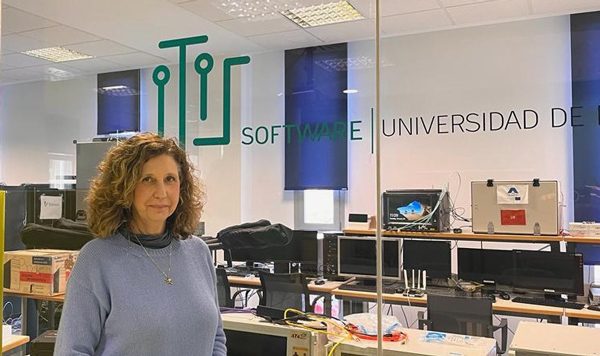 Interview with María-del-Mar Gallardo, ITIS Software, University of Málaga
Dear María, what is your role in your organization?
I am currently a full professor of Computer Science at the Institute for Software Engineering and Software Technology of the University of Malaga (ITIS) (Spain) (itis.uma.es). The institute comprises around 140 researchers and technicians, including permanent staff (approximately 60%) and trainees. Its activities are carried out in five research areas: Automatic Software Engineering, Data Science and Artificial Intelligence, Cybersecurity, Intelligent Networks and Services, and Applications. At the Institute, I co-lead the Morse group, which focuses on contributions in the areas of mobile communication networks and formal methods.
Beyond Compliance 2024: Research Ethics in the Digital Age
- Details
- Category: Joint ERCIM Actions
- Hits: 2777
by Anaëlle Martin (French National Advisory Ethics Council for Health and Life Sciences)
After Paris in 2022 [L1] followed by Porto in 2023 [L3], the third edition of the ERCIM Forum ‘Beyond Compliance’ was held in Budapest on 14-15 October 2024, at the HUN-REN Institute for Computer Science and Control [L3]. This year’s event, which took place both in person and online, continued the discussion on the tough ethical issues faced by researchers in digital sciences. The scientific richness of these two days lay not only in the distinguished status of the speakers, but also in the wide range of cutting-edge topics covered. The diversity of contributions and the high calibre of Forum participants made it possible to explore digital issues from cultural, legal, (geo)political, historical, philosophical, and ethical perspectives.
ERCIM “Alain Bensoussan” Fellowship Programme
- Details
- Category: Joint ERCIM Actions
- Hits: 3863
Announcement
The ERCIM Postdoctoral Fellowship Programme is one of ERCIM’s principal activities. The programme is open to young researchers worldwide and focuses on a broad range of fields in computer science and mathematics.
The fellowship helps promising scientists improve their knowledge of European research structures and networks, and gain insight into the working conditions of leading European research institutions. Fellowships last for 12 months (with a possible extension) and are spent at one of the ERCIM member institutes.
Marcin Żukowski Receives CWI Dijkstra Fellowship
- Details
- Category: Announcements
- Hits: 3508
Announcement
CWI awarded the Dijkstra Fellowship on 21 November to Marcin Żukowski, former CWI database researcher and co-founder of the globally successful tech company Snowflake. Żukowski’s pioneering work produced techniques that are still essential for efficiently processing huge amounts of data, leading to faster analysis and new opportunities for companies working with big data.
AIVD, CWI, and TNO Published Renewed Handbook for Quantum-safe Cryptography
- Details
- Category: Announcements
- Hits: 3129
Announcement
To prepare organizations for Q-Day, the day when quantum computers will be able to break certain widely used cryptography, the General Intelligence and Security Service (AIVD), Centrum Wiskunde & Informatica (CWI), and TNO have published a renewed handbook for quantum-safe cryptography. This extended second edition contains the latest developments and advice for transitioning to a quantum-safe environment, including more concrete advice on finding cryptographic assets, assessing quantum risks, and setting up cryptographic agility. It was presented on 3 December 2024 to the State Secretary for Digital Affairs and Kingdom Relations, Zsolt Szabó, during the Post-Quantum Cryptography Symposium in The Hague.
CWI Research Semester Programme - Truth is in the Eyes of the Machines
- Details
- Category: Announcements
- Hits: 1858
Amsterdam, 8-9 May 2025
How do misinformation and hate speech fuel and influence each other? How can sustainable and FAIR data (Findable, Accessible, Interoperable and Reusable) be developed to independently investigate misinformation and hate speech? How robust are generative AI models at detecting and actively countering information disorders? These research questions will guide the Research Semester Programme on misinformation detection and countering in the era of Large Language Models. The Program will be organized along three full-day workshops, with keynotes and breakout sessions.
ERCIM Published a Stragegy Report “Towards a Shared AI Strategy for European Digital Science Institutes and Organisations”
- Details
- Category: Announcements
- Hits: 1832
Announcement
Generative AI (GenAI) and Large Language Models (LLMs) are transforming science and society, presenting significant opportunities alongside inherent challenges. European digital science institutes and organizations are well-positioned to contribute to responsible development and use of these technologies.
Dagstuhl Seminars and Perspectives Workshops
- Details
- Category: Announcements
- Hits: 2983
Call for Proposals
Schloss Dagstuhl – Leibniz-Zentrum für Informatik is accepting proposals for scientific seminars/workshops in all areas of computer science, in particular also in connection with other fields.
13th International Workshop on Computational Intelligence for Multimedia Understanding - Call for Participation
- Details
- Category: Announcements
- Hits: 2967
in conjunction with ISCAS’2025, London 25-28 May 25–28 2025
MUSCLE (formerly IVU, Image and Vision Understanding) is the ERCIM Working Group focused on multimedia understanding through semantics, computation, and learning. For over 15 years, this working group has brought together teams from ERCIM and non-ERCIM institutions, uniting expertise in machine learning, artificial intelligence, image/video/audio processing, and multimedia processing and management.
IDIMT 2025 - 33rd Interdisciplinary Information Management Talks
- Details
- Category: Announcements
- Hits: 3398
Hradec Kralove, Czech Republic, 3-5 September 2025
“ICT in Business: AI Everywhere? Glory and Disgrace of AI”
The 2025 edition of the IDIMT conference- an interdisciplinary forum for the exchange of concepts and visions in the area of software intensive systems - is organized by the University of Economics and Business in Prague and JKU in Linz, Austria. Papers are peer reviewed and indexed by Scopus and Web of Science.
SAFECOMP 2025 and DECSoS Workshop - Call for Participation
- Details
- Category: Announcements
- Hits: 3623
Stockholm 9-12 September 2025
The international SAFECOMP Conference takes part this year in Stockholm, Sweden, at KTH, from 9-12 September 2025, the first day being reserved for several parallel workshops.