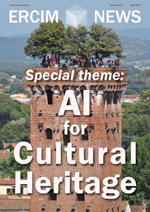
ERCIM News 141
July 2026
Special theme AI for Cultural Heritage
Guest editors George Pavlidis (Athena RC) and Laura Hollink (CWI)





AI for Cultural Heritage - Introduction to the Special Theme
- Details
- Category: Special Theme
- Hits: 7542
by the guest editors George Pavlidis (Athena RC) and Laura Hollink (CWI)
Artificial Intelligence (AI) has become an integral part of the cultural heritage sector. Libraries, archives, and museums are increasingly employing AI to preserve, interpret, and engage with artifacts of historical and cultural significance. As such, the adoption of AI represents a significant leap forward for the sector. However, this progress brings ethical and practical challenges. Cultural heritage artifacts often reflect diverse and complex histories, and developing AI that can fully capture the breadth and nuance of these narratives is no trivial task. The societal role of cultural heritage institutions as trusted sources of information can sometimes conflict with AI systems that may produce biased results when trained on incomplete or skewed datasets. Moreover, many state-of-the-art AI systems operate as “black boxes,” which creates tension with the sector’s emphasis on data curation and provenance. As a result, there is a growing need for AI systems that are tailored to the specific values and requirements of the cultural heritage field.
The Unique Authenticity Identifier and AI Tools for Provenance Research of Unregistered Cultural Objects
- Details
- Category: Special Theme
- Hits: 3479
by Petros Patias (AUTH), Themistocles Roustanis (KIKLO), and Charalampos Georgiadis (AUTH)
The Unique Authenticity Identifier is a novel, non-destructive, multi-parametric, digital indicator that is being developed during the implementation of the EU-funded project ENIGMA [L1]. The UAI will be used to provide a unique provenance metric for unknown/unregistered cultural items by exploiting contextual similarities between the unknown and known items.
The ENIGMA Project and Informed Decision-Making on Illicit Trafficking of Cultural Objects
- Details
- Category: Special Theme
- Hits: 3762
by Charalampos Georgiadis and Petros Patias (AUTH)
ENIGMA (Endorsing, Safeguarding, Protection, and Provenance Management of Cultural Heritage), is an EU-funded project that aims to achieve excellence in the protection of cultural goods (CGs) and artefacts from man-made threats by contributing to identification, traceability, and provenance research of CGs as well as safeguarding and monitoring endangered heritage sites.
Structural Monitoring of Heritage Buildings Via Deep Learning Algorithms
- Details
- Category: Special Theme
- Hits: 3907
by Maria Girardi (CNR-ISTI), Gianmarco Gurioli (University of Florence), and Nicola Messina (CNR-ISTI)
Monitoring systems constitute a significant, non-invasive tool for verifying the structural health of buildings and infrastructure over time. Deep learning neural networks can be used to analyse data from long-term monitoring systems, such as time series of velocity/acceleration measured at specific points and environmental parameters, and to predict the main features of the buildings’ structural behaviour with respect to ambient stresses. Potential anomalies of the structure’s vibrational features related to damage or unexpected events, such as earthquakes or exceptional loads, can also be detected. The paper focuses on the application of a Temporal Fusion Transformer (TFT) network to data from the dynamic monitoring of a medieval tower in the historic centre of Lucca (Tuscany, Italy).
AI-Powered Federated Digital Twins for Enhanced Cultural Heritage Preservation and Predictive Analytics
- Details
- Category: Special Theme
- Hits: 7361
by Gizealew Alazie Dagnaw and Henry Muccini (University of L’Aquila)
Federated Digital Twin (FDT) technology, enhanced by Artificial Intelligence (AI), is revolutionising cultural heritage preservation. By enabling decentralised, collaborative monitoring, predictive analytics, and immersive interactions, FDTs ensure the longevity, accessibility, and sustainability of historical sites. This innovative approach optimises conservation strategies through multi-institutional cooperation, paving the way for future advancements in heritage management.
MuNDAR: An AI-Driven, Gamified Augmented Reality Framework for Cultural Heritage Exploration
- Details
- Category: Special Theme
- Hits: 5460
by Federico Martusciello and Henry Muccini (University of L’Aquila - DISIM)
The rapid advancement of digital technologies is revolutionizing how we engage with Cultural Heritage (CH). MuNDAR is an ambitious project focused on the integration of Gamification (GAM), Generative Artificial Intelligence (GAI) and Augmented Reality (AR) to create immersive and personalised user journeys in mobile applications in the context of CH. By integrating these technologies, we aim to enhance user engagement, accessibility, and storytelling, offering a dynamic and interactive way to explore history and culture.
Intelligent Extended Reality Cultural Heritage Guide: Enhancing Immersive Experiences
- Details
- Category: Special Theme
- Hits: 5416
by Marina Toumpouri, Václav Milata, and Fotis Liarokapis (CYENS - Centre of Excellence)
AI-powered chatbots and virtual guides are transforming cultural heritage, making it more interactive, immersive, and accessible. Leading this transformation, the EU-funded XR4ED project is driving innovation in XR-based education and training. A key outcome of the project is the Intelligent XR Assistant, an AI-driven system enhancing user interaction, adaptive learning, and real-time engagement in XR environments. As part of this effort, an AI-powered guide for Nicosia brings its historic centre to life with AI avatars. By leveraging advanced XR and AI technologies, the assistant transforms the way cultural heritage is experienced.
CulturAI: Advancing Mixed Reality Art Experiences with Large Language Models
- Details
- Category: Special Theme
- Hits: 4194
by Dimitrios Koukopoulos (University of Patras, Greece), Christos A. Fidas (University of Patras, Greece), Marios Belk (Cognitive UX GmbH, Germany)
An innovative Mixed Reality application, funded under the EU Erasmus+ CREAMS project, combines immersive technologies and large language models to revolutionise the way we experience and interact with virtual art exhibitions.
Towards more Inclusive Museums Using AI: Guidance in Sign Language
- Details
- Category: Special Theme
- Hits: 5224
by Dimitrios Kosmopoulos (University of Patras), Evanthia Papadopoulou (Archaeological Museum of Thessaloniki), Antonis Argyros (FORTH-ICS)
The SignGuide project has developed an interactive museum guide system for deaf and hard-of-hearing visitors using mobile devices to promote inclusion for this social group. The system is capable of understanding visitors’ questions in sign language and provides additional content also in sign language using AI methods. The system has been deployed in the Archaeological Museum of Thessaloniki.
TCRMQ: An Application for Generating CIDOC-CRM SPARQL Queries from Text by Using Large Language Models
- Details
- Category: Special Theme
- Hits: 4216
by Michalis Mountantonakis and Yannis Tzitzikas (FORTH-ICS and University of Crete)
TCRMQ (Text-2-CIDOC-CRM Query) is a research prototype that can generate SPARQL queries over CIDOC-CRM Knowledge Graphs using a novel two-stage ontology path pattern method and Large Language Models (LLMs). The generated SPARQL queries can include in the filtering conditions information that are not even part of the KG, by exploiting knowledge from the LLM.
AI Multilingual Search Platform for EU Audiovisual Media Archives
- Details
- Category: Special Theme
- Hits: 2765
by Pilar Orero, Chiara Gunella, and Sarah McDonagh (Universitat Autònoma de Barcelona)
Culture and linguistic diversity in Europe is both a jewel and a barrier to communication. Broadcaster’s archives are part of the EU cultural heritage –inaccessible for many reasons. The MOSAIC project aims to develop tools for multilingual translation, automatic subtitling, and AI-driven content adaptation. MOSAIC seeks to empower broadcasters and media producers by making their content available to a wider audience, enhancing cultural exchange and unity across Europe.
Taming AI both as Tool and Artefact for Computer Museums
- Details
- Category: Special Theme
- Hits: 2923
by Christophe Ponsard, Caroline Djambian, Emrick Poncet
The current AI revolution is shaking up the cultural world and its creation process. In computer museums AI can be seen both as a powerful curatorial tool and an artefact requiring careful processing. We present and illustrate here the dual roles of AI in enhancing museum preservation and storytelling by providing a few specific scenarios, while being part of the story itself and raising concerns about cultural authenticity and ethics.
Digital Transformation in Legal History Through Automatic Machine Learning Annotation
- Details
- Category: Special Theme
- Hits: 3233
by Giovanni Puccetti (CNR-ISTI), Vincenzo Roberto Imperia (University of Palermo), and Andrea Esuli (CNR-ISTI)
An interdisciplinary project leverages AI to automatically annotate legal references in the Liber Extra’s Ordinary Gloss, creating a valuable index for researchers in Legal History and Religious Studies. Using efficient machine learning techniques, we achieved near-perfect accuracy in automatically identifying and linking thousands of legal references. The resulting open-source workflow offers a replicable solution for similar tasks in the humanities.
AI-driven Extraction of Structured Data from a Large Newspaper Archive
- Details
- Category: Special Theme
- Hits: 5362
by Nikos Kontonasios, Yannis Tzitzikas (FORTH-ICS and University of Crete), and Pavlos Fafalios (FORTH-ICS and Technical University of Crete)
The project PortADa investigates ship arrivals at the ports of Barcelona, Marseille, Havana, and Buenos Aires from 1850 to 1914, aiming to generate an open-access database containing thousands of records related to 19th-century maritime trade. As part of this effort, the Centre for Cultural Informatics of FORTH-ICS is developing a data extraction pipeline for ship arrivals recorded in the historical newspaper Le Sémaphore de Marseille (1827–1944). The pipeline integrates document layout analysis, optical character recognition (OCR), and generative AI-driven techniques to extract relevant data from scanned newspaper images and store it in a well-structured, machine-readable format for further analysis.
Automatic Extraction of Regesta for Medieval Latin Text Summarization
- Details
- Category: Special Theme
- Hits: 3601
by Giovanni Puccetti (CNR-ISTI), Laura Righi (University of Modena and Reggio Emilia), Ilaria Sabbatini (University of Palermo), and Andrea Esuli (CNR-ISTI)
We produced a novel dataset of 4,533 medieval Latin regesta (summaries) paired with full texts, extracted through a meticulous pipeline involving manual annotation, custom model training, text extraction, and post-processing to ensure high-quality, structured data for AI-driven summarization tasks.
Who Are You, AI? – Artificial Intelligence as a Potential Metaphysical Humiliation of Humanity
- Details
- Category: Special Theme
- Hits: 5501
by Michael Fleischhacker (University of Applied Sciences Burgenland), Igor Ivkić (University of Applied Sciences Burgenland and Lancaster University), and Friedrich Roithmayr (University of Applied Sciences Burgenland)
Artificial Intelligence as a potential fourth metaphysical humiliation—questioning human uniqueness in reason, freedom, and moral standing, and unsettling our place in the world after Copernicus, Darwin, and Freud.
Green AI’s Role in Cultural Heritage and Sustainability
- Details
- Category: Special Theme
- Hits: 3697
by Enrico Barbierato and Alice Gatti (Catholic University of the Sacred Heart)
Cultural heritage represents societies' collective memory and identity, encompassing both tangible and intangible assets passed down through generations. As technology advances, Artificial Intelligence (AI) emerges as a powerful tool for preserving, analysing, and making heritage accessible to a wider audience. However, the environmental cost of AI, particularly the high energy demands of large-scale models, raises concerns about sustainability.
Estimating Bias in Book Recommender Systems
- Details
- Category: Special Theme
- Hits: 3362
by Savvina Daniil and Laura Hollink (CWI)
Online book recommender systems are known to propagate biases that historically exist in the book market, such as unfair treatment of authors based on their sensitive characteristics. At CWI, we study the challenges that researchers face in measuring and reporting on bias, by conducting extensive experimentation and exploring the gap between theory and practice.
Cultural Contexts in AI Design: Addressing Cultural Biases in AI Models and Data
- Details
- Category: Special Theme
- Hits: 3784
by Javier Ibanez-Guzman, Imane Taourarti, Arunkumar Ramaswamy (Renault Group) and Ayesha Choudhary (Jawaharlal Nehru University)
This article explores how AI systems in autonomous vehicles perform differently across regions due to cultural, geographical, and socioeconomic factors embedded in their training data.
From Toxic Memes to Toxic Symbols and Back - Towards Automating Toxic Meme Analysis
- Details
- Category: Special Theme
- Hits: 3964
by Davide Ceolin (CWI), Delfina Sol Martinez Pandiani (University of Amsterdam), and Erik Tjong Kim Sang (NL eScience Center)
Memes are extremely viral information items that, in many cases, are used to spread hateful messages. CWI, in collaboration with the University of Amsterdam and the Netherlands eScience Center investigates the effectiveness of semi-automated methods in analysing toxic memes.
Development of Advanced Intelligent Robot Platform for Industrial Applications
- Details
- Category: Research and Innovation
- Hits: 3740
by János Hollósi, Rudolf Krecht, and Áron Ballagi (Széchenyi István University)
Deploying traffic cones has never been smarter or safer. This article unveils a cutting-edge autonomous robot platform equipped with advanced GNSS, AI-driven vision, and precise robotic manipulation to revolutionize traffic cone placement and retrieval. With a design tailored for efficiency, safety, and centimeter-level accuracy, this innovation tackles monotony and danger head-on, setting a new benchmark in automated traffic management.
Initiative on Diversity and Inclusion in Computer Science at FORTH-ICS
- Details
- Category: Joint ERCIM Actions
- Hits: 3414
Interview with Magdalini Chatzaki, FORTH-ICS
Dear Magdalini, What role do you play in your organization?
I am an Msc Computer Scientist working as a telecommunication engineer for the Department of Systems and Networks (DSN) within the Institute of Computer Science (ICS) of the Foundation for Research and Technology Hellas (FORTH). I received my degrees from the Computer Science Department of the University of Crete in mid-1990s and have been working at FORTH-ICS for many years. At that time, female students were among a very small minority in the field of computer science in Greece. As a newcomer I was one of only nine women out of approximately 100 students admitted to the CS department that semester. Although things are much better today, there is still a gap to fill in and progress to balance is extremely slow. Despite the global shortage of computer science specialists and the availability of numerous highly paid vacancies, women and other groups remain far less represented among candidates compared to their male counterparts—an issue worthy of discussion.
Report on the AIOTI Workshop: Semantic Interoperability for Digital Twins
- Details
- Category: Joint ERCIM Actions
- Hits: 2320
by Dave Raggett, Rigo Wenning (ERCIM/W3C) and Peter Kunz (ERCIM)
ERCIM hosted the AIOTI (Alliance for AI, IoT and Edge Continuum Innovation) Workshop on Semantic Interoperability for Digital Twins in Sophia Antipolis, France, on 5–6 February 2025. The workshop brought together around 50 experts in the field of semantic interoperability, who enjoyed a packed two-day programme featuring 13 keynotes and 15 long and short talks, with ample space for engaging discussions.
Vanessa Evers Appointed New Director of CWI
- Details
- Category: Announcements
- Hits: 3556

The Board of NWO-I, the institute organization of NWO, appointed Prof. Vanessa Evers as Director of CWI, the national research institute for mathematics and computer science in the Netherlands. In September 2025, she will succeed the current director, Prof. Ton de Kok, who has led the institute since 2020 and will retire. Vanessa Evers is a leading researcher in the field of social artificial intelligence. The appointment as director of CWI is for a period of five years, with the possibility of a reappointment for the same period.
The Importance of Software
- Details
- Category: Announcements
- Hits: 3183
Announcement
A new position paper authored by an ERCIM task group highlights the crucial role of software technology, development, and maintenance in securing Europe’s economic prosperity. The document calls for greater investment and attention to this often-overlooked area, stressing its foundational importance across industries and innovation.
Dagstuhl Seminars and Perspectives Workshops
- Details
- Category: Announcements
- Hits: 3582
Call for Proposals
Schloss Dagstuhl – Leibniz-Zentrum für Informatik is accepting proposals for scientific seminars/workshops in all areas of computer science, in particular also in connection with other fields.