
 No. 146
  No. 145
  No. 143
  No. 142
  No. 141
  No. 140
  No. 139
 by Massimiliano Assante, Luca Frosini, Francesco Mangiacrapa, and Pasquale Pagano (CNR-ISTI)
D4Science supports Virtual Research Environments that integrate data, computing, and collaboration tools, making Open Science part of everyday research practice across diverse communities.
Open Science is increasingly embedded in research practice, but implementing it in everyday workflows remains both a technological and organisational challenge. D4Science [1] addresses this challenge by adopting the as-a-Service paradigm and by offering Virtual Research Environments (VREs) [2], also called Virtual Laboratories (VLabs), as integrated, web-based, working environments. These environments provide researchers with seamless access to data, computational resources, and analytical services within a unified framework. By abstracting away the complexities of storage management, computation, and service orchestration, VREs enable scientists to focus on research design, methodological rigour and knowledge production rather than on IT and infrastructure concerns.
However, fragmentation of tools and the effort required to prepare artefacts for reuse often hinder adoption. D4Science addresses this by embedding Open Science practices directly within VREs.
An Integrated Research Lifecycle
Each VRE integrates four complementary services that work together as a coherent whole. It includes the Workspace service, a File Sync and Share solution for structured and versioned management of research artefacts, a Collaborative Research Space that enables contextualised scientific discussion using social networking-like tools, a Data Analytics Platform to execute and share computational workflows where researchers can import and execute their models, and a Catalogue-Based Publishing Platform to disseminate research outputs as early as possible. Together, these components support the entire data-driven research lifecycle, from early hypotheses to analysis and dissemination, within a coherent digital ecosystem.
The Workspace service provides structured, versioned cloud storage for research artefacts. Beyond simple file storage, it assigns persistent identifiers, maintains automatic versioning, and enriches items with extensible metadata. Researchers can keep materials private, share them with collaborators, or make them accessible to the entire VRE community. This flexibility supports progressive openness while preserving control over intellectual contributions.
The Collaborative Research Space enables contextualised interaction within each VRE. Scientific openness also requires transparent communication. Researchers can post, comment on artefacts, annotate results, and discuss methodological choices directly in connection with stored datasets. Discussions are preserved as part of the research record, strengthening transparency and collective validation.
The Data Analytics Platform (see Figure1) allows researchers to execute computational models in distributed and cloud-based facilities. Algorithms developed in multiple programming languages can be shared and exposed as reusable services. Each analytical execution automatically generates detailed provenance records capturing inputs, parameters, outputs, and execution context. These records are preserved and linked to associated artefacts in the Workspace Cloud Storage. Reproducibility is therefore embedded into routine practice. Publishing a dataset or model also means preserving the computational pathway required to replicate or extend the results.
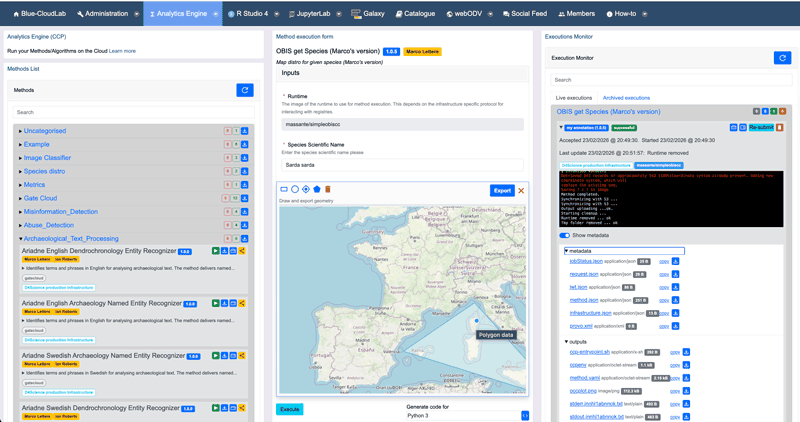
Figure 1: The Data Analytics Platform Web User Interface.
As scientific knowledge increasingly resides not only in journal articles but also in datasets, software, models, and computational workflows, the Catalogue-Based Publishing Platform enables researchers to publish these artefacts at different stages of maturity, supporting a genuine “publishing beyond the paper” approach. Each catalogue entry is assigned a persistent identifier and enriched with structured metadata and clear licensing information. This ensures proper attribution, facilitates discovery, and enables reuse. Publication increases visibility within the VRE while also supporting interoperability with external systems through standard interfaces. Publishing is therefore no longer treated as the final step of the research process. Intermediate results, updated versions, and evolving artefacts can be shared early, fostering iterative refinement, transparency, and collaborative improvement.
Recent developments extend these environments with AI-based assistance, as described in the article by Dell’Amico et al. in this issue.
Interoperability and Sustainability
Sustainable Open Science infrastructures require interoperability across platforms and disciplines. D4Science services expose standard interfaces and APIs, enabling integration with external repositories, analytics tools, and research infrastructures. This federated approach reflects the broader EOSC vision of interconnected services operating across institutional and national boundaries. No single platform can serve all scientific domains. Interoperability ensures modular growth and long-term sustainability.
The D4Science experience demonstrates that effective Open Science depends on cohesive ecosystems rather than isolated tools. By reducing fragmentation and lowering the cost of sharing, VREs make openness a natural outcome of daily research activity. Currently, thousands of users [L1] operate across more than two hundred active VREs spanning biodiversity, environmental science, marine research, social sciences, and computational biology. These environments combine domain-specific datasets and services with shared infrastructure components designed to promote FAIR data management and reproducibility. The D4Science model aligns closely with the vision of the European Open Science Cloud (EOSC) [L2], contributing to a federated ecosystem of interoperable services that supports cross-disciplinary collaboration and sustainable digital research infrastructures across Europe.
This alignment is not merely conceptual but already operational. D4Science also forms the technological foundation of the Digital Twin of the Ocean (DTO) EOSC Node [L3], a flagship Thematic Node within the emerging EOSC Federation. Building on the legacy of the Blue-Cloud initiative [3], the DTO Node adopts a 'System of Systems' approach to federate mature marine data infrastructures and modelling services. In this context, D4Science provides the core VRE technology, the federated AAI, and Catalogue interfaces required for seamless integration with the EOSC EU Node. This enables the execution of advanced, cross-domain analytics workflows and the publication of FAIR research artefacts, ensuring that the European marine community is at the forefront of the European digital research landscape.
Links:
[L1] https://www.d4science.org/
[L2] https://research-and-innovation.ec.europa.eu/strategy/strategy-research-and-innovation/our-digital-future/open-science/european-open-science-cloud-eosc_en#what-is-eosc
[L3] https://eosc.eu/building-the-eosc-federation/eosc-node-digital-twin-of-the-ocean
References:
[1] M. Assante et al., “Enacting open science by D4Science,” Future Generation Computer Systems, vol. 101, pp. 555–563, 2019, doi: 10.1016/j.future.2019.05.063.
[2] M. Assante et al., “Virtual research environments co-creation: The D4Science experience,” Concurrency and Computation: Practice and Experience, vol. 35, no. 18, p. e6925, 2023, doi: 10.1002/cpe.6925.
[3] D. Schaap, M. Assante, et al., “Blue-Cloud: Exploring and demonstrating the potential of Open Science for ocean sustainability,” in Proc. 6th Int. Workshop on Metrology for the Sea; Learning to Measure Sea Health Parameters (MetroSea), IEEE, 2022, pp. 198–202, doi: 10.1109/MetroSea55331.2022.9950819.
Please contact:
Massimiliano Assante
CNR-ISTI, Italy