 No. 146
  No. 145
  No. 143
  No. 142
  No. 141
  No. 140
  No. 139
 by Federico Drago (EGI Foundation), Delphine Dobler (Euro-ARGO ERIC) and Ulrich Bundke (Forschungszentrum Jülich / IAGOS AISBL)
The new ENVRI-Hub platform, developed by the ENVRI-Hub NEXT project, serves as a central science gateway for Europe's environmental research. It demonstrates how interoperable Virtual Research Environments can accelerate collaborative Open Science and make FAIR data actionable for tackling global challenges.
Environmental research is key to addressing planetary challenges, yet data and tools are often fragmented across disciplines and infrastructures. This inefficiency not only drains scientific time and resources but also erodes the core Open Science principles of transparency, collaboration, and reproducibility. The recently upgraded ENVRI-Hub platform [L1], directly addresses this by serving as an integrated science gateway and offering a Virtual Research Environment (VRE) interface for Europe’s Environmental Research Infrastructures (ENVRIs).
Developed over the past two years by the Horizon Europe ENVRI-Hub NEXT project [L2], this platform is the result of extensive collaboration between leading research institutions, e-infrastructures, and ESFRI Landmarks across Europe. Its core aim is to operationalise Open Science principles bay providing a unified, FAIR-compliant point of access.
The ENVRI-Hub enables users to search, access, and process datasets and services from across the ENVRI landscape. Users can be assisted by an AI Environmental Expert, which allows them to formulate their request and receive answers, centred on the ENVRI-Hub and Environmental RIs assets, in a natural language [1,2]. A core focus of the current development is ensuring that Essential Climate Variables (ECVs), critical indicators for climate research, are easily accessible and processable from all contributing ENVRI sources, supported by dedicated functionalities and workflows.
How the Hub Fosters Open Science Practices
The ENVRI-Hub represents more than a service and data catalogue; it is a collaborative environment designed to lower barriers for researchers and citizen scientists alike.
Through the ENVRI Catalogue of Services (Figure 1), users can discover and access a diverse range of data access services and analytical tools from atmospheric, marine, terrestrial, and biodiversity domains [1]. This ENVRI-federated approach breaks down traditional silos, a fundamental step for open collaboration, enhancing discoverability and accessibility.
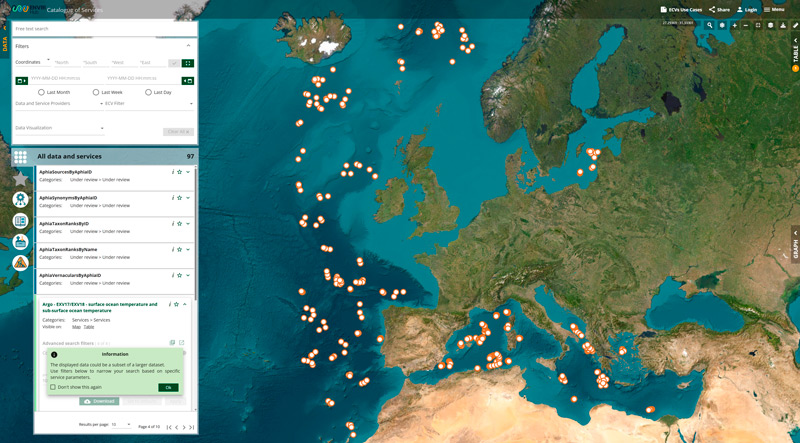
Figure 1: ENVRI Catalogue of Services providing unified access to environmental data and analytical tools across research domains.
The integrated Virtual Research Environment interface enables researchers to compose, execute, and share analytical workflows using data and services from multiple sources, all within the platform. This not only streamlines complex analyses but also ensures that methodologies and computational environments can be precisely documented and reused, enhancing reproducibility.
Newly developed components, such as the AI Environmental Expert (part of the Knowledge Base) [2], utilise conversational interfaces to assist users in navigating complex scientific resources. This makes the platform's wealth of information more accessible to non-specialists, supporting interdisciplinary inquiry.
A central ENVRI Authentication and Authorisation Infrastructure (AAI) – the ENVRI-ID – enables simplified access to data and metadata sources that require a login, enhancing the user experience with the EOSC-compatible single sign-on system [3].
Orientation, Collaboration, and Future Path
The ENVRI-Hub is fundamentally oriented toward community-driven science. Its development has involved close co-creation with a dedicated User Group, ensuring the platform meets real-world needs. Furthermore, its architecture is designed for interoperability with larger European frameworks, such as the European Open Science Cloud (EOSC), positioning it as a key reference in the broader Open Science landscape.
Looking ahead, activities will focus on onboarding more services, expanding user training, and refining the platform based on community feedback. The ultimate goal is to establish the ENVRI-Hub as a sustainable and widely adopted gateway where open, collaborative, and reproducible environmental science becomes the standard practice, empowering researchers to generate the robust evidence needed for science-based policy and a sustainable future.
Links:
[L1] https://envri-hub.envri.eu/
[L2] https://envri.eu/envri-hub-next/
References:
[1] ENVRI-Hub NEXT D10.1 Semantic Search in ENVRI Catalogue and RI Catalogues https://doi.org/10.5281/zenodo.18433332
[2] ENVRI-Hub NEXT D9.1 Knowledge Base Recommender System Design https://doi.org/10.5281/zenodo.18668275
[3] ENVRI-Hub NEXT D11.1 Legal Framework for Cross-Domain AAI System https://doi.org/10.5281/zenodo.18662641
Please contact:
Federico Drago, EGI Foundation, Italy
Delphine Dobler, Euro-Argo ERIC, France