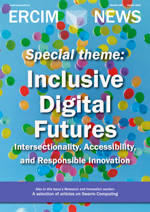
ERCIM News 142
October 2025
Special theme Inclusive Digital Futures: Intersectionality, Accessibility, and Responsible Innovation
Guest editors Magdalini Chatzaki (FORTH-ICS) and Anna Szlávi (Johannes Kepler University)
 No. 146
  No. 145
  No. 144
  No. 143
  No. 141
  No. 140
  No. 139
 - Details
- Category: Special Theme
- Hits: 2217
Guest Editors: Magdalini Chatzaki (FORTH-ICS) and Anna Szlávi (Johannes Kepler University)
As Computer Science (CS) drives the digitalisation of nearly every aspect of modern life, it is vital that it reflects the diversity and variability of the real world in order to develop systems that address a wide range of societal needs. Digital technologies and artefacts influence all domains of life: they transform the world we live in, including society, the economy, and culture. Technological development and systems design are intrinsically intertwined with social progress and change. They are, in fact, the flagships of our societies.
- Details
- Category: Special Theme
- Hits: 2045
by George Hatzivasilis and Sotirios Ioannidis (Technical University of Crete)
Open source solutions empower innovation and accessibility worldwide, but their security challenges can hinder responsible and inclusive digital development. The EU-funded SecOPERA project addresses this by delivering a holistic framework for securing open source software and hardware, reinforcing trust and sustainability.
- Details
- Category: Special Theme
- Hits: 3027
by Emmanouela Kokolaki and Paraskevi Fragopoulou (FORTH-ICS)
In Greece, SafeLine—the national hotline for reporting illegal online content and a core service of the Greek Safer Internet Center under the auspices of the Foundation for Research and Technology–Hellas (FORTH), is the first officially recognized Trusted Flagger under the Digital Services Act (DSA). Among its key activities is monitoring emerging challenges brought about by new regulatory developments. At present, a matter of particular concern to the Greek Hotline regarding children's access to online services is age estimation techniques. Do these practices truly serve the best interests of children, or do they risk reinforcing surveillance and bias at the expense of fostering genuine inclusion?
- Details
- Category: Special Theme
- Hits: 3065
by Meltini Christodoulaki and Paraskevi Fragopoulou (FORTH-ICS)
Under the Digital Services Act (DSA) [L1], lawmakers aim to tackle the spread of illegal internet content and to protect the fundamental rights of internet users, especially minors who use very large online platforms (VLOPs) and very large online search engines (VLOSEs). Safeline [L2], the Greek Hotline against illegal internet content, has been officially recognised as the first Trusted Flagger at national level in Greece, under the DSA.
- Details
- Category: Special Theme
- Hits: 2109
by Christophe Ponsard, Marie d’Udekem-Gevers (University of Namur) and Gaelle De Cupere (NAM-IP)
Today, digitalisation has nearly achieved global coverage, but it still falls short of ensuring fair and inclusive access for all citizens, regardless of origin, age, or gender. Here, we provide a historical perspective that highlights how major biases have emerged over time in computing, how they are being addressed, and barriers that remain to overcome.
- Details
- Category: Special Theme
- Hits: 1652
by Anna Szlávi (Johannes Kepler University), Minh Dan Nguyen (Norwegian University of Science and Technology)
The scarcity of women in computing – broadly STEM –is a persistent challenge. A number of interventions have been dedicated to tackle the key challenges related to the gender gap; the Erasmus+ “Women STEM UP” project being one of these efforts. In this article, we provide details about tools and resources developed for setting up a mentorship program for a better gender inclusion in the field.
- Details
- Category: Special Theme
- Hits: 3137
Eliot Bytyçi (University of Prishtina)
The Ministry of Education, Science, Technology and Innovation of Kosovo, together with the Austrian-funded HEI25 project, is pioneering innovative approaches to link research and teaching in public universities. At the University of Prishtina, computer science students turned their coursework into hands-on research, gaining skills while promoting gender balance in academia. This initiative marks a bold step toward more innovative, competitive, and inclusive higher education in Kosovo.
- Details
- Category: Special Theme
- Hits: 1717
by Petros Patias (KIKLO), Charalampos Georgiadis (AUTH), Patrick Bourdot (EuroXR)
The SURE-VFT project aspires to harness XR technologies for inclusive and accessible training in photogrammetry, 3D modelling, and remote sensing based on training provided through virtual field trips (VFTs) available through the XR4ED education platform [L1]. The project aims to lower barriers of geography, cost, mobility, and access to equipment—contributing to more equitable opportunities for hands-on education.
- Details
- Category: Special Theme
- Hits: 1850
by Magdalini Chatzaki, Maria Makridaki (Institute of Computer Science – Foundation for Research and Technology Hellas)
MindGenGapICT is an institutional change project for promoting Diversity, Inclusivity and Gender Equality (DIE) at the Institute of Computer Science of the Foundation for Research and Technology – Hellas (FORTH-ICS). It responds to the persistent underrepresentation of women and other marginalized groups in Computer Science research and professional environments, an imbalance also evident within FORTH-ICS.
- Details
- Category: Special Theme
- Hits: 1970
by Marina Buzzi (CNR-IIT), Barbara Leporini (University of Pisa & CNR-ISTI), Angelica Lo Duca (CNR-IIT)
Within the STEMMA (Science, Technology, Engineering, Mathematics, Motivation and Accessibility) project, we explore how Artificial Intelligence (AI) can make data literacy more inclusive exploiting storytelling approaches that open access for blind and visually impaired students, and adaptive platforms that support teachers in personalising educational strategies.
- Details
- Category: Special Theme
- Hits: 1764
by Eva M. Molin, Alexander Schindler and Peter Biegelbauer (AIT Austrian Institute of Technology)
Becoming “AI-ready” is not about chasing trends but about laying solid foundations. At the AIT Austrian Institute of Technology, a dedicated AI Task Force drives this shift by building the right infrastructure, fostering targeted training, and setting clear ethical and legal guidance. Together, these pillars turn artificial intelligence from promise into practice, making innovation both rapid and responsible.
- Details
- Category: Special Theme
- Hits: 1646
by Rukiye Altın (Kiel University), Monica Landoni (Università della Svizzera italiana) and Vivian Vimarlund (Linköping University)
Digital technologies are transforming society, yet gender inequalities in science, technology, engineering, and mathematics (STEM) remain a persistent challenge [L1] in all levels of education. Gender stereotypes in STEM function in two ways: on the one hand, they undermine girls’ interest and performance; on the other hand, they boost boys’ attraction to and confidence in the field [L2].
- Details
- Category: Special Theme
- Hits: 2002
by Attila Bekkvik Szentirmai (University of South-Eastern Norway)
A rainy-day pilot shows how current AR headsets struggle outdoors, turning ordinary weather into amplified situational disabilities and underscoring the need for weather-ready inclusive design.
- Details
- Category: Special Theme
- Hits: 1810
Attila Bekkvik Szentirmai (University of South-Eastern Norway)
We built an inclusive augmented reality guitar to make music-making accessible to almost anyone. But our tests revealed a paradox: can too much accessibility undermine an instrument’s authenticity?
- Details
- Category: Special Theme
- Hits: 1909
by Damien Dechambre and Isabelle Lacoffrette (Inria)
Digital tools have become essential to our personal and professional lives. With the rise of remote work, most administrative and business processes have moved online. It has become nearly impossible to manage without a smartphone or internet access! When digital accessibility is overlooked, millions of people with disabilities are excluded, along with those who are digitally marginalized (such as older adults or individuals with limited digital skills). Implementing and respecting digital accessibility within an organization, institution, or company means promoting inclusion for all!
- Details
- Category: Special Theme
- Hits: 2028
by Susanne Peer (University of Applied Science Burgenland) and Igor Ivkić (University of Applied Science Burgenland and Lancaster University)
Intelligent office solutions increasingly rely on the Internet of Things (IoT) and Artificial Intelligence (AI) to optimize efficiency and comfort1]. However, these solutions often neglect the needs of different generations, such as the tech-savvy Generation Z, work-life balance-conscious Millennials, and experienced Generation X employees [L3, L7]. To address this, a cloud-based IoT prototype integrating adaptive environmental control with generation-specific workplace strategies was created [3], demonstrating its potential to promote inclusion and productivity for all age groups in modern workplaces [2]. The approach improves comfort and inclusivity by incorporating generation-specific adaptations, positively impacting well-being and productivity.
- Details
- Category: Special Theme
- Hits: 2124
by George Margetis, Stavroula Ntoa and Constantine Stephanidis (FORTH-ICS)
For more than three decades, the Human–Computer Interaction Laboratory at FORTH-ICS has pioneered research and development in Design for All and Universal Access. Today, these principles are more relevant than ever as society faces global challenges and transitions to AI-enabled digital environments, necessitating new methodologies and tools to make technology accessible to all.
- Details
- Category: Special Theme
- Hits: 2613
by Mae Sosto (CWI), Delfina Sol Martinez Pandiani (University of Amsterdam), Laura Hollink (CWI)
AI systems don't just learn language, they also absorb and reproduce social biases. At CWI's Human-Centered Data Analytics group, we test Large Language Models with template-based sentences and queer identity markers, revealing systematic patterns of exclusion. Our goal: to develop methods and datasets that help make language technologies fairer and more inclusive.
- Details
- Category: Special Theme
- Hits: 1717
by Lucile Sassatelli (Université Côte d'Azur, CNRS, I3S) and Hui-Yin Wu (Université Côte d'Azur, Inria)
Designing AI models to help analyse film corpora by detecting character objectification, or "male gaze"? Building an interdisciplinary synergy between three laboratories in social sciences and three laboratories in computer science, this is the endeavor of the TRACTIVE research project [L1] we present in this article.