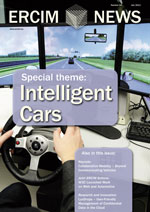
ERCIM News 94
July 2013
Special theme Intelligent Cars
Guest editors Jaroslav Machan (ŠKODA AUTO a.s.) and Christian Laugier (Inria)
 No. 146
  No. 145
  No. 144
  No. 143
  No. 142
  No. 141
  No. 140
  No. 139
 Collaborative Mobility – Beyond Communicating Vehicles
- Details
- Category: Keynote
- Hits: 8516
by Ilja Radusch

European efforts for more intelligent transport systems have a long history with the first programmes focusing on Road Transport Informatics (RTI) dating back to the 1980’s. The corresponding Intelligent Vehicles Safety Systems started even earlier in the late 1950’s by progressing from passive safety systems towards truly pro-active safety functions we envision today. The state of the art in road and vehicle safety is today represented by the concept of cooperative driving. Current cooperative driving is based on vehicles communicating with each other – widely regarded as vehicle-2-vehicle communication – and with the infrastructure – accordingly named vehicle-2-infrastructure communication. This development has been driven mainly by safety needs to provide travellers sufficient information early enough to be able to respond to dynamic traffic situations. Additionally, vehicles anonymously announcing their general position and velocity are set to be far more effective for assessing current traffic conditions and improving general traffic efficiency. Thus, vehicle-2-x communication technology (the “x” stands for vehicles and infrastructure) extends the range of vehicle sensors to yet unseen distances allowing vehicles to “see” around corners and warn drivers of upcoming dangers, making sure she or he can act in due time to avoid an accident or at least mitigate its impact.
Intelligent Vehicles as an Integral Part of Intelligent Transport Systems
- Details
- Category: Special Theme
- Hits: 15240
by Jaroslav Machan and Christian Laugier
The recent global economic growth and the related overall increase in volumes of transportation, along with stronger public demand for mobility, are leading causes of road infrastructure congestion and of a large number of accidents and deaths (about one fatality per every 100 million km of driving and a social cost in France of 23 billion Euros in 2011). These factors have lead to a heavy rise in both energy consumption and also environmental and social problems.- ABV – A Low Speed Automation Project to Study the Technical Feasibility of Fully Automated Driving
- Cooperative Systems for Car Safety Improvement
- Location Assurance and Privacy in GNSS Navigation
- Paving the Way for Apps in Vehicles
- Mobile Opportunistic Traffic Offloading for Map-Based ADAS Applications: the MOTO Project Approach
- Autonomous Traffic Warning System with Car-to-X Communication
- Understanding V2X Communication Dynamics Through Complex Network Science
- The VESPA Project: Driving Advances in Data Management for Vehicular Networks
- Intelligent Vehicles: Complex Software-Based Systems
- Modularity Analysis of Automotive Control Software
- Electro Vehicle Car-Sharing System – A Simulation Model for Big Cities
- The Car that Looks Like Me: Similarity Cues can Increase Trust in the Self-Driving Cars of the Future
- Digital Road Authority for Coordination between In-Car Navigation Systems and Traffic Control Centres
- W3C Launched Work on Web and Automotive
- Imperia: The 21st Century Eco-Friendly Sports Car
- An Innovative Active Suspension System for Autonomous Vehicles: A Safe and Comfortable Ride and Good Handling
- Wire-Speed Regular-Expression Scanning at 20 Gbit/s and Beyond
- DRMSim: A Routing-Model Simulator for Large-Scale Networks
- LuxDrops – User-Friendly Management of Confidential Data in the Cloud
- InGeoCloudS: A Cloud-Based Platform for Sharing Geodata Across Europe
- Electromagnetic Fields for Neuron Communications
- A Patented Position Determination Solution
- SoFWIReD – Southampton Fraunhofer Web and Internet Research & Development
- Preserving Linked Data
- TransForm School on Research Directions in Distributed Computing
- MediaEval 2012 Evaluation Campaign
- Digital Stereoscopy – Scene to Screen 3D Production Workflow
- Formal Methods for Industrial Critical Systems: A Survey of Applications
- Set-theoretic Fault-tolerant Control in Multisensor Systems
- Michael Wilson Obituary
- Cryptographer Ronald Cramer appointed Fellow of IACR
- National ICT Awards 2013 for Python and SIG
- European Laboratory on Big Data Analytics and Social Mining