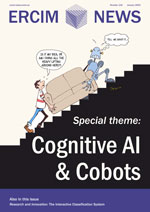
ERCIM News 132
January 2023
Special theme Cognitive AI & Cobots
Guest editors Theodore Patkos (ICS-FORTH) and Zsolt Viharos (SZTAKI)
 No. 146
  No. 145
  No. 144
  No. 143
  No. 142
  No. 141
  No. 140
  No. 139
 Cognitive AI & Cobots - Introduction to the Special Theme
- Details
- Category: Special Theme
- Hits: 5260
by Theodore Patkos (ICS-FORTH) and Zsolt Viharos (SZTAKI)
The wave of popularity of modern Artificial Intelligence (AI) systems is creating well-justified expectations that its application to diverse domains will lead to even bigger advancements in the future. At the same time, there is an open debate in the research community regarding the limitations of existing methods, and whether the current success can scale up to a broader spectrum of problems than those current AI is focusing on. Especially considering that modern intelligent systems are affecting our everyday lives at an increasing pace, the request for future intelligent machines is to exhibit capabilities that are not only effective, but also closer to human intuition and intellect.
Automatic Vision-based Monitoring of Work Postures and Actions for Human-Robot Collaborative Assembly Tasks
- Details
- Category: Special Theme
- Hits: 6344
by Konstantinos Papoutsakis (FORTH-ICS), Maria Pateraki (National Technical University of Athens & FORTH-ICS)
Visual monitoring of human behaviour during work activities is a key ingredient for task progress monitoring and fluency in human-robot collaboration as well as for supporting worker safety in industrial environments. The proposed framework employs low-cost, fixed sensors in a realistic manufacturing environment for the real-time observation of work postures and actions during car door assembly actions, as part of the FELICE project. This task aims to estimate workers’ states and potential ergonomic risks in order to initiate robot collaboration with a specific worker, delegate tasks to the robot and ease the physical burden, while also contributing to the well-being of the worker.
A Multi-stereo Camera System for Improving Physical Ergonomics in Human-Robot Collaboration Scenarios
- Details
- Category: Special Theme
- Hits: 4103
by Christos Anagnostopoulos (ISI, ATHENA R.C), Gerasimos Arvanitis (University of Patras), Nikos Piperigkos (ISI, ATHENA R.C), Aris S. Lalos (ISI, ATHENA R.C) and Konstantinos Moustakas (University of Patras)
Robot behaviour affects worker safety, health and comfort. Enhancing operator physical monitoring reduces the risk of accidents and musculoskeletal disorders. Within CPSoSAware, we propose a multi-stereo camera system and novel distributed fusion approaches that are executed on accelerated AI platforms, continuously monitoring the posture of the operators and assisting them to avoid uncomfortable and unsafe postures, based on their anthropometric characteristics and a real-time risk assessment standard methodology.
Speech and Gesture Command Recognition to Improve Human-Robot Interaction in Manual Assembly Lines
- Details
- Category: Special Theme
- Hits: 4193
by Mario Vento, Antonio Greco and Vincenzo Carletti (University of Salerno)
UNISA is working on a more natural human-robot interaction and cooperation in manual assembly lines through speech and gesture commands. Where are we with the FELICE project?
Cobot Protocol Customisation Manager – PLUME
- Details
- Category: Special Theme
- Hits: 3322
by Antonello Calabrò and Eda Marchetti (ISTI-CNR)
Making cobot safety protocols closer to a cookbook than to methodologies: Let users implement protocols without overhead in knowledge and understanding of the procedures.
Behaviour Trees for Representing Human-Robot Collaboration Processes in the World-Wide Lab
- Details
- Category: Special Theme
- Hits: 5204
by Mohamed Behery, Philipp Brauner, Martina Ziefle and Gerhard Lakemeyer (RWTH Aachen University)
Shorter product lifecycles, more product variants, individualised production, and the desire for sustainable production call for agile control frameworks that enable smarter robotic control and collaborating human-robot teams. We propose generalising and standardising “Behaviour Trees” that use human action nodes as a process model and task-execution-monitoring approach for human-robot collaborative assembly processes to increase the agility of human-robot teams while ensuring a safe and trusted human-robot interaction. Within the DFG (Deutsche Forschungsgemeinschaft) funded Cluster of Excellence “Internet of Production”, we take a cross-disciplinary approach to conceptualisation and validation to ensure algorithmic soundness, technical viability, and social acceptance by the workers of increasingly agile human-robot teams.
Cognitive Mimetics and Human Digital Twins – Towards Holistic AI Design
- Details
- Category: Special Theme
- Hits: 5461
by Antero Karvonen (VTT) and Pertti Saariluoma (Jyväskylä University)
AI is replacing and supporting people in many intelligence-requiring tasks. Therefore, it is essential to consider the conceptual grounds of designing future technical artefacts and technologies for practical use. We are developing two new practical design tools: cognitive mimetics and human digital twins for AI designers. Cognitive mimetics analyses human information processing to be mimicked by intelligent technologies. Human digital twins provide a tool for modelling what people do based on the results of cognitive mimetics. Together they provide a new way of designing intelligent technology in individual tasks and industrial contexts.
Understanding Partners’ Behaviour for Transparent Collaboration
- Details
- Category: Special Theme
- Hits: 3673
by Maria Dagioglou (NCSR ‘Demokritos’, Greece) and Vangelis Karkaletsis (NCSR ‘Demokritos’, Greece)
For this teaser we were asked to describe what is the article about, who is doing what and why. Fittingly enough, this is literally what we discuss in this article: in human-robot collaboration, who is doing what and why?
Coachable AI
- Details
- Category: Special Theme
- Hits: 4822
by Loizos Michael (Open University of Cyprus & CYENS Center of Excellence)
AI systems that are compatible with human cognition will not come as an afterthought by patching up opaque models with post-hoc explainability. This article reports on our research program to develop Machine Coaching, a computationally efficient and cognitively light paradigm that supports a form of interactive and developmental machine learning, through supervision that is not only functional, on “what” decisions should be made, but also structural, on “how” they should be made. We discuss the role that this paradigm can play in neural-symbolic systems, in operationalizing fast intuitive and slow deliberative thinking, and in supporting the explainability and contestability of AI systems by design.
Cognitive Machine Argumentation
- Details
- Category: Special Theme
- Hits: 4109
by Antonis Kakas (University of Cyprus)
How can machines think in a human-like way? How can they argue about and debate issues? Could machines argue on our behalf? Cognitive Machine Argumentation studies these questions based on a synthesis of Computational Argumentation in AI with studies on human reasoning in cognitive psychology, philosophy and other disciplines.
AI Meets Culture: Cognitive AI Enabling User Interaction in Multimodal Installation Art
- Details
- Category: Special Theme
- Hits: 5437
by Christian Thomay and Benedikt Gollan (Research Studios Austria FG), Anna-Sophie Ofner (Universität Mozarteum Salzburg) and Thomas Scherndl (Paris Lodron Universität Salzburg)
We propose using Cognitive AI methods for use in multimodal arts installations to create interactive systems that learn from their visitors. Researchers and artists from Research Studios Austria FG and the Universität Mozarteum Salzburg have created a multimodal installation in which users can use hand gestures to interact with individual instruments playing a Mozart string quartet. In this article, we outline this installation and our plans to realise Cognitive AI methods that learn from their users, thereby improving the performance of gesture recognition as well as usability and user experience.
Piktor-O-Bot: The Robotic Face-Drawing Solution
- Details
- Category: Special Theme
- Hits: 5918
by Tamás Cserteg, Anh Tuan Hoang, Krisztián Kis, János Csempesz (SZTAKI) and Zsolt János Viharos, (SZTAKI and John von Neumann University)
The combination of cognitive AI and robotics has already had a significant impact on the way we live. Novel developed solutions not only cover industrial applications, but are widely spread in the field of social robotics as well. To bring cognitive AI and robotics closer to people not exposed to these technologies on a day-to-day basis, a portrait-drawing demonstrator, called Piktor-O-Bot has been developed at SZTAKI. Over the past year and a half, portraits of more than a thousand people have been drawn, which shows great interest in the demonstrator and that people are genuinely interested in cognitive robotic applications.
How AI can Exploit Body Language to Understand Social Behaviour in the Wild
- Details
- Category: Special Theme
- Hits: 5347
by Hayley Hung (Delft University of Technology)
Researchers at the Socially Perceptive Computing Lab at Delft University of Technology in the Netherlands investigate novel ways to measure our quality of experience in social encounters. Their aim is to understand the difference between good and bad social encounters, from speed-dates, to professional networking events, to long-term simulated space missions. This paves the way for the development of technologies to understand and ultimately improve our social encounters.
Personalisation of Humanoid Robots: Serious Games for Older Adults Based on Biographical Memories
- Details
- Category: Special Theme
- Hits: 23796
by Benedetta Catricalà, Marco Manca, Fabio Paternò, Carmen Santoro and Eleonora Zedda (ISTI-CNR)
We present an approach to novel digital cognitive training through serious games able to adapt to personally relevant material from the older adult’s life. The games are based on memories associated with the older adult’s biography, thus making interactions personalised, relevant, and more engaging. The serious games are accessed through humanoid robots, which can make the training exercise more engaging because of their human-like behaviour.
Novel Deep Neural Architecture Search Algorithm for Human Activity Recognition
- Details
- Category: Special Theme
- Hits: 18000
by Anh Tuan Hoang (SZTAKI) and Zsolt János Viharos (SZTAKI and John von Neumann University)
Human Activity Recognition (HAR) is a prevalent topic in the field of cognitive intelligence, closely related to Human-Centred Artificial Intelligence (HCAI). The emergence of deep learning has brought breakthroughs in many HAR problems. This research proposes a novel search algorithm to determine the optimal deep neural model structure that considers the internal relationships as well as the information content incorporated in the data, and as a result serving with superior capabilities in recognition of various human activity types.
ERCIM Fellows Community Event 2022
- Details
- Category: Joint ERCIM Actions
- Hits: 2812
by Emma Lière (ERCIM Office)
ERCIM organized an online community event for its fellows and guests for the second time on 4 November 2022.
Forum on Digital Ethics in Research: Beyond Compliance
- Details
- Category: Joint ERCIM Actions
- Hits: 7492
by Anaëlle Martin (CNPEN/CCNE)
The ERCIM Ethics Working Group organised jointly with Inria (the French National Institute for Research in Digital Science and Technology) and the CNPEN (the French National Pilot Committee for Digital Ethics) a forum targeted at scientists and Research Ethics Boards on 17-18 October 2022 in Paris.
Food Waste Reduction in Healthcare – Challenges in Integrating Usage Data with Scorings
- Details
- Category: Research and Innovation
- Hits: 4152
by Johann Steszgal (Steszgal Informationstechnologie GmbH), Peter Kieseberg (St. Pölten UAS) and, Andreas Holzinger (University of Natural Resources and Life Sciences Vienna)
Reduction of food waste is an important target for reducing the human footprint and achieving better utilisation of natural resources. The healthcare sector especially offers a lot of potential for more sustainable handling of food. In this article we present major challenges for food waste reduction in real-world healthcare environments, as well as a solution approach.
How Quickly do Trees Grow?
- Details
- Category: Research and Innovation
- Hits: 3572
by Refiz Duro (Austrian Institute of Technology), Hanns Kirchmeir (E.C.O. Institut für Ökologie Jungmeier), Anita Zolles (Bundesforschungs- und Ausbildungszentrum für Wald, Naturgefahren und Landschaft) and Günther Bronner (Umweltdata)
Changing climatic circumstances have a significant impact on forests: besides higher temperatures, more intense and frequent storms and drought spells affect forest growth. To see what the future is bringing, and to be able to deal with forest conservation and management, it is necessary to answer the question “how quickly do trees grow in an environment of climate change?” We take on a challenge to answer this question by integrating state-of-the-art data collection and AI-based methods.
AI-Enabled Services for Reconnaissance
- Details
- Category: Research and Innovation
- Hits: 3893
by Refiz Duro, Rainer Simon (AIT Austrian Institute of Technology GmbH) and, Christoph Singewald (Syncpoint GmbH)
Climate change, pandemics and unstable geopolitical and economic circumstances on the global level are complex challenges necessitating approaches leveraging technological advances and human cross-domain expertise and experience. One piece of the puzzle addressing these challenges is to provide efficient services assisting decision and policy makers with insights extracted from the available data. Combining AI-based natural language processing and computer vision services with human-centred annotation and information enrichment service to build knowledge graphs for reconnaissance has a prospect to make a difference in the safety and security domain. But what does such an implementation look like, and shouldn’t such services already be integrated into most decision-making processes?
The Interactive Classification System
- Details
- Category: Research and Innovation
- Hits: 3231
by Andrea Esuli (ISTI-CNR)
ISTI-CNR released a new web application for the manual and automatic classification of documents. Human annotators collaboratively label documents with machine learning algorithms that learn from annotators’ actions and support the activity with classification suggestions. The platform supports the early stages of document labelling, with the ability to change the classification scheme on the go and to reuse and adapt existing classifiers.
FMICS 2023: 28th International Conference on Formal Methods for Industrial Critical Systems - Call for Papers
- Details
- Category: Announcements
- Hits: 4293
Antwerp, Belgium, 20-22 September 2023
FMICS is the annual conference organised by the homonymous ERCIM working group. The aim of the conference series is to provide a forum for researchers who are interested in the development and application of formal methods in industry. FMICS brings together scientists and engineers who are active in the area of formal methods and are interested in exchanging their experiences of the industrial usage of these methods. The FMICS conference series also strives to promote research and development for the improvement of formal methods and tools for industrial applications. As in previous years, FMICS 2023 is part of the CONFEST umbrella conference. In addition to FMICS, CONFEST also comprises CONCUR, FORMATS, and QEST, as well as pre- and post-conference workshops and tutorials. CONFEST will be held in Antwerp, Belgium on 18-23 September 2023.
Dagstuhl Seminars and Perspectives Workshops
- Details
- Category: Announcements
- Hits: 3326
Call for Proposals
Schloss Dagstuhl – Leibniz-Zentrum für Informatik is accepting proposals for scientific seminars/workshops in all areas of computer science, in particular also in connection with other fields.
Launch of the New Horizon Europe Project GLACIATION
- Details
- Category: Announcements
- Hits: 3133

Fourteen leading European organisations join forces to provide a framework for green and privacy-preserving data operations in an edge-to-cloud architecture.