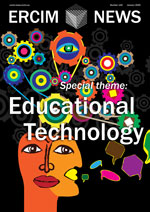
ERCIM News 120
January 2020
Special theme Educational Technology
Guest editors Vassilis Katsouros (Athena Research and Innovation Centre) and Martin Hachet (Inria)
 No. 146
  No. 145
  No. 144
  No. 143
  No. 142
  No. 141
  No. 140
  No. 139
 Educational Technology - Introduction to the Special Theme
- Details
- Category: Special Theme
- Hits: 7645
by Vassilis Katsouros (Athena Research and Innovation Centre) and Martin Hachet (Inria)
This special theme addresses the state of the art in educational technologies, “EdTech”, illustrating the range of scientific fields and challenges faced by the research community when it comes to integrating tools and systems that apply to real-life learning situations.
Education, either formal or informal, is a key driver for the future of our societies; it fosters personal fulfilment and development, social inclusion and active citizenship, as well as generating innovation and economic activities. Right now, digital tools are opening up promising new opportunities to take education to the next level.
Α Logic-Based Affective Tutoring System
- Details
- Category: Special Theme
- Hits: 6039
by Achilles Dougalis and Dimitris Plexousakis (ICS-FORTH)
In science fiction, artificial agents are portrayed as being capable of interacting with and helping humans. This aid could take the form of holding intelligent conversations and even acting as teachers and coaches. Some progress has been made in this direction in real life. Indeed, systems utilising intelligent agents, such as duolingo™, have proven capable of acting as personal tutors. These “intelligent tutoring systems” (ITS) emulate a human tutor by using AI techniques to adapt instructions and teaching according to each individual learner’s background and progress but also guide the learner through an exercise by providing hints and feedback.
Learning Introductory Programming with Smart Learning Environment
- Details
- Category: Special Theme
- Hits: 5448
by Boban Vesin (University of South-Eastern Norway), Katerina Mangaroska and Michail Giannakos (NTNU)
Programming Tutoring System (ProTuS) is an adaptive learning system developed to support introductory programming. ProTuS utilises a cross-platform architecture that aggregates and harmonises learner analytics coming from different systems and quantifies learners’ performance through a set of indicators. ProTuS has been successfully used within universities to support teaching and learning.
Interoperable Education Infrastructures: A Middleware that Brings Together Adaptive, Social and Virtual Learning Technologies
- Details
- Category: Special Theme
- Hits: 6316
by Christopher Krauss and Manfred Hauswirth (Fraunhofer FOKUS)
What should a course provider do if all course content, which is stored in Moodle, needs to be migrated to a new learning management system? How could a provider easily use advanced technologies like learning analytics, learning recommender systems or virtual learning to create a compelling learning experience? How can a provider incorporate the content of another provider into an existing course? To address such questions, we developed the Common Learning Middleware in a joint project with several Fraunhofer institutes trying to solve these typical challenges facing educational institutions.
Fraunhofer IAIS IoT Programming Language NEPO® in the Open Roberta® Lab
- Details
- Category: Special Theme
- Hits: 10900
by Thorsten Leimbach (Fraunhofer IAIS), Daria Tomala (Fraunhofer IAIS)
Technology now pervades all areas of our lives, including our home life, education and work. As society becomes increasingly digitalised, digital skills such as “computational thinking” are becoming more important – this applies to children in school, adults in the workforce and senior citizens alike.
Modelling Student Learning and Forgetting for Optimally Scheduling Skill Review
- Details
- Category: Special Theme
- Hits: 6646
by Benoît Choffin (LRI), Fabrice Popineau (LRI) and Yolaine Bourda (LRI)
Current adaptive and personalised spacing algorithms can help improve students’ long-term memory retention for simple pieces of knowledge, such as vocabulary in a foreign language. In real-world educational settings, however, students often need to apply a set of underlying and abstract skills for a long period. At the French Laboratoire de Recherche en Informatique (LRI), we developed a new student learning and forgetting statistical model to build an adaptive and personalised skill practice scheduler for human learners.
Ontology-based Learning Analytics in Medicine
- Details
- Category: Special Theme
- Hits: 6248
by Fabrice Jouanot (Univ. Grenoble Alpes), Olivier Palombi (Univ. Grenoble Alpes, CHU de Grenoble) and Marie-Christine Rousset (Univ. Grenoble Alpes, IUF)
Through SIDES 3.0, we are developing an ontology-based e-learning platform in medicine to make learning analytics transparent and explainable to end-users (learners and teachers). In this project, the educational content, the traces of students' activities and the correction of exams are linked and related to items of an official reference program in a unified data model. As a result, an integrated access to useful information is provided for student progress monitoring and equipped with a powerful query language allowing users to express their specific needs relating to data exploration and analysis.
Blockchain for Education: Lifelong Learning Passport
- Details
- Category: Special Theme
- Hits: 8340
by Wolfgang Prinz, Sabine Kolvenbach and Rudolf Ruland (Fraunhofer FIT)
Certificates are important to document educational attainments, and educational documentation is required when it comes to job-seeking and career advancement. It is therefore vital that these records are stored in long-term available and tamper-proof ledgers. The Blockchain for Education platform is a secure and intuitive solution for issuing, sharing, and validating of certificates.
An Educational Platform for Logic-based Reasoning
- Details
- Category: Special Theme
- Hits: 6830
by Dimitrios Arampatzis (FORTH-ICS), Maria Doulgeraki (FORTH-ICS), Michail Giannoulis (Univ. of Crete), Evropi Stefanidi (FORTH-ICS), and Theodore Patkos (FORTH-ICS)
EduBAI (Educational Basketball playing using Artificial Intelligence) is an educational platform that helps users familiarise themselves with the main tenets of common-sense reasoning in dynamic, causal domains, by means of an interactive entertaining environment. This article discusses the design and features of the platform, along with the rationale of sample game tactics of diverse modelling complexity.
Authoring Game-Based Learning Activities that are Manageable by Teachers
- Details
- Category: Special Theme
- Hits: 8258
by Pedro Cardoso (FEUP/ FBAUP and INESC TEC), Leonel Morgado (Universidade Aberta and INESC TEC), and António Coelho (FEUP and INESC TEC)
The great ambition of using games as the cornerstone of education is hindered by its associated teaching workload. The BEACONING project developed a framework based on an authoring tool for gamified lesson paths, which has been rolled-out in large scale across Europe. It includes stages for planning game-based educational activities, plus their deployment, monitoring, and assessment.
LudiMoodle: Adaptive Gamification to Improve Learner Motivation
- Details
- Category: Special Theme
- Hits: 8993
by Élise Lavoué (Université Jean Moulin Lyon 3)
The LudiMoodle project aims to adapt game elements integrated into the Moodle learning environment to help motivate learners.
Can Tangible Robots Support Children in Learning Handwriting?
- Details
- Category: Special Theme
- Hits: 7813
by Arzu Guneysu Ozgur, Barbara Bruno, Thibault Asselborn and Pierre Dillenbourg, (EPFL)
A large body of research suggests that robots could indeed be useful for supporting children in learning handwriting. However, few studies have investigated the role and use of tangible robots in teaching handwriting to children with attention and/or visuo-motor coordination difficulties. Over the course of multiple iterations, globally involving 17 typically developed children and 12 children with attention and visio-motor coordination issues within one school and two different therapy centres, we have designed a robotic activity to teach the grapheme (shape) and the ductus (the way to draw) of cursive letters.
“You Tell, I Do, and We Swap until we Connect All the Gold Mines!”
- Details
- Category: Special Theme
- Hits: 6109
by Jauwairia Nasir, Utku Norman, Barbara Bruno and Pierre Dillenbourg (EPFL)
The Project JUSThink has a double goal: (i), to help train the Computational Thinking skills of children with a collaborative, robot-mediated activity, (ii), to acquire insights about how children detect and solve misunderstandings, and what keeps them engaged with a task, the partner or a robot. The result? An abstract reasoning task with a few pedagogical tricks and a basic “robot CEO” that can keep 100 ten-year-olds engaged, and, in turns, frustrated and jubilant!
Gestures in Tangible User Interfaces
- Details
- Category: Special Theme
- Hits: 6805
by Dimitra Anastasiou and Eric Ras (Luxembourg Institute of Science and Technology)
2D gestures have been extensively examined on surface and interactive tabletop computing, both in the context of training of predefined datasets and “in the wild”. The same cannot be said for 3D gestures, however. The current literature does not address what is happening above the tabletop interfaces, nor does it address the semantics.
Kniwwelino: A Microcontroller-based Platform Introducing Children to Programing and Electronics
- Details
- Category: Special Theme
- Hits: 6221
by Valérie Maquil and Christian Moll (Luxembourg Institute of Science and Technology)
The Luxembourg Institute of Science and Technology (LIST) has developed Kniwwelino, a microcontroller-based development platform that uses a visual programming interface to help children discover programming and electronics in a creative and hands-on approach.
Virtual Simulation Environment for Medical Training
- Details
- Category: Special Theme
- Hits: 6734
by Thomas Luiz, Dieter Lerner, Dominik Schnier (Fraunhofer IESE)
Virtual Realities (VR) are increasingly used as a simulation technology in emergency medicine education and training. In the project EPICSAVE, a highly immersive room-scaled multi-user 3D virtual simulation environment was developed for medical training scenarios. This enables a realistic and sustainable training experience.
Mixed Reality and Wearables in Industrial Training
- Details
- Category: Special Theme
- Hits: 6347
by Ralf Klamma (RWTH Aachen University), István Koren (RWTH Aachen University) and Matthias Jarke (Fraunhofer FIT and RWTH Aachen University)
The Horizon 2020 project WEKIT has created an industrial training platform, combining sensor technologies, artificial intelligence and mixed reality. The platform creates training materials on the fly and delivers them in a standardised manner.
Personalized Interactive Edutainment in Extended Reality (XR) Laboratories
- Details
- Category: Special Theme
- Hits: 7153
by Aris S. Lalos (ISI, ATHENA R.C.), Chairi Kiourt (ILSP, ATHENA R.C.), Dimitrios Kalles (Hellenic Open University)
and Athanasios Kalogeras (ISI, ATHENA R.C.)
XR-LAB envisages developing a highly innovative & interactive extended reality (XR) platform that will empower users, including educators and trainees, to create easily accessible and sustainable edutainment experiences. This will be achieved using holographic interfaces and gamified elements that will develop gradually as familiarity with interactive features is gained. The proposed approach is expected to create convenient, safe, economic, rapid, flexible and user-friendly spaced educational tools that challenge, engage and prepare students for their real scientific experiment in remote STEM education laboratories.
Music in Education through Technology
- Details
- Category: Special Theme
- Hits: 5328
by Maximos Kaliakatsos-Papakostas, Kosmas Kritsis, Vassilis Katsouros (Institute for Language and Speech Processing, Athena Research and Innovation Centre)
Combining Science, Technology, Engineering, Arts and Mathematics (STEAM) into a unified pedagogical framework, enables students to directly identify connections between abstract concepts and elements of the real-world. The iMuSciCA project has made the first steps towards developing tools, methods and lesson plans for stimulating creativity in learning and providing the basis for deeper learning. This is achieved with cross-disciplinary lesson plans implemented through the iMuSciCA workbench: an innovative suite of web-based software tools around STEAM.
Dance Education and Digital Technologies
- Details
- Category: Special Theme
- Hits: 8270
by Katerina El Raheb and Yannis Ioannidis (“Athena” Research and Innovation Center and National and Kapodistrian University of Athens)
WhoLoDancE (Whole-body Interaction Learning for Dance Education), a three-year EU funded project, has developed innovative technologies for dance practice, creation and education, focusing on four dance genres: ballet, contemporary, flamenco, and Greek folk.
Intelligent Classroom: Materialising the Vision of Ambient Intelligence for Education
- Details
- Category: Special Theme
- Hits: 6083
by Asterios Leonidis, Maria Korozi, Margherita Antona and Constantine Stephanidis (FORTH-ICS)
The ICS-FORTH Ambient Intelligence (AmI) Programme is a long-term horizontal interdisciplinary RTD Programme aiming to develop pioneering human-centric intelligent technologies and environments that seamlessly support everyday human activities and enhance well-being through human-technology symbiosis.
Innovative Monitoring of Learning Habits and Motivation in Undergraduate Mathematics Education
- Details
- Category: Special Theme
- Hits: 4082
by Brigitta Szilágyi (Budapest University of Technology and Economics), Szabolcs Berezvai (Budapest University of Technology and Economics) and Daniel Horvath (EduBase Online Ltd.)
The Educational platform EduBase ensures continuous testing opportunities and analyses the learning behaviour and performance of undergraduate engineering students in a mathematics course. Compared to the conventional method, students using EduBase were found to be more motivated to practice consistently throughout the semester and acquire deeper level of knowledge.
When a Master of Sciences on EdTech becomes an International Community
- Details
- Category: Special Theme
- Hits: 5401
by Margarida Romero, Saint-Clair Lefèvre (UCA, INSPE, LINE) and Thierry Viéville (Inria)
Nelson Mandela said, “Education is the most powerful weapon which you can use to change the world”. How do we best achieve this? Part of the answer may lie in SmartEdTech, a Master of Science (MSc) program specialising in digital education.
DE-TEL - A European initiative for Doctoral Education in Technology-Enhanced Learning
- Details
- Category: Special Theme
- Hits: 5702
by Mikhail Fominykh and Ekaterina Prasolova-Førland (NTNU)
The Doctoral Education for Technology-Enhanced Learning (DE-TEL) project is developing high quality resources and an internationally recognised program to train PhD students in the area of educational technology. The interdisciplinary expertise that this program will foster is essential for an efficient and effective digitalisation of education in Europe.
Ethical Teaching Analytics in a Context-Aware Classroom: A Manifesto
- Details
- Category: Special Theme
- Hits: 4386
by Romain Laurent (Univ. Grenoble Alpes/LaRAC), Dominique Vaufreydaz (Univ. Grenoble Alpes, CNRS, Inria, Grenoble INP, LIG), and Philippe Dessus (Univ. Grenoble Alpes/LaRAC)
Should Big Teacher be watching you? The Teaching Lab project at Grenoble Alpes University proposes recommendations for designing smart classrooms with ethical considerations taken into account.
KANDINSKY Patterns: A Swiss-Knife for the Study of Explainable AI
- Details
- Category: Research and Innovation
- Hits: 6342
by Andreas Holzinger (Medical University Graz and Alberta Machine Intelligence Institute Edmonton, Canada), Peter Kieseberg (University of Applied Sciences, St.Poelten) and Heimo Mülller (Medical University Graz)
Kandinsky Patterns are mathematically describable, simple, self-contained, hence controllable test datasets for the development, validation and training of explainability in artificial intelligence (AI) and machine learning (ML).
Building Reliable Storage Systems
- Details
- Category: Research and Innovation
- Hits: 4260
by Ilias Iliadis (IBM Research – Zurich Laboratory)
A huge and rapidly growing amount of information needs to be stored on storage devices and on the cloud. Cloud users expect fast, error-free service. Cloud suppliers want to achieve this high quality of service efficiently to minimise cost. Redundancy, in particular erasure coding, is widely used to enhance the reliability of storage systems and protect data from device and media failures. An efficient system design is key for optimising operation.
Browse, Visualise, Analyse EU Procurement Data
- Details
- Category: Research and Innovation
- Hits: 5110
by Ahmet Soylu and Till C. Lech (SINTEF)
Annually, around 14% of the EU’s GDP is spent on the procurement of goods and services by over 250,000 public authorities. Imfproving the effectiveness, efficiency, transparency and accountability of government procurement is therefore in the public’s interest. The increasing amount of open procurement data enables us to analyse public spending to deliver better quality and more economical public services, prevent fraud and corruption, and build healthy and sustainable economies.
More on 5G: Millimetre-Waves
- Details
- Category: Research and Innovation
- Hits: 4426
by Gregor Dürrenberger (FSM) and Harry Rudin
The tumult surrounding 5G continues in Switzerland. The telecommunications providers are intensely promoting 5G; industry is waiting for 5G, citizens are concerned about potential health issues associated with 5G, and the press is full of articles about 5G. In a few years, the technology will also use millimetre-wave transmission. In anticipation of this in June this year the Swiss Research Foundation for Electricity and Mobile Communication (FSM) at the Swiss Federal Institute of Technology in Zurich organised a millimetre-wave workshop.
Dagstuhl Seminars and Perspectives Workshops
- Details
- Category: In Brief
- Hits: 3801
Call for Proposals
Schloss Dagstuhl – Leibniz-Zentrum für Informatik is accepting proposals for scientific seminars/workshops in all areas of computer science, in particular also in connection with other fields.
W3Cx Introduction to Web Accessibility – New Online Course
- Details
- Category: In Brief
- Hits: 4819
Announcement
The W3C and UNESCO Institute for Information Technologies in Education (IITE) have launched a new W3Cx course: Introduction to Web Accessibility. Designed for technical and non-technical audiences, including developers, designers, content authors, project managers, people with disabilities, and others, this course helps get a strong foundation in digital accessibility to make websites and apps work well for people with disabilities, meet international standards, and provide a better user experience for everyone. The course starts on 28 January 2020 and is self-paced. Read more in the course description and enroll soon!
David Chaum and Guido van Rossum awarded Dijkstra Fellowship
- Details
- Category: In Brief
- Hits: 4530
Announcement
CWI has awarded David Chaum and Guido van Rossum for the first time the newly established honorary title ‘Dijkstra Fellow’. Chaum ‘forefather of blockchain’ is well known for his groundbreaking research in the area of Privacy and Cryptology and the development of digital currency. Van Rossum created the world-famous programming language Python almost 30 years ago, when he was working at CWI.