
ERCIM News 108
January 2017
Special theme Computational Imaging
Guest editors Joost Batenburg (CWI) and Tamas Sziranyi (MTA SZTAKI)








Imaging as a Ubiquitous Technique: New and Old Challenges
- Details
- Category: Keynote
- Hits: 6897
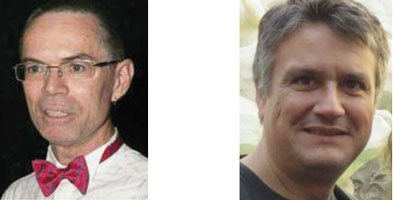 by Andy Götz, Head of Software at European Synchrotron Radiation Facility (left) and Armando Solé, Head of Data Analysis at European Synchrotron Radiation Facility
The increasing use of algorithms to produce images that are easier for the human eye to interpret is perfectly illustrated by the progress that is being made with synchrotrons. Synchrotrons like the European Synchrotron Radiation Facility (ESRF), commonly known as photon sources, are like huge microscopes that produce photons in the form of highly focused and brilliant x-rays for studying any kind of sample. We have come a long way from the first x-rays that took crude images of objects much like a camera - the first x-ray image of a hand being taken by Wilhelm Röntgen 120 years ago (http://wilhelmconradroentgen.de/en/about-roentgen). Photon sources like synchrotrons did not always function in this way, however. Owing to the very small beams of x-rays produced by synchrotrons, the first uses were for deducing the properties of a sample’s microscopic structure. Computers have changed this. Thanks largely to computers and computational algorithms the photons detected with modern day detectors can be converted to 2D images, 3D volumes and even n-dimensional representations of the samples in the beam.
Computational Imaging - Introduction to the Special Theme
- Details
- Category: Special Theme
- Hits: 7783
by Joost Batenburg (CWI) and Tamas Sziranyi (MTA SZTAKI)
For the young generation it is hard to imagine that just two decades ago, taking a picture took days, or even weeks, requiring us to wait until the film was full, after which it was taken to a photo shop for further development. These days, digital cameras are all around us, which has revolutionised the way we deal with images. The development of digital sensors has followed a similar path in other disciplines within science and engineering, resulting in the development of a broad range of detectors and sensors that can collect various types of high-dimensional data reflecting various properties of the world around us. This has fuelled the development of a new field of mathematics and computation, which deals with interpreting such sensor data, applying algorithms to it, and generating new data.
- Convolutional Network Layers Map the Function of the Human Visual Cortex
- Data Fusion at the Nanoscale: Imaging at Resolutions Better than Wavelength/100
- Computational Processing of Histological Images
- Segmenting Cells in the Presence of a Diffuse and Heterogeneous Membrane Marker
- Application of Digital Holographic Microscopy for Automatic Monitoring of Freely Floating Microorganisms
- Modelling Neurodegenerative Diseases from Multimodal Medical Images
- Microwave Imaging for Brain Stroke Detection and Monitoring using High Performance Computing
- Natural Disaster Monitoring: Multi-Source Image Analysis with Hierarchical Markov Models
- Processing Satellite Imagery to Detect and Identify Non-collaborative Vessels
- Geometric Imaging for Subsurface Salt Bodies
- Bringing Modern Mathematical Modelling to Orientation Imaging for Material Science
- Towards Computational Photomechanics
- Novel Concepts for Wave Imaging in Complex Media
- Low-dose X-ray Tomography Imaging Based on Sparse Signal Processing
- 3D Flashback: An Informative Application for Dance
- Identifying Persons of Interest in CCTV Camera Networks
- Computational Fusion of Multi-View and Multi-Illumination Imaging
- Multispectral Imaging for the Analysis of Cultural Heritage Objects and Image Registration for Results Optimisation
- Computational Snapshot Spectral Imaging
- Philipp Hoschka appointed ERCIM Manager
- International Workshop on Computational Intelligence for Multimedia Understanding
- Activities of the ERCIM Working Group Dependable Embedded Software in 2016
- Joint 21st International Workshop on Formal Methods for Industrial Critical Systems and 16th International Workshop on Automated Verification of Critical Systems
- MR-DIS: A Scalable Instance Selection Algorithm using MapReduce on Spark
- Towards Efficient Numerical Optimal Transport
- Subsampling Enables Fast Factorisation of Huge Matrices into Sparse Signals
- Deep Learning Applied to Semantic Content Extraction of Document Images
- Forensics using Internal Database Structures
- Development Tool Interoperability Specifications and Standardization
- Enabling Research and Innovation Beyond Continental Borders: A Case for Satellite Events in Evaluation Campaigns
- University College London wins first Minerva Informatics Equality Award
- ALaDDIn wins 2016 Best Practices in Education Award
- IPIN 2016 Indoor Localization Competition