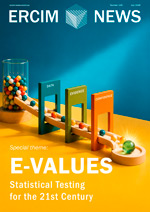
ERCIM News 145
July 2026
Special theme E-values: Statistical Testing for the 21st Century
Guest editors Peter Grünwald (CWI and Leiden University), Wouter Koolen (CWI and University of Twente), and Johanna Ziegel (ETH Zurich)

- Details
- Category: Research and Innovation
- Hits: 771
by Giovanna Broccia, Maurice H. ter Beek (CNR–ISTI), and Alessio Ferrari (University College Dublin and CNR–ISTI)
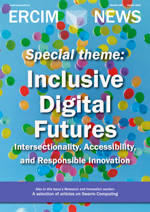
Can large language models help designers move faster without sacrificing human centrality? Researchers from CNR–ISTI and University College Dublin are exploring how large language models can support the rapid creation and refinement of industrial graphical user interfaces through a case study involving the Italian railway operator Trenord, helping development teams move more quickly from textual requirements to interactive mockups, while keeping humans at the centre of the design process.
- Details
- Category: Research and Innovation
- Hits: 683
by Hubert Schölnast, Peter Kieseberg, Patrick Kochberger and Henri Ruotsalainen (University of Applied Sciences St. Pölten)
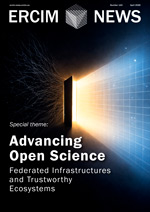
While the concepts of data sharing and data reuse are simple in theory, they face a plethora of challenges and obstacles when transferred into real-life applications. In this article we discuss the major challenges encountered in the successful construction of a sharing infrastructure for oncological data, as well as best practices and learnings in order to overcome similar issues.
- Details
- Category: Research and Innovation
- Hits: 1630
by Antonello Monti (Fraunhofer Institute for Applied Information Technology FIT, Germany)
European electricity networks are becoming increasingly complex as renewable energy sources, electrification and cross-border interconnections continue to grow. The AI.Grids initiative brings together 48 European organizations to develop open, trustworthy and sovereign AI models and data foundations tailored to the needs of Europe’s critical energy infrastructure.
- Details
- Category: Research and Innovation
- Hits: 1140
by András Benczúr, Edina Nemeth (SZTAKI), Jonas L'Haridon (European Science Foundation) and Magdalena Brus (EGI Foundation)
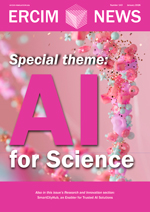
Artificial Intelligence (AI) is changing how scientific research is conceived, executed and interpreted, from analysing massive astrophysical data streams to accelerating drug discovery and improving climate and environmental modelling. Yet, the European landscape of AI enabled research remains fragmented: scientific communities, AI experts and research infrastructures often work in parallel rather than together, and strategic guidance on where to invest and how to coordinate efforts is still emerging. The SCIANCE project was launched to address this fragmentation and to help Europe turn AI into a coherent, shared engine for scientific discovery.