




by András Benczúr, Edina Nemeth (SZTAKI), Jonas L'Haridon (European Science Foundation) and Magdalena Brus (EGI Foundation)
Artificial Intelligence (AI) is changing how scientific research is conceived, executed and interpreted, from analysing massive astrophysical data streams to accelerating drug discovery and improving climate and environmental modelling. Yet, the European landscape of AI enabled research remains fragmented: scientific communities, AI experts and research infrastructures often work in parallel rather than together, and strategic guidance on where to invest and how to coordinate efforts is still emerging. The SCIANCE project was launched to address this fragmentation and to help Europe turn AI into a coherent, shared engine for scientific discovery.
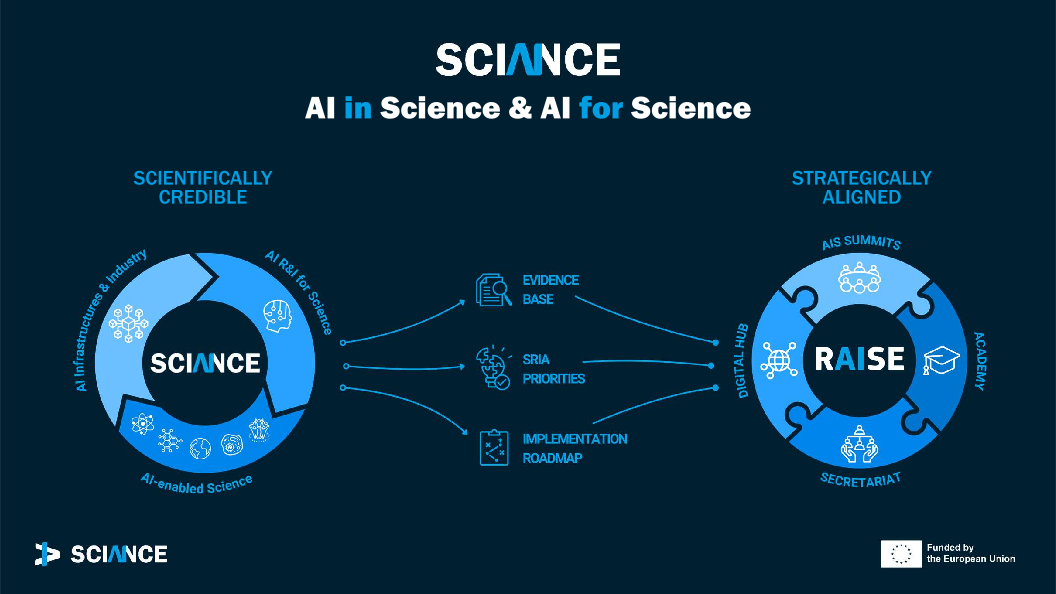
SCIANCE (Grant Agreement No. 101293570) is a 30 month coordination and support action that brings together 13 scientific organisations, research infrastructures and digital infrastructure providers from across Europe. Its overarching ambition is to help Europe develop a coordinated AI for Science ecosystem by developing a Strategic Research and Innovation Agenda (SRIA) for AI in Science, an implementation roadmap for infrastructure upgrades, and a long term cooperation framework within the Resource for AI Science in Europe (RAISE) initiative of the EU [L1].
At the heart of SCIANCE is the recognition that AI in Science is not a single domain, but a cross cutting transformation that affects many disciplines and infrastructures in different ways. To capture this diversity, the project adopts a cross domain perspective, focusing on five pilot areas where Europe has strong scientific leadership: astronomy and fundamental physics, materials science, Earth and environmental sciences, life sciences, and social sciences and humanities. Across these pilots, SCIANCE also examines transversal AI methods and approaches – such as machine learning, generative and foundation models, symbolic and knowledge based AI, hybrid and physics informed models, autonomous and agentic systems, and frugal, resource efficient AI – and how they map onto different stages of the scientific lifecycle, from hypothesis generation and experimental design to data analysis, simulation, automation and open science.
AI in Science Working Groups (AISWGs) play a central role throughout this process. They connect domain scientists, AI experts, infrastructure operators, industry innovators and open science advocates around thematic priorities, ensuring that landscape analyses and priority setting exercises remain grounded in real research practices and infrastructure constraints.
The project structure reflects this dual focus on disciplinary depth and cross cutting foundations. In its first phase, SCIANCE consolidates knowledge through a landscape analysis. This includes systematic state of the art reviews of AI applications in the pilot domains, a differential mapping of AI research and technological developments relevant for science, and a landscape analysis of European AI infrastructures and initiatives, supported by the OpenAIRE Graph as an evidence base. In parallel, SCIANCE documents good practices in AI enabled science using a context mechanism outcome framework, making visible not only successful applications but also the conditions under which they work, their limitations and their implications for transparency, ethics, legal compliance, openness and frugality.
In the second phase, SCIANCE moves from evidence consolidation to co creation of priorities. A series of domain specific workshops brings together leading scientists, AI researchers, infrastructure providers and stakeholders from relevant European initiatives to identify long term research challenges where AI can make a decisive difference. Complementing these are transversal AI in Science workshops that focus on AI enhanced literature analysis and open science, data collection and processing, experimental design and policy support, automation of laboratory workflows and collaboration, and the application of frugal AI models. A dedicated interdisciplinary workshop then addresses cooperation priorities for AI model development and sharing, looking at skill profiles, governance and regulation, and practices and infrastructures for FAIR and responsible data sharing.
The third phase of SCIANCE translates these priorities into the Strategic Research and Innovation Agenda and a roadmap for actionable infrastructure scenarios. A distinctive feature of SCIANCE is its emphasis on sustainable coordination and community building. Beyond the SRIA and roadmap, the project pilots RAISE – the Resource for AI Science in Europe – as a long term coordination structure that will continue to support AI enabled science after the project ends. This encompasses multiple elements: a Secretariat that provides governance and programme management; a Digital Hub that serves as a central entry point for information, engagement and knowledge exchange; contributions to AI in Science Summits that convene communities annually; and the RAISE Academy, which equips policymakers, funders and executives with tools to translate SRIA priorities into concrete policy and funding measures. In this way, SCIANCE goes beyond roadmapping to address strategic capacity and governance, recognising that AI in Science requires not just algorithms and hardware, but informed, coordinated decisions.
For the ERCIM community, SCIANCE is particularly relevant because it treats AI in Science as both an informatics and a mathematical challenge, and because it builds on and complements existing European networks rather than duplicating them. By providing a structured, community validated SRIA and roadmap, SCIANCE offers a shared frame of reference for future projects, infrastructure investments and policy measures in AI for Science, including those emerging from ERCIM members.
Ultimately, SCIANCE aims to ensure that AI methods and tools are adopted in science in ways that are scientifically robust, socially responsible and strategically aligned with European values and goals. Its integrated methodology – combining meta analysis, landscape mapping, good practice registries, co creation workshops, feasibility assessments and capacity building – is designed to turn disparate initiatives into an evolving, interconnected AI in Science ecosystem. As AI continues to redefine what is possible in scientific research, SCIANCE seeks to help Europe harness these possibilities deliberately, transparently and collaboratively.
The consortium brings together 13 leading scientific organisations, research infrastructures, and digital infrastructure providers from 9 European countries, combining expertise in science, artificial intelligence, policy, and infrastructure operation. Consortium partners include: European Science Foundation (ESF), EGI Foundation (EGI), OpenAIRE, Consiglio Nazionale delle Ricerche – ISTI (CNR-ISTI), Euro-BioImaging ERIC, Constructor University, University of Manchester, University of Twente (ITC), National Institute for Subatomic Physics (NIKHEF), German Research Center for Artificial Intelligence (DFKI), HUN-REN Institute for Computer Science and Control, and the Big Data Value Association (BDVA).
Link:
[L1] https://sciance.eu
Please contact:
Jonas L'Haridon, Project Coordinator
European Science Foundation (ESF), France,
Magdalena Brus, Communications Manager
EGI Foundation (EGI), The Netherlands
Landscape analysis:
András Benczúr and Edina Németh, SZTAKI, Hungary,