







by Antonello Monti (Fraunhofer Institute for Applied Information Technology FIT, Germany)
European electricity networks are becoming increasingly complex as renewable energy sources, electrification and cross-border interconnections continue to grow. The AI.Grids initiative brings together 48 European organizations to develop open, trustworthy and sovereign AI models and data foundations tailored to the needs of Europe’s critical energy infrastructure.
Artificial intelligence is rapidly becoming a key enabling technology for the operation of critical infrastructures. In the energy sector, AI promises to improve forecasting, operational planning, system monitoring and decision support. At the same time, growing dependence on proprietary technologies developed outside Europe raises concerns about transparency, trustworthiness, long-term availability and technological sovereignty.
To address these challenges, 48 European organizations have joined forces in the AI.Grids initiative [L1], a large-scale collaborative effort dedicated to developing open, trustworthy and European-built AI models for electricity network applications. Supported by the European Commission and aligned with the broader European strategy for the digitalization of the energy system [1], the initiative represents one of the most ambitious public-private collaborations currently underway at the intersection of artificial intelligence and energy systems.
The increasing complexity of modern electricity networks creates a strong need for advanced analytical capabilities. The large-scale integration of renewable energy sources, the electrification of transport and industry, and the growing interconnection of national energy systems require operators to manage unprecedented amounts of data and increasingly dynamic operating conditions. AI technologies offer considerable potential to support these tasks while improving efficiency, resilience and sustainability, reflecting priorities identified in the European Commission’s Digitalization of the Energy System strategy [1].
AI.Grids aims to establish a distinctly European approach to AI for critical infrastructures. Beyond technological sovereignty, the initiative also addresses a significant gap in the current landscape: there are currently no foundation models specifically designed for electricity grids. AI.Grids therefore seeks to explore and evaluate different architectural approaches for developing AI models tailored to power system applications. While international initiatives such as GridFM have started exploring this area, AI.Grids seeks to evaluate alternative approaches and to develop models trained on European data and infrastructure characteristics. Rather than relying exclusively on externally developed technologies, the initiative seeks to create AI models that are developed, governed and maintained within Europe. The objective is not only technological excellence but also transparency, accountability and alignment with European values and regulatory frameworks.
The initiative originated from a proposal developed by Antonello Monti of the Fraunhofer Institute for Applied Information Technology FIT together with Ricardo Bessa from INESC TEC and Elissaios Sarmas from the National Technical University of Athens. The project has evolved through close collaboration between the three institutions and a growing European community of energy and AI researchers. The concept received support from the European Commission’s Directorate-General for Energy and subsequently evolved into the current AI.Grids program.
A central principle of AI.Grids is openness. Participating organizations have agreed to adopt an open-source development model that enables broad participation across the European energy ecosystem. This approach encourages collaboration among researchers, technology providers, grid operators and public institutions while fostering transparency and trust in the resulting AI solutions.
The governance framework is coordinated by CRESYM, a European research association responsible for the organizational and legal foundations of the initiative. Participating organizations contribute expertise, data and technological resources. Within the consortium, the Fraunhofer Center Digital Energy plays a key operational role by leading activities related to the definition and establishment of the data foundations required for future AI model development.
The quality and representativeness of data are critical factors for the successful deployment of AI in electricity systems. One of the first objectives of AI.Grids is therefore to establish a common data foundation for model development and training. The initiative combines operational data contributed by participating organizations with synthetic datasets derived from information about European energy infrastructures. These data assets will support the evaluation of different AI architectures and provide the foundation for AI models trained on European operational and infrastructure data.
Initial work within AI.Grids focuses on two priority application domains. The first concerns the static representation of electricity networks and related tasks such as power flow analysis. The second addresses time-series forecasting for electricity generation and demand. These areas were selected following a series of workshops in which candidate use cases were identified, prioritized and grouped according to their relevance and potential impact.
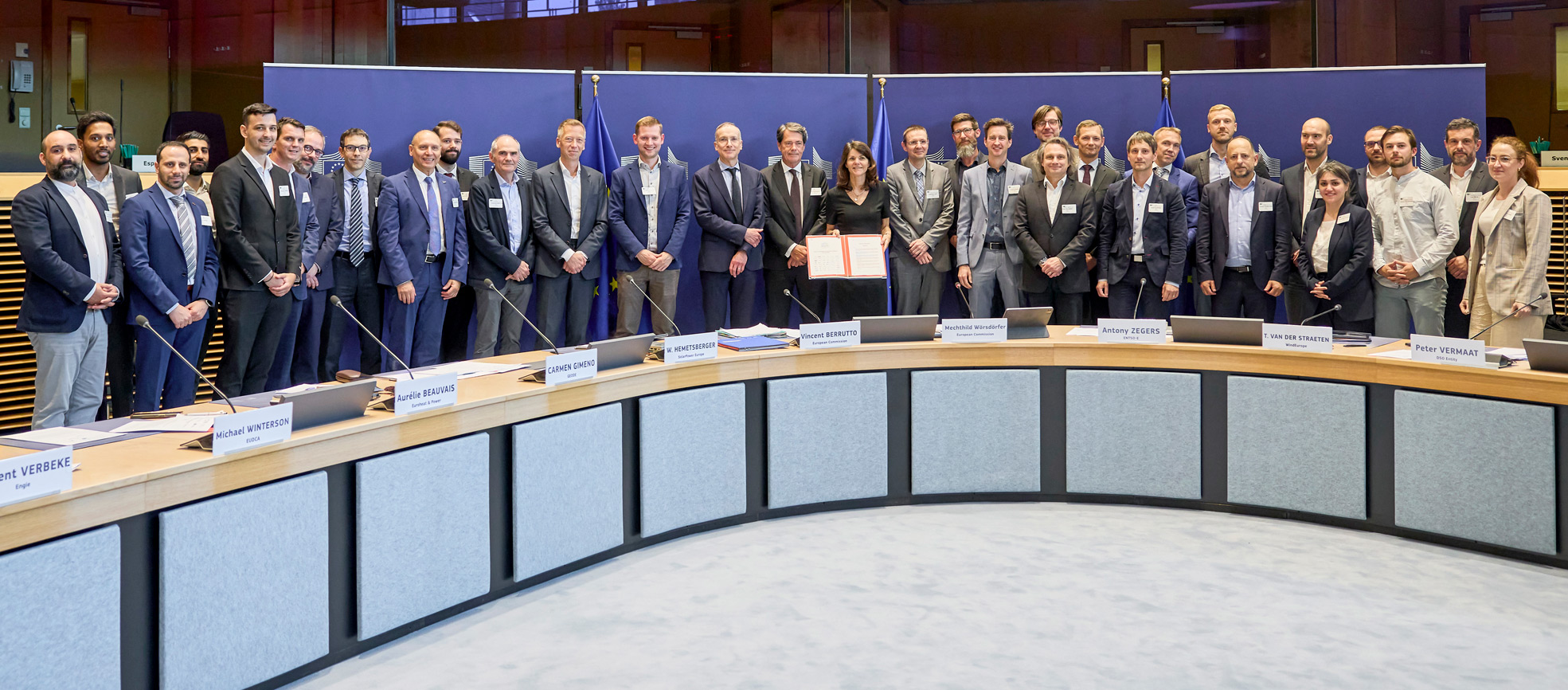
The agreement signed in Brussels on 3 June 2026 marks the first operational milestone of AI.Grids. The initiative remains open to additional participants, allowing further organizations to contribute during the coming years and helping to establish a broad European community around AI for energy systems.
The first operational software release is planned for early 2027. Developed according to open-source principles, the resulting software will be made available to participating organizations, with particular focus on the needs of European transmission and distribution system operators. By facilitating interoperability and supporting the deployment of innovative technologies, the initiative is expected to contribute to a more resilient and efficient European energy system. Representatives of participating organizations gathered in Brussels for the signing ceremony that officially launched the initiative (Figure 1).
AI.Grids demonstrates how Europe can pursue an alternative path for the development of artificial intelligence in critical infrastructures. By combining scientific excellence, industrial expertise and public-sector engagement, the initiative seeks to ensure that the benefits of AI-driven innovation remain under transparent governance and serve the broader interests of European society.
Link:
[L1] https://cresym.eu/ai-grids/
Reference:
[1] European Commission, Directorate-General for Energy, “Digitalisation of the energy system.” [Online]. Available: https://kwz.me/hIc
Please contact:
Antonello Monti, Fraunhofer Institute for Applied
Information Technology FIT, Germany