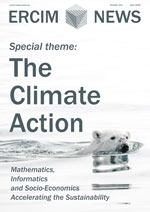
ERCIM News 121
April 2020
Special theme The Climate Action: Mathematics, Informatics and Socio-Economics Accelerating the Sustainability
Guest editors Sobah Abbas Petersen (Norwegian University of Science and Technology) and Phoebe Koundouri (Athens University of Economics and Business and Athena RC)


- Details
- Category: Special Theme
- Hits: 5918
by Sobah Abbas Petersen (Norwegian University of Science and Technology) and Phoebe Koundouri (Athens University of Economics and Business and Athena RC)
The 2018 IPCC special report on the impacts of global warming of 1.5°C above pre-industrial levels and related global greenhouse gas emission pathways, in the context of strengthening the global response to the threat of climate change, sustainable development, and efforts to eradicate poverty [L1], idicates clearly that climate change is an existential threat. Anthropogenic emissions continue to cause further long-term changes in the climate system, such as sea level rise, increased frequency in extreme weather conditions and biodiversity and ecosystems services loss, are evident around the world. These significantly increase the risks for catastrophic events and loss of food security for the world’s growing population. According to the IPCC’s report, we have 10 years to limit climate change catastrophe and keep global warming to a maximum of 1.5C, beyond which even half a degree will significantly worsen the risks of drought, floods, extreme heat and poverty for hundreds of millions of people.
- Details
- Category: Special Theme
- Hits: 6323
by Corine Laan (Amsterdam University of Applied Sciences) and Nanda Piersma (Amsterdam University of Applied Sciences and CWI)
Parks are necessary for sustainable urban vitality. We studied the optimal availability of parks by combining open data sets with polygons and classification frameworks from urban planning literature. Both distance and population density should be considered as measures of availability when planning urban parks.
- Details
- Category: Special Theme
- Hits: 8935
by Christophe Ponsard and Bérengère Nihoul (CETIC)
Humans and forests share a longstanding common history, largely driven, from the human side, by economics. The consequence is ever-increasing degradation, despite progress in forest science and public awareness. We took a “living lab” approach to support the evolution of the Greater Luxembourg forest. The aim was to restore a more sustainable balance across various forest functions, in part by adopting a multiple-use management approach.
- Details
- Category: Special Theme
- Hits: 6146
by Pieter Bons, Robert van den Hoed (Amsterdam University of Applied Sciences) and Nanda Piersma (Amsterdam University of Applied Sciences and CWI)
Smart charging protocols for electric vehicles can help avoid overload and instability in the electrical distribution network and can increase the proportion of locally generated solar energy used for charging. Our results show that the impact of smart charging depends heavily on the technical charging characteristics of the target vehicle.
- Details
- Category: Special Theme
- Hits: 5791
by Michael Kaisers (CWI), Matthias Klein and Alexander Klauer (Fraunhofer ITWM)
New software and algorithms are being developed to help communities become less dependent on the electricity grid and less of a burden on it. This decoupling is an important step towards improving sustainability without compromising on affordability, comfort and efficiency of the overall system. Experience from pilot projects provides key insights into the management of the challenges that arise.
- Details
- Category: Special Theme
- Hits: 4725
by Arthur Vidard (Inria)
Ocean model developers from Inria teams, together with external partners from Shom, Brgm and Ifremer, are coming together to develop and improve ocean modelling capabilities from regional to nearshore.
- Details
- Category: Special Theme
- Hits: 5269
by Daan Crommelin (CWI; Korteweg-de Vries Institute for Mathematics, University of Amsterdam), Wouter Edeling (CWI) and Fredrik Jansson (CWI)
The atmosphere and oceans are key components of the climate system, each involving a wide range of space and time scales. Resolving all relevant scales in numerical simulations with atmosphere/ocean models is computationally not feasible. At CWI, we are tackling this longstanding multiscale challenge by developing new algorithms, including data-based and stochastic methods, to represent small, unresolved scales.
- Details
- Category: Special Theme
- Hits: 6345
by Gaia Pavoni, Massimiliano Corsini and Paolo Cignoni (ISTI-CNR)
In recent decades, benthic populations have been subjected to recurrent episodes of mass mortality. These events have been blamed in part on declining water quality and elevated water temperatures (see Figure 1) correlated to global climate change. Ecosystems are enhanced by the presence of species with three-dimensional growth. The study of the growth, resilience, and recovery capability of those species provides valuable information on the conservation status of entire habitats. We discuss here a state-of-the art solution to speed up the monitoring of benthic population through the automatic or assisted analysis of underwater visual data.
- Details
- Category: Special Theme
- Hits: 5936
by Bella Tsachidou, Christophe Hissler (Luxembourg Institute of Science and Technology) and Philippe Delfosse (University of Luxembourg)
A team from the Environmental Research and Innovation Department of the Luxembourg Institute of Science and Technology (LIST) is investigating the contribution of biogas residues (BRs) to climate change mitigation through carbon sequestration in agricultural soils.
- Details
- Category: Special Theme
- Hits: 6182
by Theodore Dalamagas, Antonis Kokossis and Thanasis Gentimis (SymbioLabs)
SymbioLabs is working on the innovative concept of circular intelligence. Circular intelligence involves the application of business intelligence and big data technologies to drive profitable business actions in the circular economy. We provide digital solutions to collect and analyse data related to industrial facilities, waste production and supply chain economics, and detect geographic areas and industrial sectors to establish collaborative partnerships (networks of industrial symbiosis) to exchange materials, waste and energy for economic, environmental and social benefit.
- Details
- Category: Special Theme
- Hits: 7197
by George Tzagkarakis (FORTH-ICS), Maria N. Anastasiadou and Demetrios G. Eliades (KIOS, University of Cyprus)
“Lost water” in drinking water distribution systems is the water that enters the distribution network but never reaches the consumer, owing either to leakages or because it is not metered by the water utilities. SmartWater2020 is a research project that is working to develop a smart platform for real-time condition monitoring and autonomous pressure control in urban distribution networks, with the goal of reducing telemetry costs and water losses.
- Details
- Category: Special Theme
- Hits: 5964
by Athanasios Karavoulias and Athanassios A. Argiriou
A study analysing World Meteorological Organization (WMO) extreme climatic indexes in Greece for the period 1979-2019 to better understand the impact and the significance of extreme phenomena on the environment and humans.
- Details
- Category: Special Theme
- Hits: 8210
by Bokolo Anthony Jnr. (NTNU), Sobah Abbas Petersen (NTNU) and Markus Helfert (Maynooth University)
The concept of smart cities means using data and information communication technology (ICT) to manage a city’s resources to create a sustainable environment, benefit the economy and improve quality of life. Unfortunately, the rapid population increase in urban areas has reduced the quality of life for many city-dwellers. Therefore, in the Positive Energy Exchange (+CityxChange) project [L1], we have adopted an enterprise architecture framework to support sustainable smart cities.
- Details
- Category: Special Theme
- Hits: 7236
by Emanuela Tangari, Carmela Occhipinti and Luigi Briguglio (CyberEthics Lab.)
The CyberEthics Lab. is developing a model to assess the social acceptance of disruptive technologies, and specifically 5G, with the goal of enabling and accelerating innovation and sustainability.