
 No. 145
  No. 144
  No. 143
  No. 142
  No. 141
  No. 140
  No. 139
by Claudio Cicconetti (CNR-IIT) and Alessandro Zavatta (CNR-INO, Italy)
Quantum Key Distribution is already moving out of the laboratory, but today’s QKD networks are only a first step towards a full Quantum Internet. CNR is building an inter-regional quantum network across Pisa, Florence and Rome to explore how commercial QKD can be integrated into telecom infrastructure today—and how the same testbed can evolve towards quantum repeaters and networked quantum computing tomorrow.
Quantum communication technologies make it possible to transmit quantum states, or qubits in quantum information terminology, over a distance, using photons as carriers and encoding information in degrees of freedom such as space, time, or polarization. Quantum communications have matured rapidly in recent years, fostering experimentation worldwide and enabling the commercialization of products for specific applications. The opportunity is huge: unlike their classical counterparts, arbitrary unknown quantum states cannot be perfectly copied, while distant quantum systems can be entangled, opening the door to new applications connecting quantum computers and sensors across a future Quantum Internet.
Unfortunately, what makes qubits powerful also makes them fragile: quantum states cannot simply be amplified, buffered, or retransmitted as classical information can, invalidating many principles underlying today’s network protocols and devices. The research community has long debated which architectures and technologies will best support quantum networking, for instance within the Quantum Internet Research Group of the IRTF [L1], but much of this work has so far remained theoretical.
At the Consiglio Nazionale delle Ricerche (CNR), the largest public research body in Italy, we are addressing future quantum networks from a different perspective. Through a collaboration between the Institute of Informatics and Telematics (IIT) and the National Institute of Optics (INO), we are deploying an inter-regional quantum network over standard telecom fibre links as a long-term infrastructure for research and experimentation. The testbed extends from Pisa (CNR-IIT) through Florence (CNR-INO) to Rome, where the CNR headquarters are located, with intermediate sites to overcome the distance limitations of current quantum communication technologies.
Compared with existing quantum communication infrastructures, our testbed will combine three distinctive features: inter-regional scale, the use of off-the-shelf commercial technologies operating under realistic operational conditions, and support for full-stack Quantum Internet experimentation beyond the physical layer.
Following a bottom-up, technology-driven approach, we start from the most mature quantum communication technology currently available: Quantum Key Distribution (QKD). QKD comprises protocols that allow two parties, traditionally called Alice and Bob, to establish a shared secret key by exchanging quantum states and performing authenticated classical post-processing [1]. In prepare-and-measure protocols, Alice prepares qubits in different bases, while Bob measures them using randomly selected bases. Figure 1 illustrates the basic QKD process and how it fits into the planned CNR quantum network infrastructure.
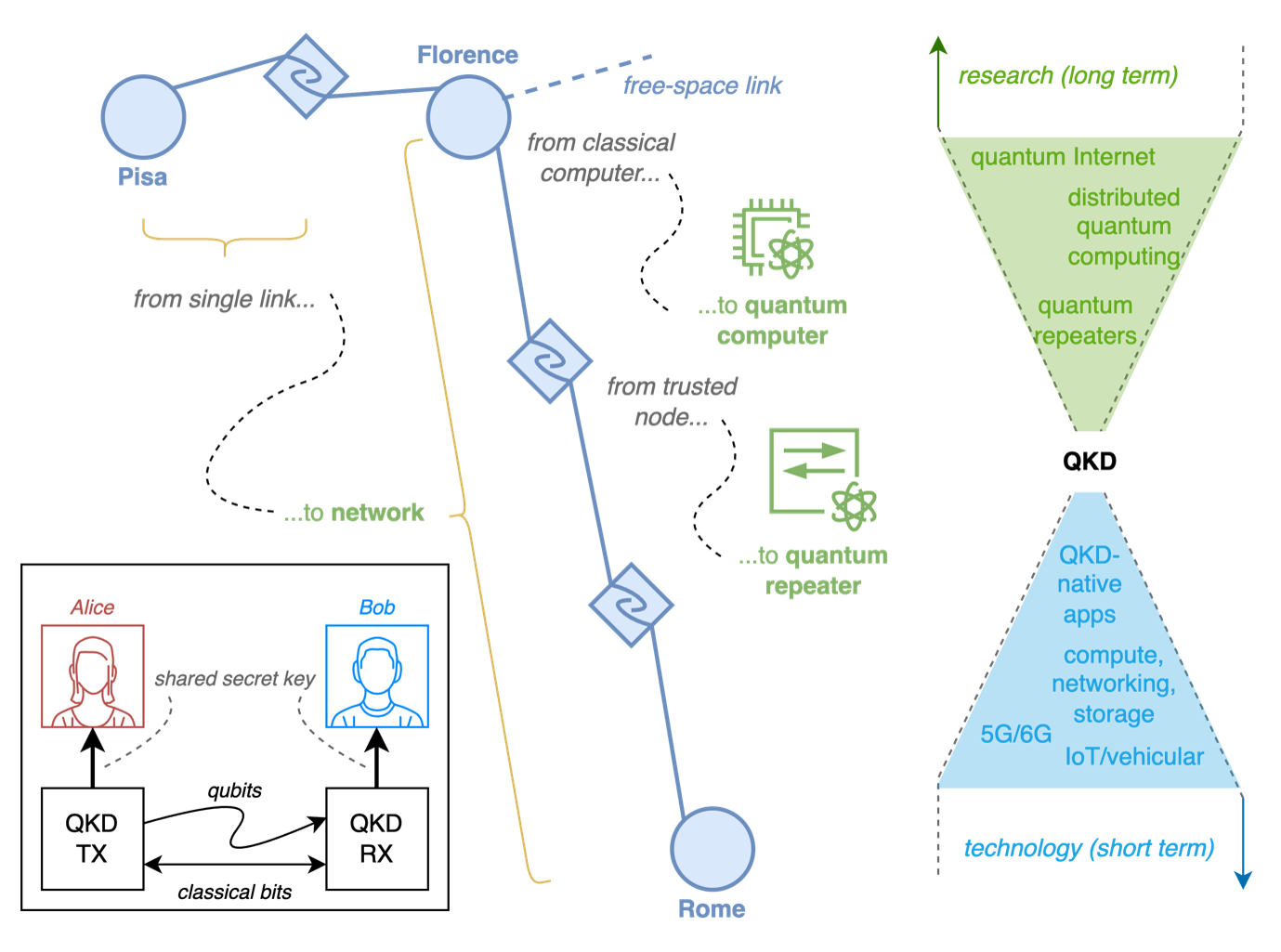
The CNR infrastructure initially consists of several QKD links interconnecting the three main sites and other stations along the route. End-to-end secret keys will be established through intermediate trusted nodes. Each trusted node establishes keys with its neighbours and participates in relaying key material between the end points. It is “trusted” because compromising such a node may also compromise the end-to-end key.
From this initial stage, we expect the infrastructure to evolve along two complementary directions: technology integration in the short term and more fundamental research in the longer term.
From a technology perspective, significant effort has been devoted to QKD devices, which are now commercially available from multiple vendors, but their integration with existing computing, storage, and communication technologies remains a practical challenge. We therefore plan to make the infrastructure available within SLICES [L2], the ESFRI research infrastructure devoted to medium- and long-term evolutions of the Internet. It will also become a core component of the national AI-PHOQUS project, integrating three key digital technologies: quantum, Internet, and AI.
This will allow experimenters from across Europe to investigate how commercial QKD devices can be integrated into telecom infrastructures through proof-of-concept scenarios involving, among others, 5G/6G mobile networks, the edge-to-cloud continuum, and IoT and vehicular systems. The infrastructure will also serve as a sandbox in which application developers can test emerging QKD-enabled applications under realistic conditions, moving beyond point-to-point key provisioning towards services such as secure storage, financial applications, authentication, and access control for sensitive data.
From a research perspective, we plan to upgrade the infrastructure as more advanced technologies become available. A first major step will be the possible replacement of trusted nodes with quantum repeaters: intermediate devices that allow entanglement to be distributed between distant end nodes. Unlike trusted-node QKD networks, a repeater-based architecture does not require intermediate stations to access the end users’ secret key material. Combined with appropriate quantum communication and verification protocols, this will enable secure communication across networks whose intermediate stations need not be trusted. This evolution will benefit from the QuRE (Quantum Repeaters) project, funded by the Italian Ministry of University and Research.
Quantum repeaters will also enable quantum processors and memories at different sites to be interconnected over long distances. The infrastructure could thus evolve into a true long-distance quantum network, allowing experiments to move beyond individual laboratories (e.g., [2]) and fostering new software and applications for the Quantum Internet. This will complement activities within the Quantum Internet Alliance [L3], where CNR is already involved in benchmarking quantum applications and systems.
A further strategic evolution will be the creation of a free-space quantum communication link across the Florence metropolitan area. Initially, it will provide a metropolitan testbed for quantum communication over free-space channels. In the longer term, it will be upgraded to operate as a ground station for satellite quantum communications, bridging terrestrial quantum networks and future space-based systems and contributing to integrated global quantum communication and sensor networks.
Links:
[L1]: https://www.irtf.org/qirg.html
[L2]: https://www.slices-ri.eu/
[L3]: https://quantuminternetalliance.org/
References:
[1] H.-K. Lo, M. Curty, and K. Tamaki, “Secure quantum key distribution,” Nature Photonics, vol. 8, pp. 595–604, 2014, doi: 10.1038/nphoton.2014.149.
[2] C. Delle Donne et al., “An operating system for executing applications on quantum network nodes,” Nature, vol. 639, no. 8054, pp. 321–328, Mar. 2025, doi: 10.1038/s41586-025-08704-w.
Please contact:
Claudio Cicconetti
IIT-CNR, Italy