
 No. 145
  No. 144
  No. 143
  No. 142
  No. 141
  No. 140
  No. 139
 by Sebastian Raubitzek, Rebecca Klingbeil (SBA Research) and Werner Strasser (fragmentiX Storage Solutions)
The European Quantum Communication Infrastructure (EuroQCI) [L1] sets a strategic goal for secure communication across the EU, yet the size and shape of the national networks needed to achieve it remain unspecified. We present a reproducible method to estimate the number of nodes, total fibre length, and equipment required for national terrestrial quantum key distribution (QKD) networks, using Austria as a reference and scaling the results to other Member States.
EuroQCI targets secure communication for security-relevant sites across all Member States. Its technical core is QKD, which enables key generation and secure distribution. The security of this distribution relies on physical principles, as measuring a qubit in the wrong basis disturbs its state and yields a random result. Still, a basic planning question remains open: how large must a national QKD network actually be? It is not yet clear how many nodes each country needs, how densely they must be connected, or what total fibre length is required.
This work addresses that gap with a computational planning-level method based on a small set of stated assumptions. Endpoints represent sites where key material must be available, such as ministries and operators of critical infrastructure. They are connected by direct QKD links wherever the distance allows, and most sites host two or three links so that they do not depend on a single connection for their key supply. All distances are computed as geodesic distances and multiplied by a constant detour factor of 1.5 to approximate real fibre routing along roads and existing corridors.
A central constraint is QKD’s limited transmission distance over optical fibre. In the BB84 protocol, with photon sources at the endpoints, practical links operate over roughly 40–100 km per span, with a planning target below 75 km for stable operation. Entanglement-based QKD, with a central photon source, can reach up to twice that much [1]. To remain protocol-agnostic and to guarantee a workable key rate, we assume spans of around 50 km and use trusted repeater nodes to bridge longer distances, where a photon source for an entanglement-based QKD protocol could be placed instead.
Monte Carlo simulation is used to sample through possible network shapes. Each run constructs a network that gives every site its prescribed number of connections while preferring short links, and then places trusted repeater nodes on the longest spans first. Running many realisations produces stable estimates for the total fibre length, the distribution of span lengths, and the number of required components. The full implementation is openly available [L2].
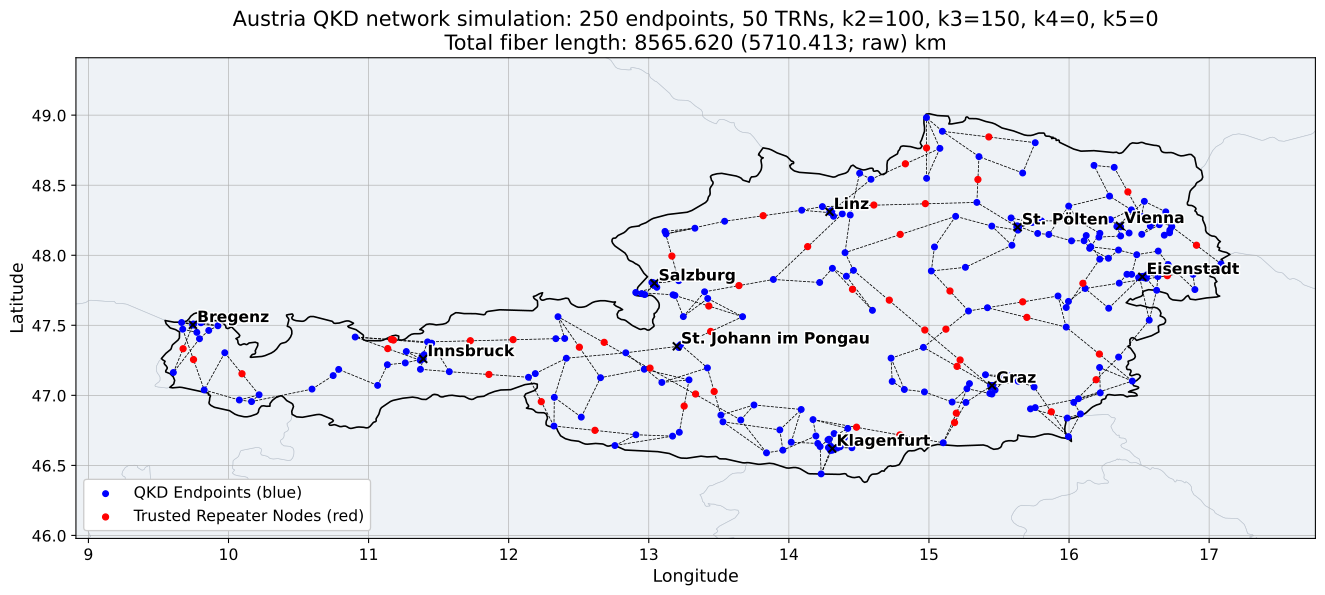
Austria serves as the reference case, with 250 endpoints and 50 trusted repeater nodes; the choice is also convenient in practice, since one of the first metropolitan QKD networks was demonstrated in Vienna [2]. Across 1000 simulation runs, the route-adjusted total fibre length is about 8,600 km and varies only slightly between runs, which shows that network size is driven mainly by national geography and the fixed endpoint count rather than by random placement. After trusted-node insertion, the mean span length is about 23 km and the maximum about 52 km after route correction, both within a practical range for QKD. The reference case also fixes the equipment counts: 750 QKD devices in total, together with one key management system and one hardware security module per participating site [3].
Austria is then used as a baseline for the other EU Member States, following two rules. The number of endpoints grows mainly with population, because a larger population implies more ministries, agencies, and operators of essential services that need key material. The number of trusted repeater nodes grows mainly with land area, because more territory means longer inter-regional links that must be split into feasible spans. Under these rules, a country with a large population but a small area, such as the Netherlands, needs many endpoints but few trusted nodes, while a country with moderate population but large territory, such as Finland, needs fewer endpoints but many trusted nodes. Large countries such as Germany and France require increases in both (Figure 1). For states with islands or remote territories, the simulation is restricted to the mainland, so that the terrestrial comparison is not distorted by unrealistic maritime links.
The results are first-order planning references rather than deployment designs. They indicate that trusted repeater nodes, key management systems, and hardware-protected key handling are central components of a national QKD architecture rather than secondary details. The next steps are to replace the synthetic endpoints with real inventories of protected sites, to use measured fibre corridors instead of a uniform detour factor, and to add cross-border links, so that national estimates can be combined into the pan-European network that EuroQCI ultimately requires. This work was supported by the Digital Europe Programme under project number 101091642 (QCI-CAT).
Links:
[L1] https://digital-strategy.ec.europa.eu/en/policies/european-quantum-communication-infrastructure-euroqci
[L2] https://github.com/Raubkatz/QCI_Simulation
[L3] https://arxiv.org/abs/2604.06764
References:
[1] S. P. Neumann et al., “Continuous entanglement distribution over a transnational 248 km fiber link”, Nat. Commun. 13, 6134, 2022.
[2] M. Peev et al., “The SECOQC quantum key distribution network in Vienna”, New J. Phys. 11(7), 075001, 2009.
[3] P. James et al., “Key management systems for large-scale quantum key distribution networks”, Proc. ARES, 2023.
Please contact:
Sebastian Raubitzek
SBA Research, Vienna, Austria