
 No. 145
  No. 144
  No. 143
  No. 142
  No. 141
  No. 140
  No. 139
 by Luca Salatino, Francesco D’Amore and Andrea Giordano (CNR-ICAR)
Quantum computing is often associated with future large-scale machines capable of solving problems beyond the reach of classical computers. However, useful applications can already emerge from today's small quantum processors. Researchers from the Italian National Research Council (CNR-ICAR) and the University of Calabria have developed a hybrid quantum-classical machine learning framework that significantly improves predictions of how chaotic systems evolve. This opens new opportunities for scientific computing and quantum-enhanced artificial intelligence.
Artificial intelligence has become an indispensable tool for analysing and predicting the behaviour of complex dynamical systems. Applications such as weather forecasting, fluid dynamics, energy management and digital twins all rely on the ability to anticipate the future evolution of systems whose behaviour is often highly nonlinear. Unfortunately, many of these systems are chaotic: small uncertainties in their current state rapidly amplify over time, making accurate long-term prediction one of the most challenging problems in computational science.
Quantum computing has recently emerged as a promising technology for scientific machine learning. Rather than replacing classical computers, current quantum devices are expected to complement them by exploiting physical processes that are difficult to reproduce efficiently using conventional hardware. Among the most promising approaches is Quantum Reservoir Computing (QRC), a machine learning paradigm in which the natural dynamics of a quantum system are used to transform input data into a representation suitable for prediction tasks, while only a simple output layer is trained.
Although QRC has attracted considerable interest, its practical implementation faces important challenges. Existing approaches often require the quantum system not only to process incoming information but also to preserve memory of previous inputs. This dual role places considerable demands on present-day quantum hardware, where noise, decoherence and repeated measurements inevitably limit the amount of information that can be retained during the computation.
To address this limitation, researchers from the Italian National Research Council (CNR-ICAR) [L1] and the Physics Department of the University of Calabria [L2] developed a new Hybrid Quantum Reservoir Computing (HQRC) architecture that combines the complementary strengths of quantum and classical computing. Instead of assigning every computational task to the quantum processor, the proposed framework separates nonlinear information processing from memory. The quantum system generates a rich set of features from the input data through its natural dynamics, while a lightweight classical recurrent layer retains the temporal information required for forecasting.
This division of responsibilities considerably simplifies the role of the quantum processor while preserving its computational advantages. The first version of the HQRC framework [1] demonstrated that this hybrid strategy significantly improves the capability of quantum reservoirs to process temporal information. By transferring memory to the classical component, the architecture becomes more robust and better suited to the capabilities of current noisy intermediate-scale quantum (NISQ) devices, which contain only a limited number of qubits but are already available in several experimental platforms.
Building upon these results, the researchers extended the framework to address a far more demanding class of problems: the prediction of multidimensional chaotic systems. Unlike standard benchmark tasks involving a single time series, many real physical systems evolve through the interaction of several coupled variables. The new architecture was therefore designed to encode multidimensional inputs [2] directly into the quantum reservoir, allowing the quantum dynamics to capture the correlations among all components of the system simultaneously.
A second important innovation is to sample the quantum system at multiple points during its evolution, an approach known as temporal multiplexing. Each observation provides complementary information about the ongoing quantum dynamics, enriching the representation generated by the same quantum processor without requiring additional qubits. This strategy substantially increases the amount of information available to the learning algorithm while remaining fully compatible with existing quantum hardware.
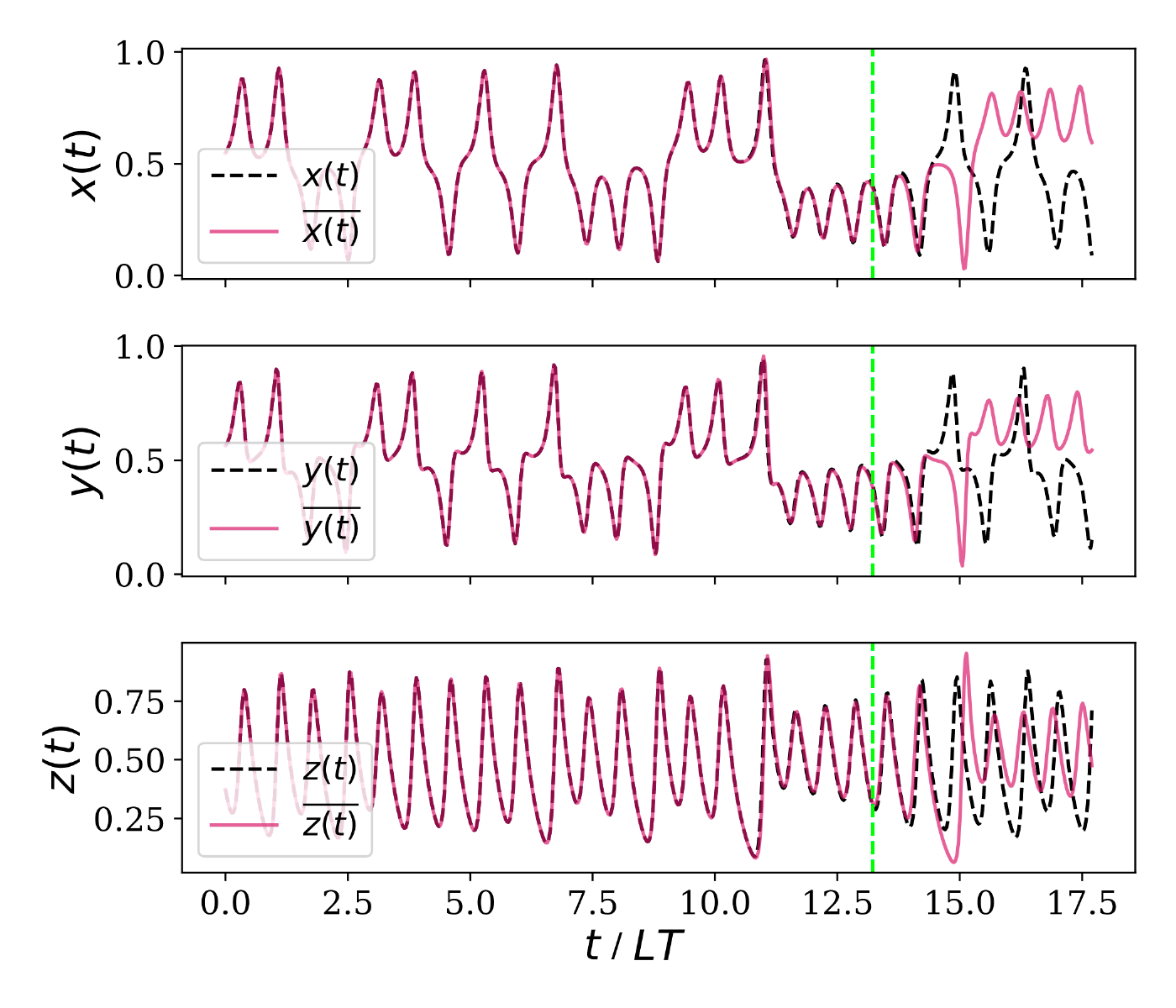
The extended HQRC architecture was evaluated on two well-known models of chaotic dynamics. The first is the Lorenz-63 system (Figure 1), a classical benchmark that introduced the concept of deterministic chaos and remains one of the most widely used models for testing forecasting algorithms. The second is a reduced-order model derived from the two-dimensional Navier-Stokes equations through a Galerkin projection. Although this simplified model consists of only five interacting modes, it preserves the essential nonlinear mechanisms responsible for the transition to turbulence and therefore represents a realistic and challenging forecasting problem. Numerical experiments show that the proposed framework successfully reconstructs the evolution of both systems over significantly longer time intervals than previous quantum reservoir implementations [3]. In particular, temporal multiplexing plays a crucial role by enabling the quantum reservoir to extract a richer description of the underlying dynamics. Perhaps the most significant outcome of this research is that these results are obtained using quantum reservoirs composed of only a handful of qubits. Rather than waiting for large fault-tolerant quantum computers, the proposed approach demonstrates that useful scientific machine learning applications can already be developed on today's NISQ technologies by combining quantum and classical resources in an efficient way.
The work illustrates a broader trend in quantum computing, where hybrid algorithms are increasingly replacing the idea of purely quantum solutions. By allowing each component to perform the task for which it is best suited, hybrid architectures offer a practical route to exploiting quantum technologies in realistic scientific applications. Future developments will focus on implementing the proposed framework on real quantum processors and extending it to increasingly complex dynamical systems. Beyond chaotic forecasting, the same methodology may contribute to new quantum-enhanced tools for modelling, monitoring and controlling complex physical processes in science and engineering.
Links:
[L1] https://www.icar.cnr.it
[L2] https://fisica.unical.it
References:
[1] J. Settino et al., "Memory-augmented hybrid quantum reservoir computing," Phys. Rev. Appl., vol. 24, no. 2, p. 024019, Aug. 2025.
[2] L. Salatino et al., "Forecasting Low-Dimensional Turbulence via Multi-Dimensional Hybrid Quantum Reservoir Computing," Chaos, vol. 36, no. 8, p. 083110, Aug. 2026.
[3] O. Ahmed, F. Tennie, and L. Magri, "Prediction of chaotic dynamics and extreme events: A recurrence-free quantum reservoir computing approach," Phys. Rev. Research, vol. 6, no. 4, p. 043082, Nov. 2024.
Please contact:
Luca Salatino
CNR-ICAR, Italy