
 No. 145
  No. 144
  No. 143
  No. 142
  No. 141
  No. 140
  No. 139
 by Giovanni Pilato (CNR-ICAR), Antonio Chella (Università degli Studi di Palermo) and Salvatore Gaglio (Università degli Studi di Palermo and CNR-ICAR)
Researchers from the University of Palermo and CNR-ICAR are investigating how quantum computing concepts can support action selection in reactive robots. Their work proposes a hybrid classical–quantum architecture in which sensor data are mapped into a Hilbert-space representation and used to select robot actions under uncertainty.
Reactive robots are designed to act fast. They sense the world, evaluate the current situation, and select an action without the long deliberation typical of planning-based systems. This makes them suitable for dynamic environments, where it is important to have quick responses. However, such agents may face uncertainty when sensor readings are noisy, when perceptual situations are ambiguous, or when the robot’s current sensor readings are near a decision threshold, so that small noise or small variations could change the selected action.
A research team from the University of Palermo and the Institute of High-Performance Computing and Networking of the Italian National Research Council (CNR-ICAR) is exploring whether concepts from quantum computing can provide a useful representational framework for this type of robotic decision-making. The work has led to a hybrid classical–quantum architecture for reactive action selection, developed by Antonio Chella, Salvatore Gaglio, Giovanni Pilato and Filippo Vella [1].
The central idea is to take the robot’s sensor readings and encode them as a classical vector, which is then mapped into a quantum feature space. In that space, typical situations or rule-defined regions are used as references associated with possible actions. By comparing the current sensor state with these references, the system can decide which action is most appropriate. This provides a bridge between classical robot sensing and Hilbert-space representations, where similarity, uncertainty, and ambiguous cases can be modelled in a natural way (Figure 1).
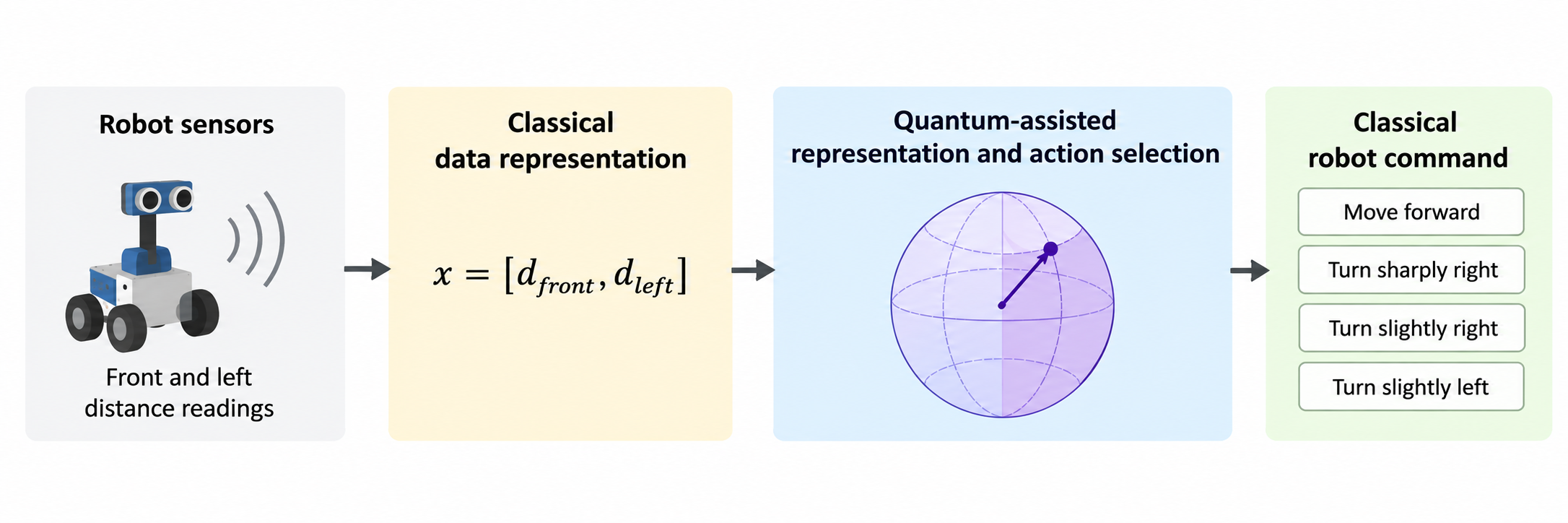
The work is motivated by the following question: how can a reactive robot select one action when the perceived situation is not completely clear? Classical condition–action rules are usually deterministic: if a condition is satisfied, the corresponding action is executed. In realistic settings, however, sensor values may be close to several decision regions at once. The proposed architecture uses quantum-inspired representations to model this uncertainty before projecting the result back to a definite classical command [1].
The research is framed in relation to teleo-reactive robot control. In the classical teleo-reactive formalism, behaviour is specified through prioritised condition–action rules that are continuously re-evaluated. The quantum component proposed in this work focuses on the perceptual evaluation and action-selection layer, where conditions can be represented as regions or reference states in a Hilbert space.
Two concrete implementations were studied. The first uses a quantum kernel based on ZZ feature maps, combined with a classical Support Vector Classifier. In this setting, the quantum feature map transforms the sensor values into a quantum feature space, while the final classification is performed by a classical machine-learning model. The second implementation is a dedicated quantum circuit for rule-based action selection. In this circuit, front and left sensor readings are encoded into condition qubits. Their activations are propagated to action qubits, an oracle-diffuser block inspired by Grover’s search increases the probability of valid single-action configurations, and a final measurement selects a classical action.
The architecture was evaluated using a public wall-following robot dataset containing ultrasonic sensor readings collected from a SCITOS G5 robot performing a wall-following task in an indoor environment. In the simplified setting considered by the team, the robot’s behaviour is determined from two sensor readings: the front distance and the left distance. These values define rule-based regions corresponding to actions such as moving forward, turning sharply right, turning slightly right, or turning slightly left.
The experimental evaluation was deliberately framed as an offline proxy for reactive decision-making. The aim was to test whether a hybrid classical–quantum representation can support the classification of perceptual states and illustrate how measurement-based action selection could be embedded in a future robotic control architecture.
The results show that the proposed framework can support both data-driven classification through quantum kernels and explicit measurement-based action selection through a quantum circuit. A classical Support Vector Classifier using a radial basis function (RBF) kernel, a standard method for measuring similarity between data points, was included as a baseline. The quantum-kernel results were then compared using single and replicated ZZ feature-maps, which encode classical data into quantum states. The rule-based quantum circuit was also evaluated through a confusion matrix, showing that most actions were selected correctly in the simplified two-sensor setting.
The work is exploratory, but it identifies a clear research direction: using quantum representations inside embodied AI systems. Future work will move beyond offline tests and evaluate the approach in closed-loop robotic platforms or simulators, where perception and action continuously influence each other. The model will also be extended to richer perceptual and proprioceptive inputs, and to learnable quantum circuits. The goal is to retain the flexibility of data-driven models while keeping an explicit mechanism for measurement-based action selection.
In the longer term, quantum-inspired robotic architectures may offer new ways to represent uncertainty, contextual similarity and action ambiguity in autonomous systems. While practical quantum robotics is still at an early stage, this work is a step toward understanding how classical robotic control and quantum computational models can interact within a coherent architecture for reactive behaviour.
References:
[1] A. Chella, et al., “An Architecture for a Quantum Teleo-Reactive Robot”, Entropy, 2026.
[2] A. Chella, et al., “A Quantum Planner for Robot Motion”, Mathematics, vol. 10, no. 14, Art. no. 2475, 2022.
[3] A. Chella, et al., “Quantum planning for swarm robotics”, Robotics and Autonomous Systems, vol. 161, 104362, 2023.
Please contact:
Giovanni Pilato
CNR-ICAR, Italy