
 No. 145
  No. 144
  No. 143
  No. 142
  No. 141
  No. 140
  No. 139
 by Smita Chakraborty (RISE)
Quantum computers could sharpen machine learning, but only if we get one step right: how everyday data such as images, audio and tables is “embedded” into a quantum system. Understanding feature representation means building a predictive theory of embedding design, including a quantum version of the well-known classical dropout trick, that says which choices actually improve learning for a given dataset and a given computing budget.
Machine learning has transformed how we analyse data, and researchers now ask whether quantum computers could push it further. The idea at the heart of quantum machine learning [L1 ,L2] is simple: take ordinary data and "embed" it into the state of a quantum system, where a vast, high-dimensional space of possibilities opens up for a model to work in. This embedding step, which turns a photograph or an audio clip into a pattern of quantum states through a so-called feature map, is where the hoped-for advantage lives, and where most of the hard questions now sit.
A powerful unifying insight is that many quantum learning models are, mathematically, kernel methods: the model compares how similar two embedded data points are, and makes decisions from those comparisons. Early work [1] showed that data could be classified inside these quantum feature spaces, and later results proved that, for carefully designed problems, quantum embeddings can offer advantages no classical computer could match. That promise, however, has become far more nuanced. A widely cited "power of data" study [2] showed that classical models, once given enough example data, can quietly match quantum ones on many realistic tasks, and introduced refined projected quantum kernels to regain a genuine edge and generalise better.
Two obstacles now dominate the field. The first is trainability. Quantum models are tuned by adjusting parameters to reduce error, but in large and highly entangled circuits the signal guiding those adjustments can vanish exponentially because of barren plateaux, where the training landscape becomes almost perfectly flat and learning stalls. The second is inductive bias: an embedding quietly encodes assumptions about what patterns matter, and if those assumptions are misaligned with the real data, the model generalises poorly no matter how long it is trained. The community's most promising answers involve structured embeddings, designs that respect inherent data symmetries and avoid needless complexity, so that models stay trainable and well-behaved on today's noisy hardware.
This is where a quantum version of a familiar classical trick becomes interesting and is currently being investigated. In ordinary neural networks, dropout randomly switches off parts of the network during training, which prevents over-reliance on any single feature and improves performance on unseen data.
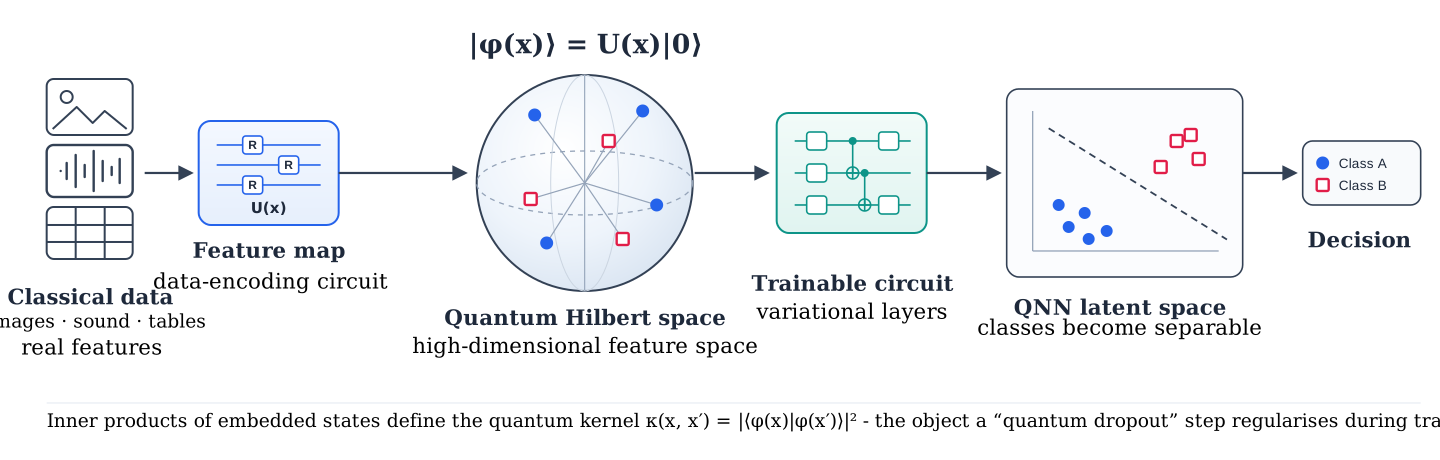
Recent work has begun to translate this idea to quantum circuits, randomly dropping quantum operations, or temporarily setting aside and measuring individual qubits, to reduce overfitting and, in some cases, to soften barren plateaux [3]. This is a genuinely appealing direction for real datasets. For images, dropout-like schemes could stop a model fixating on irrelevant pixels. For audio, they could encourage robustness to background noise and pitch shifts, while for tabular data, they could curb over-reliance on a handful of correlated columns.
But the evidence so far is fragmentary, a mix of small demonstrations and specific circuit designs, and no clear method yet tells us which form of quantum dropout suits which kind of data, or how strongly to apply it. Nor is it clear how quantum dropout should interact with the embedding itself: the same drop that stabilises training on one feature map may erase exactly the structure that made another useful. This gap deserves far more thorough and systematic investigation across realistic, multi-dimensional datasets.
Crucially, none of this happens on quantum hardware alone. Quantum machine learning today is largely hybrid – the quantum circuit proposes an embedding, while a classical computer, very often a high-performance GPU, handles the optimisation, the gradient estimates and the simulation of the quantum system itself. Simulating quantum states is exponentially expensive, so memory and energy consumption climb steeply as circuits grow.
Techniques such as quantum dropout are attractive here for a second reason: by thinning circuits and shortening training, they could cut the number of costly circuit evaluations and the associated GPU workload. Understanding embeddings therefore cannot be separated from the compute budget they demand. As models scale toward problem sizes that classical simulation can no longer reach, the same efficiency pressures will shape which experiments are feasible on real quantum processors at all. The right question is therefore not only "does this embedding help?" but "does it help enough to justify its cost in qubits, runs and energy?"
The open challenge here is the absence of a predictive, unifying account linking embedding design to real-world performance. Most positive results are existence proofs or small synthetic demonstrations. Most negative results are generic warnings. What is missing is a design theory that, given a particular dataset and a fixed hardware and energy budget, predicts which embeddings, and which regularisation tricks such as quantum dropout, will actually help. Building that theory, together with the scalable constructions needed to test it, is the aim of ongoing and upcoming projects at RISE. Achieving this would be a landmark result: moveing quantum machine learning from intriguing possibility toward dependable, resource-aware practice.
Links:
[L1] https://pennylane.ai/qml/
[L2] https://www.tensorflow.org/quantum
References:
[1] V. Havlíček, et al., “Supervised learning with quantum-enhanced feature spaces”, Nature, vol. 567, no. 7747, pp. 209–212, 2019.
[2] H.-Y. Huang, et al., “Power of data in quantum machine learning”, Nat. Commun., vol. 12, no. 1, Art. no. 2631, 2021.
[3] F. Scala, et al., “A general approach to dropout in quantum neural networks”, Adv. Quantum Technol., vol. 8, no. 12, Art. no. 2300220, 2025.
Please contact:
Smita Chakraborty
Research Institutes of Sweden RISE, Sweden