
 No. 145
  No. 144
  No. 143
  No. 142
  No. 141
  No. 140
  No. 139
 by Enrico Barbierato and Nicoleta Mihalachi (Catholic University of the Sacred Heart)
The article connects the probabilistic foundations of quantum mechanics with practical computational opportunities in finance, while emphasizing the likely role of hybrid quantum–classical approaches.
Quantum computing inherits some conceptual difficulties from quantum mechanics. Quantum advantage depends on the ability to manipulate superpositions, create correlations through entanglement, and exploit interference so that useful computational outcomes are favoured while others are suppressed. At the same time, quantum mechanics imposes important constraints: the internal quantum state cannot be inspected freely, and measurement reveals only limited information. Many quantum algorithms must therefore be executed repeatedly to estimate the probabilities associated with their possible outcomes.
This combination of controlled evolution and probabilistic observation becomes particularly interesting in finance, where many computational problems involve probability distributions. Two examples illustrate this connection particularly well: the generation of synthetic financial data and Monte Carlo estimation (see Figure 1).
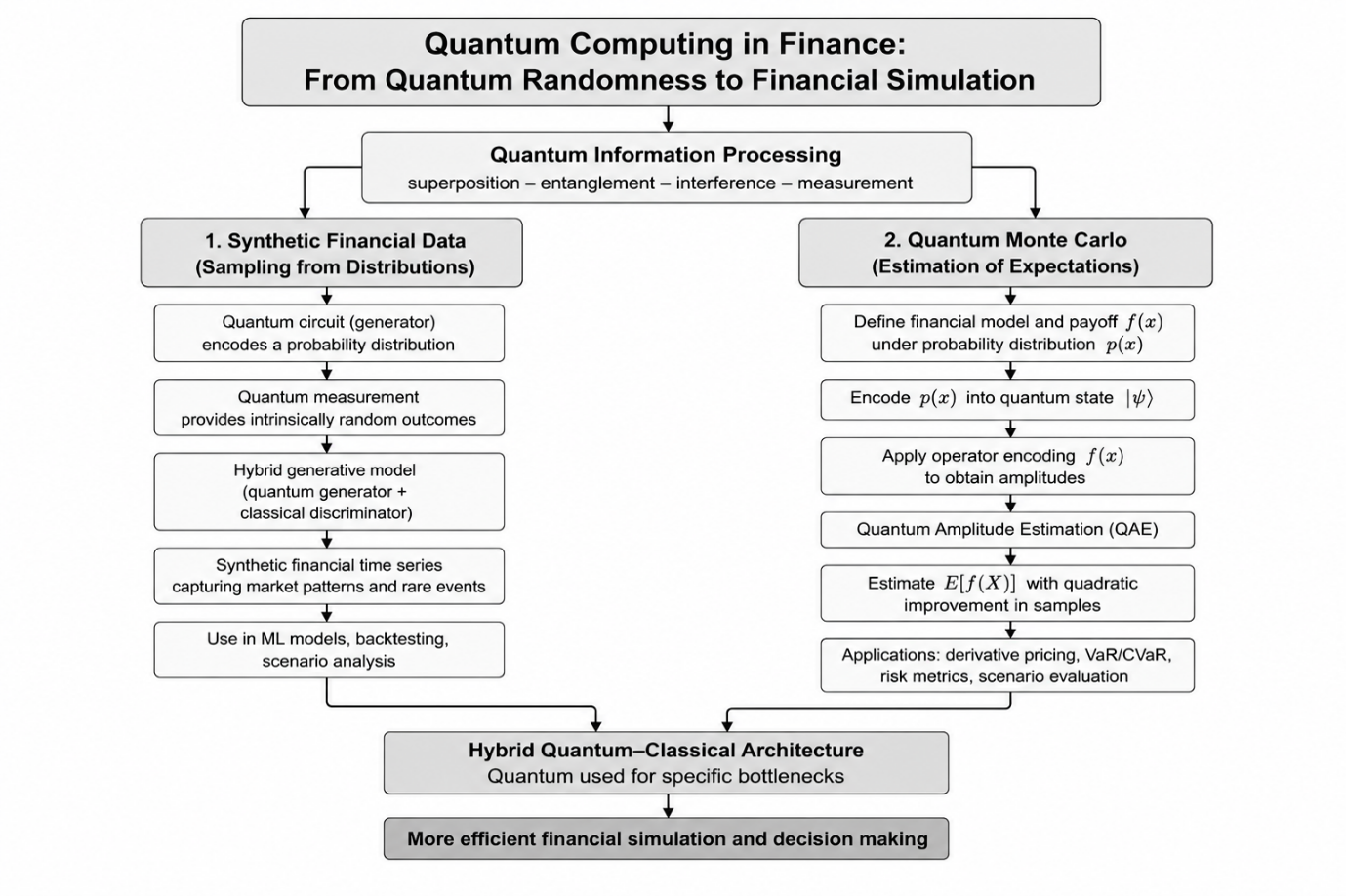
Quantum randomness and synthetic financial data
Randomness is essential to simulation and generative modelling. Classical computers normally rely on pseudorandom numbers produced by deterministic algorithms, whereas quantum measurement can provide randomness of genuinely physical origin. Yet randomness alone is not sufficient to generate meaningful financial data, and useful synthetic time series must reproduce statistical distributions, temporal dependencies, volatility patterns and, ideally, rare market events.
Quantum generative models address this more demanding task by using quantum states and circuits to represent and sample probability distributions. Orlandi et al. [1], for example, investigated a hybrid Quantum Wasserstein Generative Adversarial Network with Gradient Penalty for generating synthetic S&P 500 data. Their architecture combines a quantum generator with a classical discriminator, illustrating how a quantum component can be embedded within a conventional machine-learning workflow rather than replacing it entirely.
Synthetic-data generation therefore provides one example of a broader idea: quantum computation may be useful when financial applications require efficient manipulation or sampling of complex probability distributions.
Quantum Monte Carlo in finance
Probability plays an even more fundamental role in Monte Carlo simulation. Many problems in quantitative finance can be expressed as the estimation of an average value over a large number of possible future scenarios. The price of a derivative is a typical example: its value depends on the possible future evolution of one or more market variables and on the payoff associated with each possible outcome.
For simple financial instruments, analytical solutions may exist. For path-dependent derivatives, portfolios involving several assets, complex interest-rate models or credit-risk calculations, analytical solutions often become unavailable or impractical. Monte Carlo simulation then provides a remarkably flexible alternative. A large number of possible scenarios is generated, the relevant financial quantity is evaluated in each scenario, and the results are averaged.
The strength of classical Monte Carlo lies in its generality. Its convergence rate is largely independent of the dimensionality of the problem, which makes it particularly attractive for high-dimensional financial models. However, its weakness is that convergence is relatively slow. To reduce the statistical error by a factor of ten, approximately one hundred times as many samples are required. High accuracy can therefore become computationally expensive, especially when generating and evaluating a single scenario already involves a complex financial model.
Quantum Amplitude Estimation, one of the central techniques behind Quantum Monte Carlo methods [2], can encode information about probabilities or payoffs into a quantum state and use interference to estimate the quantity of interest. Under ideal conditions, this leads to a quadratic improvement in the number of evaluations needed to achieve a given accuracy.
The importance of this improvement is easier to appreciate by considering what Monte Carlo simulation actually does. A classical algorithm obtains greater accuracy essentially by generating more samples, while a quantum algorithm instead exploits the structure of quantum amplitudes to extract information about the expected value more efficiently. The potential advantage therefore does not arise from generating random numbers faster, but rather from a different method of processing probabilistic information.
Derivative pricing is one of the most natural applications. European options provide simple examples, but the potential becomes more interesting for products whose payoff depends on an entire price trajectory, on several correlated assets, or on complex market conditions. In these cases, classical Monte Carlo may require very large numbers of simulations, while Quantum Amplitude Estimation offers, at least theoretically, a more favourable scaling with the required precision.
The same principle extends beyond pricing. Value-at-Risk estimates the loss threshold associated with a specified probability, while Conditional Value-at-Risk focuses on the expected loss once that threshold has been exceeded. Both depend on the distribution of future financial outcomes and can require extensive simulation, particularly for large portfolios. Credit-risk calculations, counterparty exposure and scenario-based stress testing similarly involve repeated evaluation across many possible future states.
The theoretical advantage, however, depends on the assumption that the relevant probability distribution and financial payoff can be encoded efficiently into a quantum circuit. Preparing these states may itself be expensive. Current quantum hardware also remains affected by noise, limited circuit depth, and restricted numbers of usable qubits. The quadratic improvement of the algorithm concerns computational complexity under suitable assumptions; it does not guarantee that present-day quantum processors will outperform highly optimised classical Monte Carlo implementations. These limitations reinforce the case for hybrid computation.
References:
[1] F. Orlandi, E. Barbierato and A. Gatti, “Enhancing Financial Time Series Prediction with Quantum-Enhanced Synthetic Data Generation: A Case Study on the S&P 500 Using a Quantum Wasserstein Generative Adversarial Network Approach with a Gradient Penalty,” Electronics, vol. 13, no. 11, 2158, 2024.
[2] P. Rebentrost, B. Gupt, and T. R. Bromley, “Quantum computational finance: Monte Carlo pricing of financial derivatives”, Physical Review A, 98(2), 022321, 2018.
Please contact:
Enrico Barbierato
Catholic University of the Sacred Heart, Italy