
 No. 145
  No. 144
  No. 143
  No. 142
  No. 141
  No. 140
  No. 139
 by George T. Stamatiou and Kostas Magoutis (FORTH-ICS and University of Crete)
Adaptive computer systems must decide their next action in a repeated fashion and against a time deadline. Optimization lies at the heart of that decision-making process and limits how fast they can react. Researchers at FORTH-ICS and the University of Crete used a quantum annealer inside that loop across different systems, from a queueing model to a running web server to an inverted pendulum. The controllers were shown to be operational; what still stands in the way however, is not the quantum computation itself but everything around it.
Systems that adapt themselves, such as a data center reallocating resources, a web server resizing its worker pool, a robotic system correcting its balance, share a common theme: they must choose an action now, on the basis of where the system is heading, and each must choose before the next control period elapses. Model Predictive Control (MPC) is the established approach of making such choices in an optimal way. It is based on a mathematical model of the system, predicts its behavior over a future horizon, and selects the sequence of inputs that best balances close tracking of a reference value against the cost of acting. Only the first input is applied and at the next step the calculation is repeated based on the new system state. It is the prediction step that makes MPC proactive rather than merely reactive, while the optimization step lets it respect hard operational constraints; re-solving at every step keeps the controller responsive to model error and unforeseen disturbances.
The cost of the optimization problem that sits inside the MPC control loop grows with the length of the prediction horizon and with the number of discrete choices available at each step. Longer horizons are expected to lead to more stable control and also make the search space combinatorial. Engineers usually respond by simplifying the model, shortening the horizon, or solving the problem offline in advance, each of which buys speed at the expense of control quality. For distributed systems aiming at control periods of tens of milliseconds, that is an expensive trade-off.
Quantum annealing suggests a different route. A quantum annealer is a special-purpose device that searches for the lowest-energy configuration of a system of coupled qubits, exploiting quantum effects, such as quantum tunneling, to explore a rugged energy landscape. If the control cost function is reformulated so that its minimum corresponds to that lowest-energy configuration, then the annealer becomes a solver for the optimization problem in the control loop. However, the reformulation is not trivial: the control inputs must be encoded in binary form and the objective expressed as a quadratic function over those binary variables is the form that quantum machines accept. This new form is a Quadratic Unconstrained Binary Optimization (QUBO) problem. Once the translation is completed, however, the same recipe may be applied to any system whose dynamics can be modeled. Figure 1 shows the resulting workflow, with a quantum computer (or quantum annealer) as the optimizer of an otherwise conventional control loop.
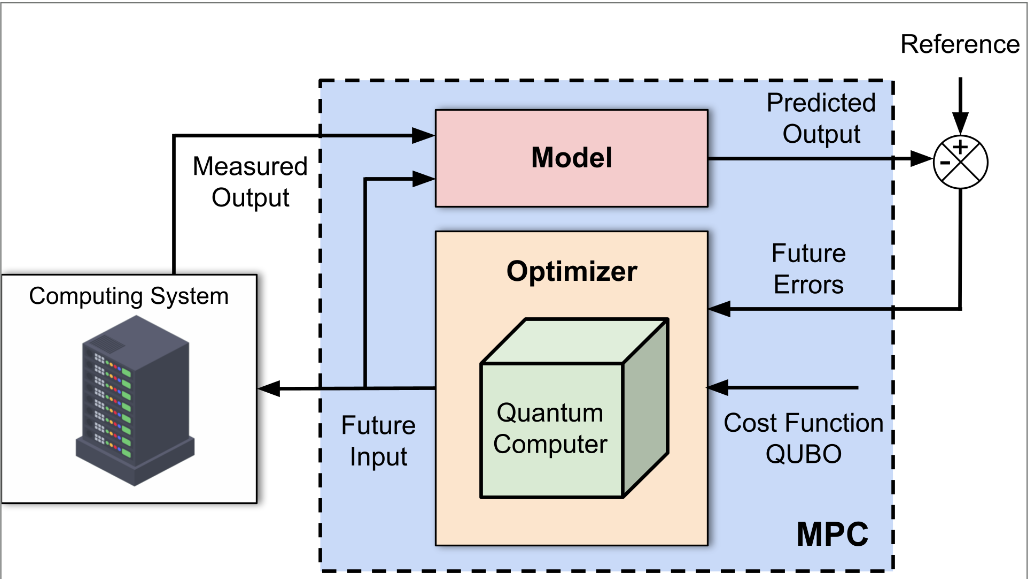
We have tested this workflow in three case studies of deliberately different character. The first was a simulated tandem queueing system, an idealized model of a computer system, in which the controller regulated end-to-end response time by tuning a fixed buffer size [1]. The second was a running Apache HTTP server under a realistic synthetic workload, where the controller held processor utilization at a reference by adjusting the number of concurrent workers, while accounting for the substantial cost of the server's own reconfiguration [2]. The third was the inverted pendulum on a cart, a classic benchmark in control engineering, chosen because it is fast, physically demanding and small enough to fit today's hardware [3]. In each case the optimization was solved on D-Wave quantum annealers and compared against classical alternatives: exact solvers, simulated annealing, and hybrid quantum-classical solvers.
The picture that emerges is encouraging and sobering, in roughly equal measure. Quantum annealing-based controllers do achieve control. They stabilize the queueing system, they track utilization references on a server in real-time, and they manage to keep the pendulum upright. Solution quality is competitive with the classical baselines, though with noticeably greater run-to-run variation. The advantage also grows with difficulty: as the prediction horizon increases and the optimization becomes genuinely hard, the annealer's solution times compare increasingly well against simulated annealing.
The honest accounting, however, is not about the quantum annealing itself. Decomposing the wall-clock time of a control step shows that the quantum computation is a small fraction of the budget. What dominates is the round trip to a cloud-hosted machine and the waiting in its queue, together with the preprocessing needed to lay the problem out on the physical qubit lattice. That layout step, which maps a densely connected problem onto a physical chip of limited connectivity, costs tens of milliseconds per step, and the network contribution varies with geographical position of the quantum devices, which are repeatedly accessed remotely. None of these costs is fundamental to quantum annealing. They are properties of how state-of-the-art quantum machines are currently accessed.
That is where the interesting engineering lies. Precomputing the problem layout, placing quantum resources close to the systems they control, and reserving quantum capacity rather than queueing for it would each remove a large factor from the latency budget, while the hardware itself continues to improve in qubit count, connectivity and error-correction. Work in the QUADS project [L1], funded by the Hellenic Foundation for Research and Innovation (HFRI) and carried out at the Information Systems Laboratory of FORTH-ICS [L2], aims to follow and extend this line of work towards adaptive systems at different scales and leveraging different quantum hardware.
Taken together, these case studies show that quantum annealing can be integrated into model predictive control across very different systems. While there is more work to be done to broaden the applicability of quantum optimization, an equally important challenge lies with the surrounding latency caused by remote access, queueing and problem embedding. Reducing these overheads will be essential if quantum optimisers are to become practically competitive in real-time control.
Links:
[L1] https://quads-project.eu/
[L2] https://www.ics.forth.gr/isl
References:
[1] G. T. Stamatiou, K. Magoutis, “Quantum-Enhanced Control of a Tandem Queue System”, Performance Evaluation Methodologies and Tools (VALUETOOLS 2023), LNICST 539, pp. 99–114, 2024.
[2] E. Papageorgiou, G. T. Stamatiou, K. Magoutis, “Model Predictive Control of Internet Servers using Quantum Annealing”, IEEE Int. Conf. on Autonomic Computing and Self-Organizing Systems (ACSOS), 2024.
[3] G. T. Stamatiou, K. Magoutis, “Quantum-Optimized Control of the Inverted-Pendulum System”, IEEE Int. Conf. on Quantum Software (QSW), 2026.
Please contact:
George T. Stamatiou
FORTH-ICS and University of Crete, Greece
Kostas Magoutis
FORTH -ICS and University of Crete, Greece