
ERCIM News 69
April 2007
Special theme The Digital Patient
Guest editors Ioannis Tollis (ICS-FORTH) and Nicholas Ayache (INRIA)
PDF
of ERCIM News 69
68 pages
 No. 146
  No. 145
  No. 144
  No. 143
  No. 142
  No. 141
  No. 140
  No. 139
 The Digital Patient - Introduction to the special theme
- Details
- Category: Special Theme "The Digital Patient"
- Hits: 87544
by Ioannis Tollis and Nicholas Ayache
Initiated by the European Commission as a major multidisciplinary scientific challenge, the Virtual Physiological Human (VPH) aims to develop robust, in silico models of human physiology and pathology. The desired outcomes include the identification of novel diagnostic biomarkers, the optimization of clinical decision-making and the discovery of innovative therapies. In this way, individualized models of human function could serve as virtual testbeds for a better understanding of pathophysiological processes (ie the disturbance of normal mechanical, physical and biochemical functions), as well as evaluating potential therapeutical strategies in silico.
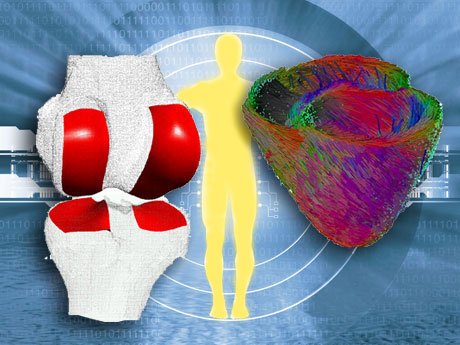
This scientific direction is reflected in the recent calls for projects for the European Union's 7th Framework Programme on VPH, which will target:
-
patient-specific computational modelling and simulation of organs or systems targeting specific clinical needs such as prediction of diseases
-
data integration and knowledge extraction, and most importantly
-
clinical applications and demonstration of the tangible benefits of patient-specific computational models.
This European initiative will give rise to new environments for predictive, individualized, evidence-based, more effective and safer healthcare. In addition, better therapy and the modelling of adverse drug effects will reduce medical errors and improve patient safety.
However, in developing such patient-specific models it is crucial to implement multi-layered models that describe different properties (eg electrical, mechanical and biochemical), and appropriate image analysis and data assimilation tools to identify their specific parameters from patient images. An ultimate goal is to meaningfully integrate these models to describe/model/mimic some life function, rather than individual properties, at different scales; for example, from cellular dynamics to organ function. To realize this ambitious scientific vision it will be necessary to address a number of challenges related both to infrastructure and data management, computational issues, validation and legal ethical issues.
The Virtual Physiological Human
- Details
- Category: Special Theme "The Digital Patient"
- Hits: 16254
by Marco Viceconti
The Virtual Physiological Human (VPH) is a methodological and technological framework that, once established, will enable collaborative investigation of the human body as a single complex system