
 No. 145
  No. 144
  No. 143
  No. 142
  No. 141
  No. 140
  No. 139
 by Göran Wendin (RISE)
The biological retina is an intelligent sensor because it uses complex neural circuits to compute, filter and pre-process data locally before sending meaningful compressed data to the brain via the optic nerve. The artificial Quantum Retina is based on the same concept: a grid of quantum sensors coherently coupled to a quantum neural network that sends pre-processed compressed quantum data to a powerful quantum processor. The concept is realistic and feasible in a long-term perspective and provides a blueprint for stepwise integration of quantum sensors, communication and information processing into an intelligent imaging system.
The overarching goal is to demonstrate quantum-enhanced sensing modalities for applications such as brain imaging, cardiovascular diagnostics, and cancer detection, with systematic benchmarking against established clinical technologies [1]. The specific goal is to develop an intelligent quantum sensor - a Quantum Retina - that coherently integrates and entangles a quantum sensor array with a quantum data processing device. It will consist of a grid of quantum sensors coherently connected to a quantum backplane that processes quantum data from the sensors. The quantum processor backplane may ultimately be a trainable analogue quantum artificial neural network. A vision of a “quantum computer at the tip of a scanning probe - SPQ” was formulated already by G. Wendin in 2017 emphasizing coherent quantum data transfer from sensor to processor. This is now a hot topic [2,3] and the rapid development of quantum technologies makes it possible to experiment with real applications.
The current project started in the spring of 2026 and involves the Emerging Technologies [L1] and Computer Science divisions [L2] at RISE. It provides a platform for broad collaboration to build systems integrating quantum sensors with both classical and quantum communication and computing. It also paves the way for in-depth collaborations between institutes and academia in Sweden and beyond.
A fully functional Quantum Retina will avoid classical-quantum conversion and quantum memory problems and will provide advantages over conventional experiments in which quantum states are measured and pre-processed, and the resulting classical data processed with classical, or even quantum, computers. One goal is to develop quantum-enhanced sensing modalities for applications such as brain imaging [1] to eventually pave the way for quantum-coherent brain-machine-computer interfaces.
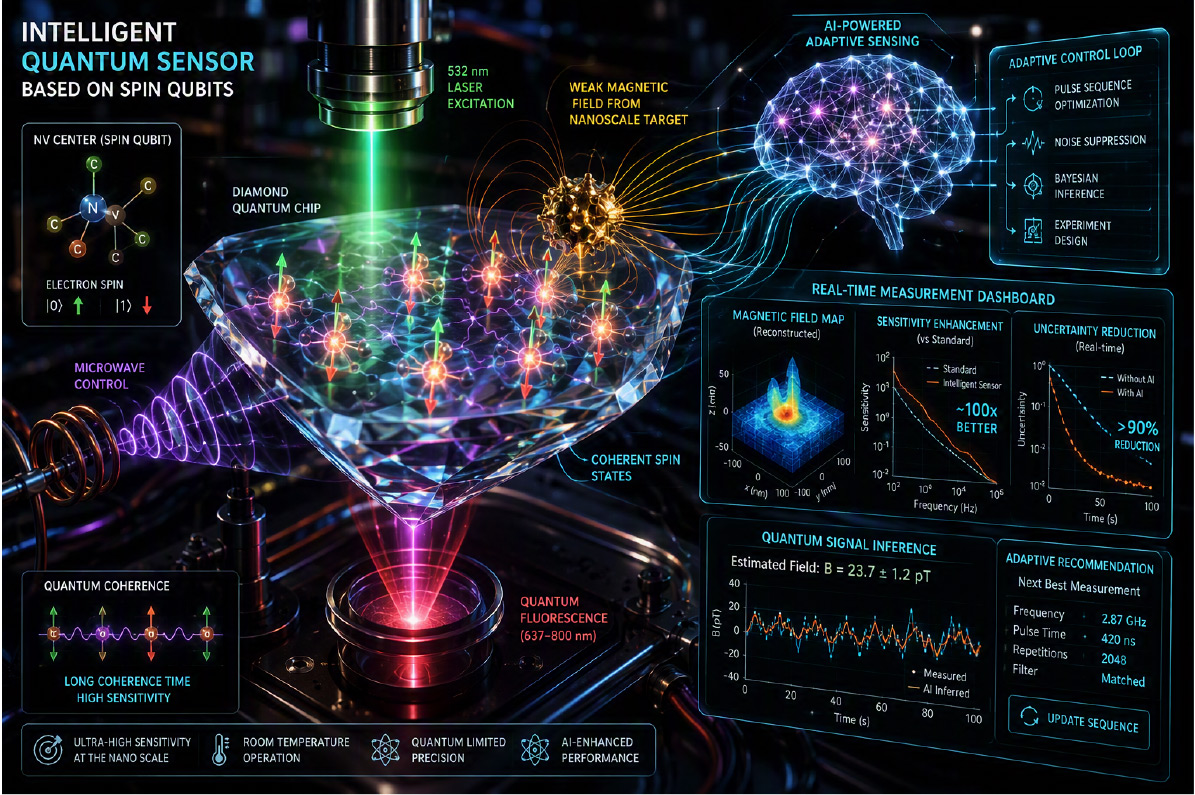
Particularly interesting as elementary sensors are electronic spin qubits in NV centres (NVC) in diamond, quantum dots in nanotubes, and molecules. The grid of quantum sensors will be directly connected to a layer of qubits, potentially a quantum neural network (QNN), functioning as a quantum pre-processor. In principle, the sensors and the processing qubits could be of the same kind, or different types coherently interfaced together - time will show what works best. Of particular interest will be to apply quantum reservoir computing and machine learning to a coherently coupled QNN to analyse time-dependent signals driving the quantum sensor array, providing pre-processed classical or quantum data communicated to an external powerful information processor.
The groundbreaking impact of the Quantum Retina builds on the potential for “quantum advantage” that the project can develop in tune with the current and future evolution of quantum technologies and AI. In the initial stage, quantum data collected by quantum sensors: NVC, quantum dots, molecules, and photonic sensors will be read out and processed classically. Later, adding and measuring a coherently connected qubit network will provide pre-processed compact classical data representing an intelligent quantum sensor. Finally, the system will be miniaturised to a compact Quantum Retina and integrated in measuring systems, e.g. forming a grid of Quantum Retinas in a brain scanning helmet. (Figure 1).
The Quantum Retina promises to provide clear Quantum Advantage. Huang et al. (Science, 2022) investigated quantum advantage in learning from experiments that processes quantum data with a quantum computer and proved that quantum machines with access to quantum data can learn from exponentially fewer experiments than the number required by conventional experiments. Exponential advantage was shown for predicting properties of physical systems, performing quantum principal component analysis, and learning about physical dynamics. 10 years from now, Quantum Retina types of projects will allow us to scan the brain, map in detail its functional network of hubs and circuits, identify problematic functional circuits, localise the “faulty” or “poorly programmed” physical neural circuits.
Quantum technologies will be at the core of this project at all levels: sensing, communication, simulation and computing. It will progress in time with the increasing maturity of quantum components, quantum communication and computing systems. AI will be integrated at all levels.
These types of projects also have a big overlap with distributed quantum computing - quantum computers connected through a quantum internet - achieving this in a local setting, with potential for useful results ahead of a working system of distributed quantum computers. On the way to that, the advanced sensing system in the form of a Quantum Retina will be groundbreaking. In a larger IoT network perspective, the Quantum Retina is an Edge quantum processor that is connected by a quantum internet to central quantum computers. And on a smaller scale, an intelligent quantum pixel in a quantum-coherent sensor for brain scanning and medical diagnostics.
Finally, printed electronics for quantum technologies is a topic of great interest and importance. It is at the focus of ongoing research at RISE [L3] and will provide a platform for experiments toward intelligent quantum sensing and imaging systems.
Links:
[L1] https://www.ri.se/en/quantum-technologies
[L2] https://www.ri.se/en/quantum-technology/expertise/quantum-computing-and-simulation
[L3] https://www.ri.se/en/advanced-electronics/printed-electronics/expertise/electrochromic-systems-and-displays
References:
[1] J. Waldthaler, I. Comarovschii, and D. Lundqvist, “Magnetoencephalography-based prediction of longitudinal symptom progression in Parkinson’s disease,” npj Parkinson’s Disease, vol. 12, Art. no. 29, 2026.
[2] R. R. Allen, F. Machado, I. L. Chuang, H.-Y. Huang, and S. Choi, “Quantum computing enhanced sensing,” arXiv preprint arXiv:2501.07625, 2025.
[3] S. A. Khan, et al., “Quantum computational sensing using quantum signal processing, quantum neural networks, and Hamiltonian engineering,” npj Quantum Information, vol. 12, Art. no. 119, 2026.
Also available: arXiv:2609.35016v1.
Please contact:
Göran Wendin, RISE, Sweden