
 No. 145
  No. 144
  No. 143
  No. 142
  No. 141
  No. 140
  No. 139
 by Jacopo Settino, Andrea Vinci and Carlo Mastroianni (CNR-ICAR)
Neuromorphic computing shows how the physical dynamics of a device can become part of the computation itself. Quantum systems offer a different but potentially complementary opportunity. This perspective considers how quantum dynamics, interactions, memory, and dissipation might open new directions for neuromorphic computing, beyond simply running neural-network models on quantum processors.
In recent years, advances in artificial intelligence have been accompanied by a rapid increase in the computational resources required to train and run increasingly complex models. Training, in particular, involves repeatedly processing vast amounts of data and iteratively updating growing numbers of parameters, with substantial costs in energy, time, and computing infrastructure. This makes it increasingly clear that the future of AI will depend not only on new algorithms, but also on rethinking the hardware on which they run. In conventional architectures, memory and processing units are physically separated, and the continuous movement of data between them contributes significantly to computational and energy costs.
Neuromorphic computing offers one possible architectural response. Inspired by organizational principles found in biological neural systems [1], neuromorphic architectures can distribute memory and processing across the same physical network and operate in an event-driven manner, activating computation only when required. More broadly, they aim for a close integration between computational function and physical substrate, exploiting properties that arise from the system’s internal dynamics. From this perspective, hardware is no longer merely the substrate on which an algorithm is executed: its physical dynamics can become part of the computation itself.
Quantum neuromorphic computing
A useful conceptual parallel can be drawn with quantum computing. In a quantum device, information is encoded in the physical state of the system, whose evolution can itself be controlled to process information. Conventional quantum computing is largely organized around programmable sequences of quantum gates. A neuromorphic perspective, however, suggests a different question: can the collective dynamics of a quantum system, including its interactions, temporal response, and memory, be directly used to perform computational tasks?
This idea is central to quantum neuromorphic computing (QNC), an emerging field that seeks to combine principles of neuromorphic computation with resources available in quantum physical systems [2]. The more distinctively neuromorphic direction is to make the dynamics and physical organization of the quantum device part of the computational architecture itself.
One of the clearest early examples of this dynamics-based approach is represented by Quantum Reservoir Computing (QRC). In reservoir computing, the internal dynamics of a complex system transform input information into a high-dimensional representation, while training is largely confined to a simple linear output layer.
In QRC, this transformation is performed by the evolution of a quantum system, whose state is represented by a vector in a Hilbert space whose dimension grows exponentially with the number of qubits, making the system’s dynamical properties an integral part of information processing.
Recent hybrid architectures further illustrate how computational functions such as memory can be distributed between quantum dynamics and classical post-processing. For example, memory augmentation through classical processing of quantum measurements can reduce experimentally demanding requirements while retaining the dynamical processing performed by the quantum system [3].
Beyond the reservoir: designing quantum-neuromorphic architectures
A broader perspective is to move from using a quantum system as a reservoir to designing it explicitly to implement specific neuromorphic functions. In such devices, the physical structure of an interacting quantum network would itself become part of the computational architecture.
For example, the topology of interactions could determine how information propagates through the system and which collective modes are excited. Different relaxation timescales, engineered through controlled coupling to the environment, could provide forms of temporal memory by making the present response depend on recent inputs. Controlled dissipation could thus become part of the design space rather than simply a process to be minimized.
This points towards quantum networks in which connectivity, timescales, dissipation, and measurement points are co-designed for a target task (Figure 1). The goal would no longer be only to exploit whatever complex dynamics a device happens to provide, as in a generic reservoir, but to construct dynamics with desired computational properties: memory, temporal selectivity, collective response, and distributed processing.
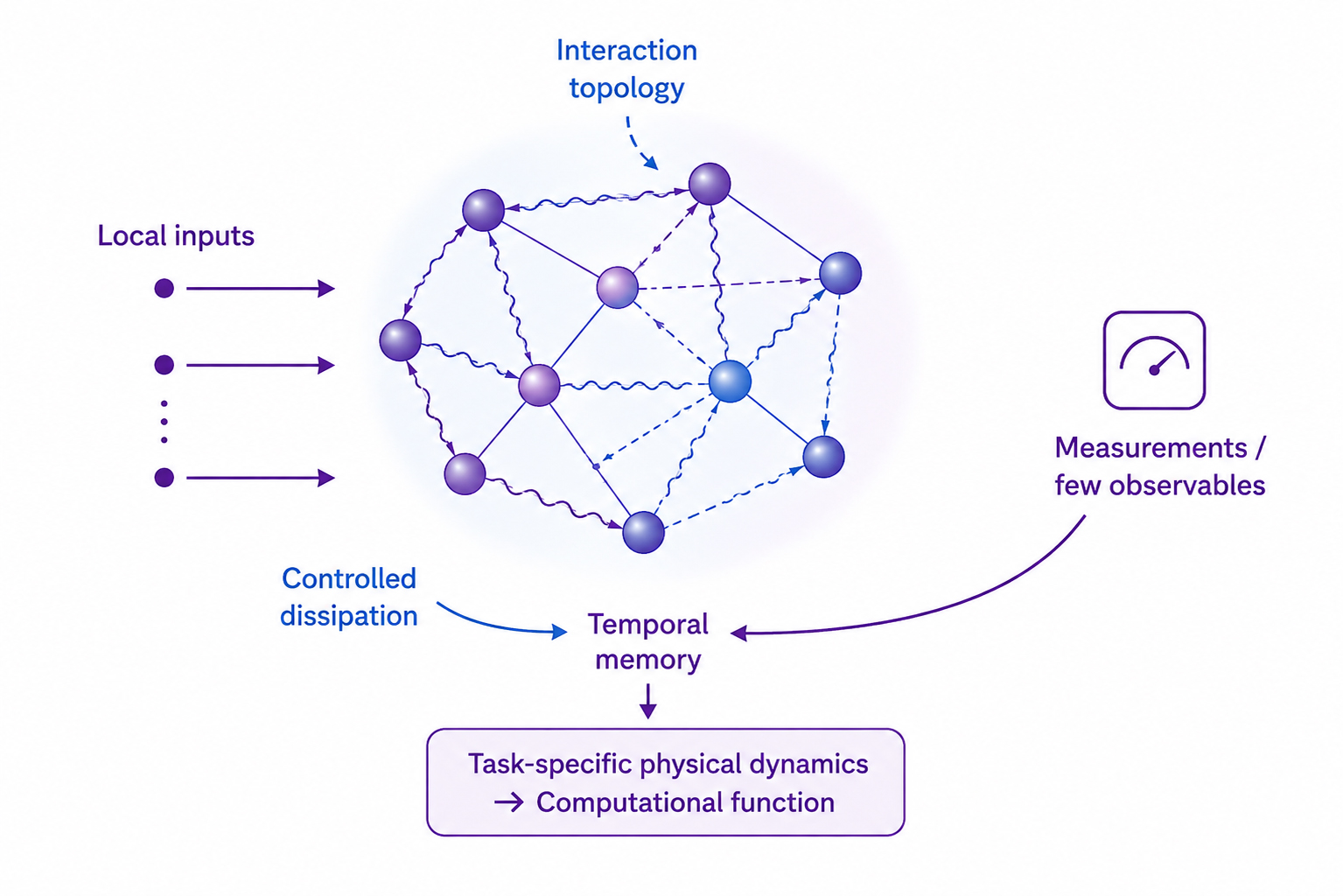
Several emerging concepts already point in this direction. Quantum memristors introduce history-dependent responses at the device level, while quantum spiking-neuron and leaky-integrate-and-fire models explore ways of translating neuromorphic primitives such as integration, leakage, thresholding, and spiking into quantum systems. These approaches are not yet a mature architectural framework. Rather, they illustrate a possible evolution of the field: from quantum systems that merely provide complex dynamics to quantum elements deliberately designed to implement specific neuromorphic primitives, which could eventually be combined into larger networks.
The decisive question is therefore not whether a quantum-neuromorphic device can be built, but what it could do better, or fundamentally differently, than the best classical neuromorphic architectures. A possible advantage might arise when the input itself is quantum and can be processed without first being converted into a classical representation, or when, for a specific task, the functions naturally generated by the quantum dynamics provide an effective representation of the relevant input-output relation, without requiring the explicit construction of complex functions by hand.
The long-term potential of quantum neuromorphic computing lies in bringing together two complementary ideas: the quantum view of information as a physical resource and the neuromorphic view of computation as an emergent property of dynamics, memory, and connectivity.
References:
[1] D. Kudithipudi et al., “Neuromorphic computing at scale,” Nature 637, 801–812 (2025). DOI: 10.1038/s41586-024-08253-8.
[2] D. Marković and J. Grollier, “Quantum neuromorphic computing,” Applied Physics Letters 117, 150501 (2020). DOI: 10.1063/5.0020014.
[3] J. Settino et al., “Memory-augmented hybrid quantum reservoir computing,” Physical Review Applied 24, 024019 (2025). DOI: 10.1103/wzwv-7rk2.
Please contact:
Jacopo Settino
ICAR-CNR, Italy