
 No. 145
  No. 144
  No. 143
  No. 142
  No. 141
  No. 140
  No. 139
 by Andreas M. Hein (SnT, University of Luxembourg) and Carl Shneider (SnT, University of Luxembourg)
Orbital data centres are moving from vision to hardware, yet almost every concept still assumes conventional CMOS hardware. We argue that a cryogenically cooled photonic satellite constellation is a promising near-term architecture for computing in orbit and the natural on-ramp to photonic quantum processing and quantum networking in space.
From vision to hardware
In little more than a year, orbital data centres have gone from a niche subject to a crowded field. A start-up flew a commercial graphics processor to orbit in 2025; Kepler Communications launched orbital cloud infrastructure in 2026; Google published its Project Suncatcher concept, a formation of satellites carrying conventional tensor processors linked by dense coherent optical inter-satellite links [1], [L2]. The Horizon Europe ASCEND study and a 2025 report by the European Space Policy Institute examined far larger installations as a lower-carbon alternative to terrestrial facilities.
Nearly all of these studies share one assumption: the computing payload is based on an off-the-shelf terrestrial data-centre rack. Our own exploration of more than 20,000 candidate orbital computing architectures suggests this is exactly where the hidden leverage is located [3]. It is the computing paradigm, not the solar array and not the radiator, that decides whether an orbital data centre will have a future in space. We evaluated the potential of in-memory computing, neuromorphic processors, temporal computing, photonic and optical computing, quantum processors, and longer-horizon reversible computing schemes. Among them, hybrid photonic-electronic hardware showed order-of-magnitude potential, because it avoids much of the radiation shielding mass that electronics demand and because vacuum is an unusually good medium for moving photons.
A cold photonic constellation
We selected one architecture out of that trade space that combines photonic with quantum computing: a cryogenically cooled photonic mesh satellite constellation (Figure 1). Each node carries a photonic matrix-multiplication accelerator, a Mach-Zehnder interferometer mesh or a microring weight bank in silicon nitride or thin-film lithium niobate. It is held at 70–80 K by combined passive and active cooling. Neighbouring nodes exchange activations over coherent free-space optical links, with no conversion back to electronics at the chip boundary. Indicative targets are 10 to 100 nodes, links of one to ten terabits per second across separations of 100 to 1000 km, and a constellation power budget of 10 to 100 kW.
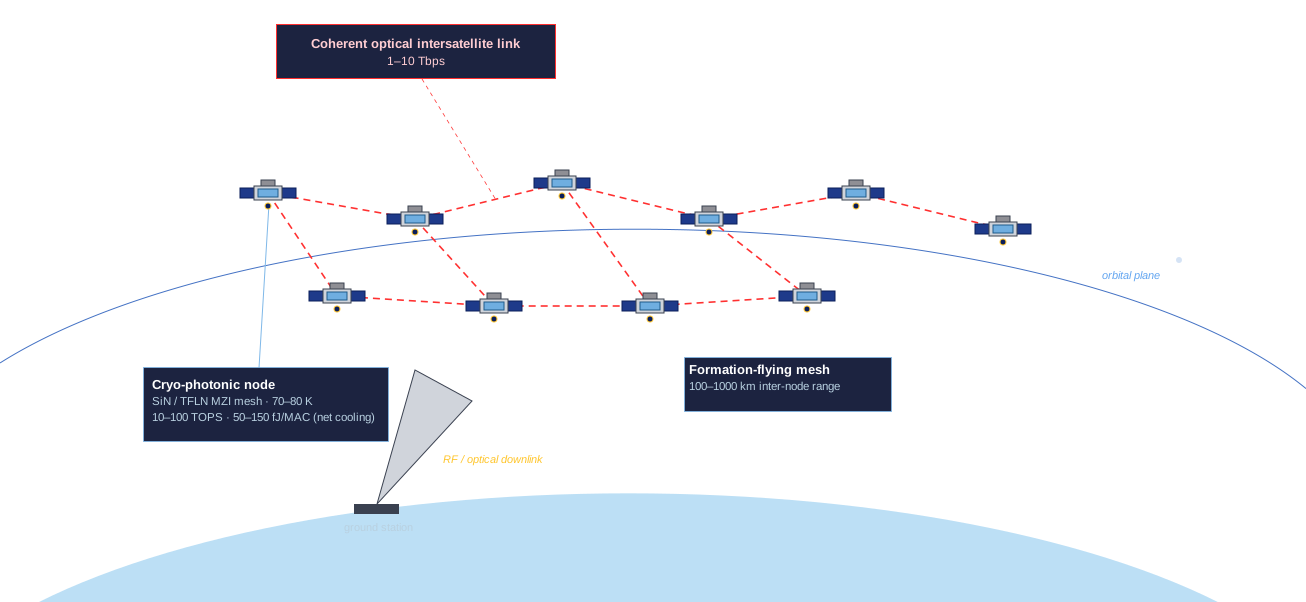
The low temperatures in space, combined with the cryogenic cooling on board, suppress the thermal drift in phase shifters that limits photonic accelerators on the ground, while also lowering optical loss. The choice of 70–80 K rather than something colder is deliberate: it is reachable with single-stage Stirling or pulse-tube coolers and avoids the roughly tenfold power penalty of the 4 K regime.
Falsifiable, not aspirational
Cryogenics in orbit is expensive, so the project is built around claims that can be refuted. Our goal is to validate whether the constellation can deliver energy per useful inference at least twice lower than a room-temperature orbital baseline of equal throughput, counted after cooler efficiency, parasitic loads, vibration isolation and radiator area; whether phase-shifter drift stays below the accuracy threshold for 90% of an orbit without active recalibration; and whether coherent links sustain a terabit per second at representative inter-satellite distances. Project Suncatcher is treated as the primary benchmark rather than as a foil: cold photonics is only worth flying if its advantage survives the cooling bill.
Where quantum enters
A cryogenic, low-loss, optically interconnected node provides close to optimal conditions for photonic quantum information processing. Superconducting nanowire single-photon detectors, deterministic photon sources and quantum memories still need to be demonstrated in space. The cold stage, the optical packaging, the coherent inter-satellite links and the acquisition and pointing technologies have already been operated in space. A constellation built for classical optical inference in the early 2030s seems a credible pathway towards photonic quantum processors and distributed quantum networking as those components mature towards 2045.
Method, partners and outputs
We intend to characterise and size the computing payload, including the full cooling chain; build an integrated spacecraft and constellation model; and explore the trade space against terrestrial photonic accelerators, room-temperature orbital alternatives and conventional data centres.
The work builds on existing collaborations with TU Berlin, which leads the OMLO work on optical computing for machine learning in orbit [2], and the Silesian University of Technology, working on quantum computing for space applications.
Links:
[L1] Space Systems Engineering (SpaSys) group, SnT, University of Luxembourg: https://www.uni.lu/snt-en/research-groups/spasys/
[L2] Google Research, “Exploring a space-based, scalable AI infrastructure system design”: https://research.google/blog/exploring-a-space-based-scalable-ai-infrastructure-system-design/
References:
[1] B. Agüera y Arcas et al., “Towards a future space-based, highly scalable AI infrastructure system design”, arXiv:2511.19468, 2025.
[2] F. Kübler et al., “Concept of an in-orbit AI-system based on optical computing”, CEAS Space J., vol. 18, 2026.
[3] A. M. Hein et al., “Orbital Data Centers: A Techno-Economic and Sustainability Analysis”, forthcoming, 2026.
Please contact:
Andreas M. Hein
SnT, University of Luxembourg, Luxembourg