 No. 145
  No. 144
  No. 143
  No. 142
  No. 141
  No. 140
  No. 139
 by Hannes Hübel, Manuela Kos and Sebastian Ramacher (AIT Austrian Institute of Technology)
The project QCI-CAT is advancing Austria’s contribution to Europe’s quantum-secure communication infrastructure by bringing quantum key distribution and post-quantum cryptography from research into operational networks and real-world applications. Austrian research, industry and government partners have deployed long-distance QKD networks and demonstrated quantum-secure governmental and medical use cases laying the foundations for scalable, resilient and quantum-safe communications across Europe.
As Europe moves towards a continent-wide quantum communication infrastructure, the Austrian QCI-CAT project [L1] has taken an important step from experimental quantum networks towards demonstrating real-world use cases. The project operated quantum key distribution (QKD) networks connecting sites across Austria, demonstrated quantum-secure applications with governmental and medical stakeholders, developed training activities for future users and specialists, and advanced research towards future quantum repeater networks.
A central achievement was the deployment of three complementary network environments (Figure 1): an inner-city network in Vienna, a connection between Vienna and Graz, and a long-distance proof-of-concept network extending approximately 400 km from Vienna to St. Johann im Pongau. The deployments brought together QKD equipment fromFigure 1: QKD-secured networks deployed in Austria as part of QCI-CAT combining hybrid QDK/PQC key management, the Arnika VPN solution, and governmental and medical applications. multiple European suppliers, trusted nodes, classical networking infrastructure and quantum-enabled encryption systems.
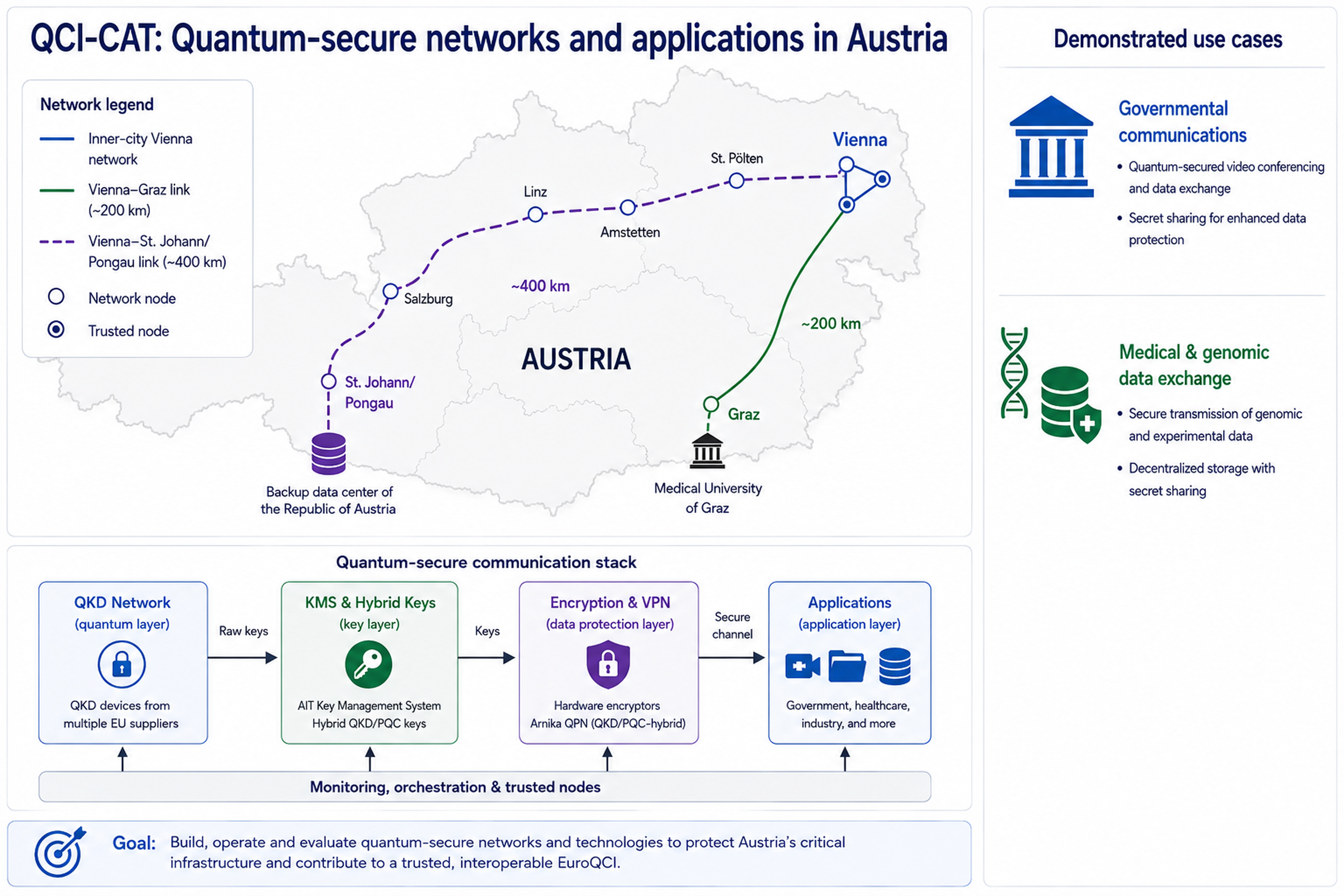
The Vienna–Graz connection linked the Medical University of Graz with the Vienna network over approximately 150 km. The longer Vienna–St. Johann link connected the Austrian Ministry of Defence in Vienna with a backup data centre of the Republic of Austria. Because of the distance involved, the latter network required several intermediate links along a route passing through St. Pölten, Amstetten, Linz and Salzburg. All QKD devices procured by QCI-CAT were brought together for this demonstration, making it an important test of long-distance terrestrial QKD operation.
An important aspect of QCI-CAT was the integration of quantum and classical security technologies rather than treating QKD as an isolated technology. A key management system developed by AIT [L2] managed key material and supported hybrid QKD/post-quantum cryptography (PQC) keys. Point-to-point hardware encryptors and the software-based Arnika VPN [L3] provided QKD/PQC-hybrid protection at the data layer.
The deployed networks became platforms for demonstrating applications in operational environments [1]. In the governmental use case, representatives of Austrian ministries participated in demonstrations combining QKD with secret sharing and secure video conferencing. A quantum-secured video call and simultaneous data exchange demonstrated how different security technologies can be combined to protect sensitive governmental communications.
A second application addressed highly sensitive medical information. Pathogen genome sequence data are increasingly important information assets for public health, while their sensitivity and dual-use potential impose confidentiality requirements. QCI-CAT demonstrated secure transmission and decentralized storage of genomic and experimental data between the Medical University of Graz and Austrian governmental sites. The approach combined QKD-generated keys with a secret-sharing architecture in which information was divided between independent storage locations. During the demonstration, genomic data and associated files were transferred and subsequently reconstructed, with integrity checks confirming that the recovered data matched the original data. The experiment illustrated how quantum-secure communications can form part of a broader security architecture rather than simply providing a point-to-point cryptographic link.
Operating QKD networks also revealed challenges that will matter for future large-scale infrastructures. Intermittent instabilities required remote reboots and, in some cases, physical power cycling or intervention by equipment manufacturers. This experience highlights that deploying a future European quantum communication infrastructure will depend not only on QKD performance, but also on hardware reliability, software resilience, interoperability and maintainability.
QCI-CAT therefore also investigated what scaling from experimental networks to national infrastructure would entail with respect to capital and operational expenditures [2]. Network planning and cost-estimation work examined a terrestrial Austrian QKD backbone for critical infrastructure. This work included abstract network planning and Monte Carlo simulations to estimate network length and was subsequently extended to all EU Member States.
Developing infrastructure must be accompanied by developing skills. QCI-CAT established training curricula for engineers as well as stakeholders and decision-makers, implemented online courses [L4] using a Moodle-based learning environment, and complemented these with in-person training. More than 50 participants registered for the online courses and over 160 attended in-person training activities, substantially exceeding the project's original training target. Feedback also led to a compact quantum-communication course designed specifically for employees entering the sector from related technical fields.
Alongside deployment, QCI-CAT continued research towards technologies that may underpin future generations of quantum networks. For instance, a new rack-mounted trapped-ion node with an integrated optical cavity was developed. Entanglement between trapped-ion systems was established using telecom-wavelength photons transmitted over a 50 km optical-fibre link.. The experiment represented the first trapped-ion entanglement over such fibre distances using a two-photon technique robust against path-length fluctuations [3]. QCI-CAT also contributed to the design and implementation of FAEST [L5], a post-quantum digital signature scheme and a 3rd round candidate in NIST’s call for additional signature schemes. FAEST builds its security on well-established cryptographic primitives, notably AES and SHA-3, and constructs signatures as non-interactive zero-knowledge proofs of knowledge of an AES key. These contributions complement the project's QKD activities by advancing post-quantum cryptographic mechanisms that can protect authentication mechanisms against quantum adversaries.
QCI-CAT's results illustrate the transition now taking place in European quantum communications: from individual technologies and laboratory experiments towards integrated networks, operational applications and an emerging ecosystem of users, engineers and infrastructure providers. Just as importantly, the project has identified practical challenges that must be addressed for production deployments. These lessons provide a foundation for Austria's contribution to the European Quantum Communication Infrastructure (EuroQCI) and for the next generation of interconnected quantum-secure infrastructure across Europe.
Links:
[L1] https://qci-cat.at
[L2] https://qkd-kms.ait.ac.at/
[L3] https://github.com/arnika-project/arnika
[L4] https://qurios.academy/
[L5] https://faest.info
References:
[1] C. Döberl, W. Eibner, H. Hübel, M. Kos, F. Kutschera, S. Laschet, A. Neuhold, S. Ramacher, P. Stanzer, and W. Strasser, “Implementation of a hybrid QKD/PQC network and applications,” in Proc. IEEE Int. Conf. Quantum Commun., Netw., Comput. (QCNC), 2026. https://www.ieee-qcnc.org/2026/
[2] S. Raubitzek, W. Strasser, S. Ramacher, T. Lebeth, A. Neuhold, and C. Pacher, “Towards national quantum communication in Europe: Planning and sizing terrestrial QKD networks,” arXiv preprint arXiv:2604.06764, 2026. https://arxiv.org/abs/2604.06764):2604.06764
[3] V. Krutyanskiy, M. Canteri, M. Meraner, V. Krcmarsky, and B. Lanyon, “Multimode ion-photon entanglement over 101 kilometers,” PRX Quantum, vol. 5, Art. no. 020308, 2024. https://journals.aps.org/prxquantum/abstract/10.1103/PRXQuantum.5.020308
Please contact:
Sebastian Ramacher
AIT Austrian Institute of Technology, Austria