
 No. 145
  No. 144
  No. 143
  No. 142
  No. 141
  No. 140
  No. 139
 by Giulia Petrarulo, Filip Maksimovic and Thomas Watteyne (Inria)
OpenSwarm, an EU-funded project coordinated by Inria that concluded in April 2026, has developed and validated a new open-source approach for enabling large groups of small, low-power wireless devices to work together intelligently, efficiently and autonomously.
Running from January 2023 to April 2026, OpenSwarm addressed a fundamental challenge in large-scale swarm systems: how to enable highly constrained devices to communicate, collaborate and make use of artificial intelligence (AI), while minimising energy consumption and simplifying the way such systems are programmed and managed. The project’s results now provide a set of reusable technologies for researchers and developers working on energy-aware swarms of collaborative smart devices.
OpenSwarm brought together advances across three closely connected areas: efficient networking and management of smart nodes; collaborative, energy-aware AI; and energy-aware programming of swarms. Together, these contributions move beyond conventional approaches in which connected devices largely operate as isolated units or depend on centralised infrastructure.
Scientific advances enabling new capabilities
The project’s key scientific contribution is an integrated approach to building collaborative smart nodes: small, resource-constrained devices that can interpret the data they generate, share information with neighbouring devices and collectively adapt their behaviour. Before OpenSwarm, achieving this combination at large scale was difficult because the capabilities required for intelligent collaboration (e.g. wireless communication, localisation, etc.) typically compete for limited power. OpenSwarm demonstrated that these capabilities can be coordinated as part of a common, energy-aware architecture.
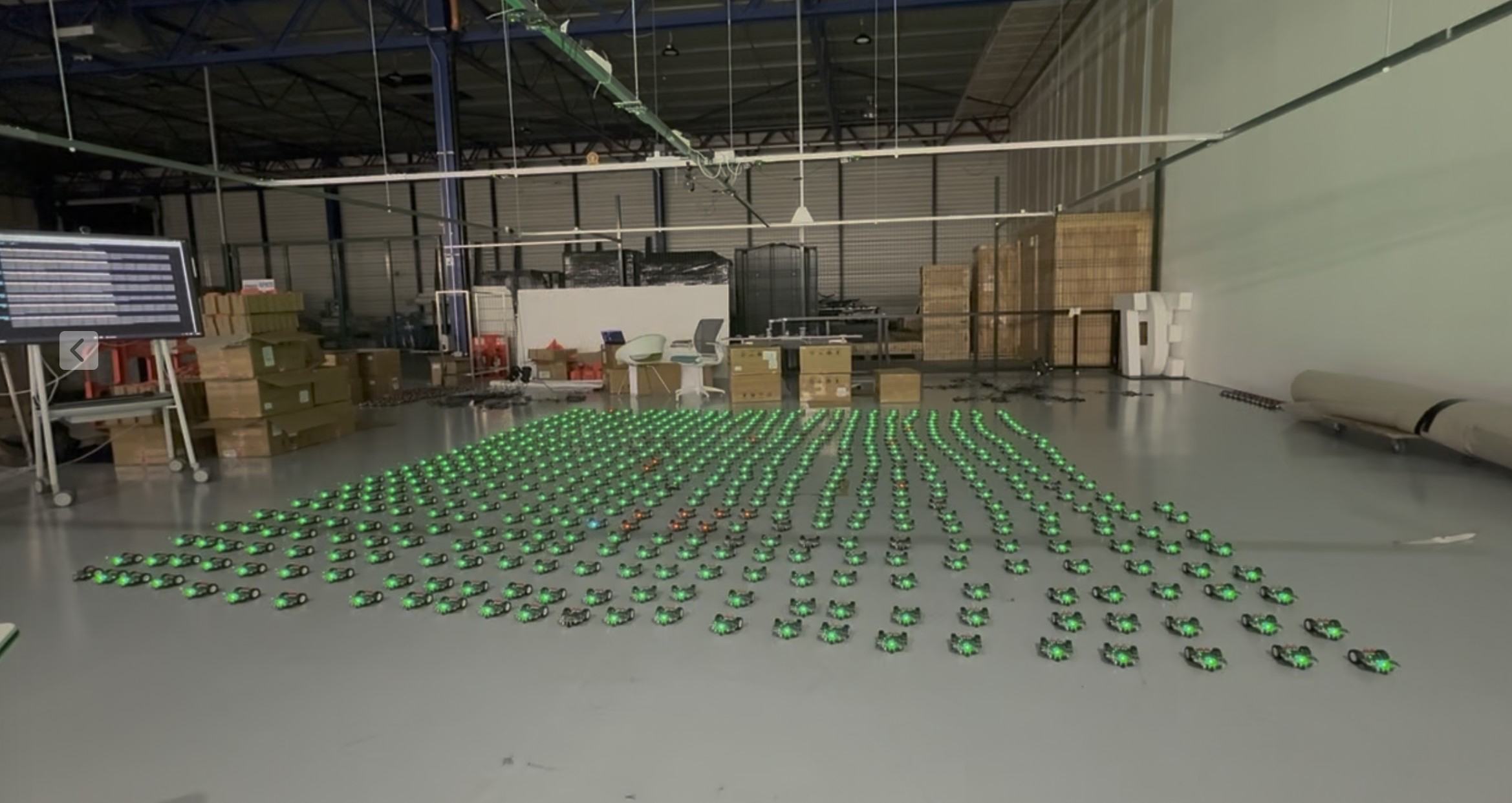
A further achievement was demonstrating these capabilities at large scale for constrained swarm devices. The technologies were validated on two large laboratory testbeds: the 900-node KiloBot testbed, which assessed the versatility and portability of the framework, including operation on severely constrained robots, and the 725-node DotBot testbed, which focused on low-power networking, energy management and localisation (Figure 1).
From research results to reusable technologies
The technologies developed were integrated into the OpenSwarm “package”, an open-source architecture underpinning all swarm capabilities and enablers, including software and other documents. Through this single reference point, the project’s results can be easily re-used by researchers and developers interested in energy-aware swarms of collaborative smart nodes, serving as a basis for further advances in this type of technologies.
The project’s results were tested and demonstrated through five real-world Proofs of Concept covering four broad application areas: cities and communities, environmental monitoring, industrial and occupational safety, and mobility.
Taken together, these demonstrations showed the versatility of the OpenSwarm approach across very different environments and operational requirements. The use cases explored how collaborative, energy-aware swarms could support renewable energy communities, assist human workers during harvesting, monitor ocean noise pollution, improve health and safety in industrial production environments, and operate in moving networks such as trains. Videos presenting the features and outcomes of each Proof of Concept are available on the project website [L1].
Collaboration turning into impact
OpenSwarm also established a coherent framework for coordinating a heterogeneous software ecosystem across its partners, supporting traceability across partners’ developments. This collaborative approach helped the consortium meet its initial scientific and outreach targets and define additional indicators to assess the performance and outcomes of its demonstrations more precisely.
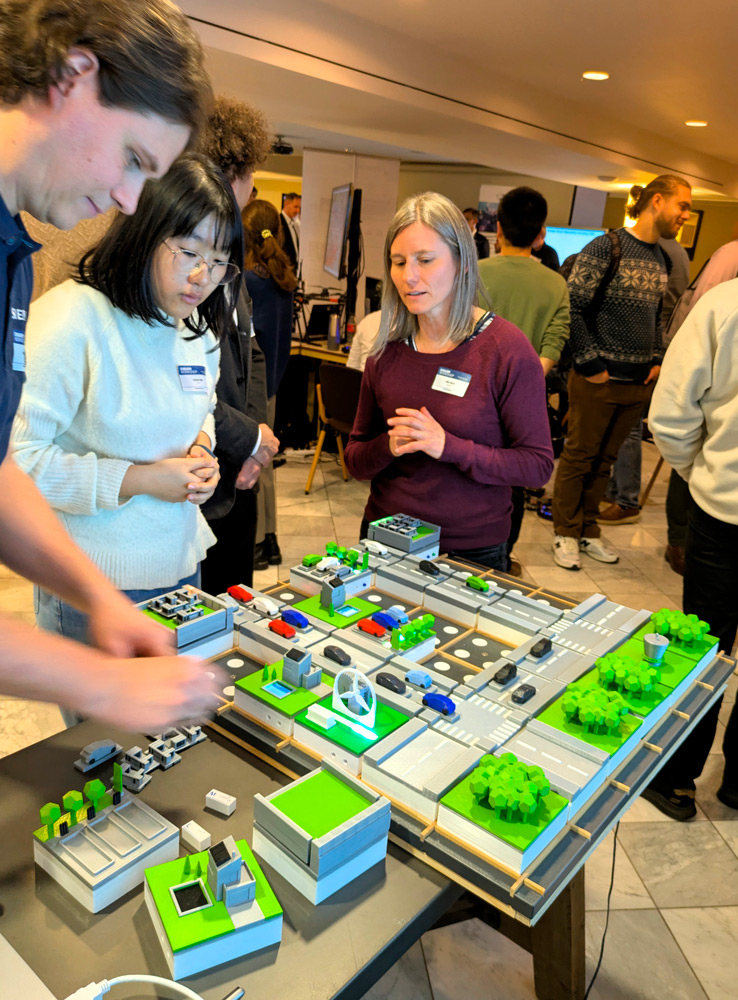
The project resulted in 22 journal articles in open-access journals, 62 conference papers at leading venues and four awards. Beyond publications, partners contributed to standardisation, education, open science and outreach through activities including hackathons, workshops and roadshows. These efforts are intended to extend the project’s impact and support the continued adoption and development of its results (Figure 2).
A foundation for the next generation of smart nodes
OpenSwarm’s results point towards a next generation of distributed systems in which connected devices are equipped with intelligence to interpret the data they generate, collaborate in a decentralized manner, and communicate efficiently.
By demonstrating these capabilities at scale, integrating them into an open-source architecture and validating them across diverse real-world scenarios, OpenSwarm has helped establish a foundation for future energy-efficient and trustworthy swarm systems. Its results contribute to broader European priorities around sustainability, clean energy and digital transformation, while providing researchers and developers with technologies they can continue to reuse and advance.
OpenSwarm brought together ten partners from Austria, Belgium, France, Germany, Ireland, Portugal and the UK, combining expertise in swarm robotics, IoT, low-power wireless communications, nanoelectronics and global Internet standards. The consortium included research leaders such as Inria, IMEC, KU Leuven and the University of Sheffield, market leaders including Analog Devices and Siemens, and SME Ingeniarius, which applies novel technologies to environmental protection.
This project has received funding from the European Union’s Horizon Europe Framework Programme under Grant Agreement No. 101093046. Disclaimer: The content of this article reflects the views of the authors and not necessarily those of the European Commission.
Links:
[L1] https://openswarm.eu/
[L2] EU Cordis webpage: https://cordis.europa.eu/project/id/101093046
References:
[1] J. Argote-Gerald, et al., “Design for one, deploy for many: Navigating tree mazes with multiple agents”, in Proc. IEEE Int. Symp. Multi-Robot & Multi-Agent Syst. (MRS), Singapore, Dec. 4–5, 2025, doi: 10.48550/arXiv.2510.26900.
[2] S. Alvarado-Marin, et al., “Automatic lighthouse calibration using conics for indoor robot localization”, IEEE Robot. Autom. Lett., vol. 10, 2025, doi: 10.1109/LRA.2025.3575319.
[3] T. Avé, M. Hutsebaut-Buysse, and K. Mets, “Temporal distillation: Compressing a policy in space and time”, Mach. Learn., vol. 114, 2025, doi: 10.1007/s10994-025-06889-9.
Please contact:
Giulia Petrarulo
Inria, France