





by Julia Pöschl, Philip Taupe, Jakob Hurst (AIT Austrian Institute of Technology GmbH)
Staying informed is crucial for decision-makers, particularly in time-critical domains such as disaster response and public safety. The Enhanced Language Interpreter (ELI) presented here supports decision-makers in making use of information that is available but cumbersome to process. It analyses heterogeneous inputs using large language models and knowledge graphs and converts them into a concise representation tailored to the target domain, thereby enhancing the operational picture of the situation.
Today’s age of information and communication technology offers the possibility to receive information updates on almost everything that is going on anywhere around the world in near real time. This abundance of information can be leveraged to enhance the operational picture of e.g., emergency forces in disaster response or other civil protection scenarios. The palette of information sources ranges from social media, news outlets, and (space-based) earth observation services, to in-field reports of front-line responders. The abundance of information brings a major challenge: extracting domain-relevant material, filtering out noise, and delivering an accurate operational picture. This challenge is further complicated by the inhomogeneity of data sources with respect to the used domain-specific vocabulary and the way information is presented, which makes it challenging to establish one coherent operational picture to support decision-making.
To alleviate these challenges, we develop ELI (Enhanced Language Interpreter), a powerful AI-based tool based on principles of semantic cross-domain interoperability to extract, categorize, interlink, and present information to decision makers. The research incentive behind ELI is to investigate AI-driven systems to improve situational awareness in complex emergency response settings, safety-related operations, and similar contexts. The tool evolved from a series of national and international research and development projects starting from 2020 and is being developed by the Austrian Institute of Technology GmbH.
ELI focuses on textual input and operates on the assumption that any information input can be translated into a written form and hence ingests unstructured or semi-structured incident reports with varying degrees of detail, or any other textual data gathered from heterogeneous sources. ELI offers a concise, structured representation of knowledge in the form of relevant entities and their interrelationships, as well as the possibility to trace these back to their individual occurrences in the source documents. One of the main strengths of our tool is its capability to align its output with domain-specific vocabulary and ontologies, tailored to the specific needs of decision makers in various domains.
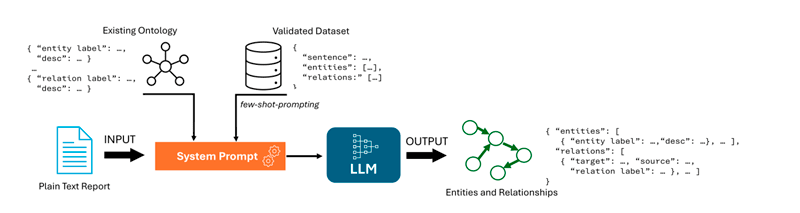
Figure 1: ELI’s information extraction and categorization process utilizing large language models.
ELI leverages natural language processing and knowledge graph techniques for gaining insights on written documents. In a first step (Figure 1), the system utilizes state-of-the-art large language models (LLMs) to identify entities and their relationships in a text. This step also includes categorizing the extracted information according to a pre-supplied domain-specific target ontology. In a second processing step, links between entities and groupings thereof are identified across all documents using semantic similarity matching. Finally, the system provides a graph representation of the extracted information including references into the source documents. A graph-RAG [1] based module is currently under active development, allowing for a chatbot-like interaction between ELI and the user to access the gathered knowledge.
Multiple evaluations were performed to investigate ELI’s applicability beyond specific safety or security missions. The underlying methods were tested against common benchmarks and synthetic datasets. This includes GraphRAG-Benchmark [2], a domain-specific question-answering benchmark for information retrieval and reasoning on graphs in fiction and medical domain. RE-3d [L1], a knowledge graph construction dataset in the defense domain, was used to validate the information extraction process. Finally, ELI’s overall approach has been verified with stakeholders in a controlled live demonstration.
As ELI is currently in the stage of a first prototype, there are many possible future directions for research and development. Most obvious is the improvement and expansion of its methods in terms of utility, accuracy and efficiency, for example considering other entity grouping strategies or missing link prediction. Moreover, we hope to be able to validate the approach in real-world scenarios with stakeholders from different domains in the future. Widening the scope of ELI, one could also further investigate other types of input data, e.g. by adding speech transcription and image description generation, or testing the tool against them.
To summarize, most of the information that emergency responders and other decision makers work with comes in or can be represented in a written form. ELI is a tool designed to help gain situational awareness for decision support by efficiently analyzing such written information. It leverages large language models, semantic similarity search, and knowledge graphs to structure information into an operational picture. With its semantic cross-domain interoperability credo, it is especially capable to handle inputs with heterogeneous forms and domain vocabulary.
Link:
[L1] https://github.com/dstl/re3d
References:
[1] H. Haoyu et al., “RAG vs. GraphRAG: A Systematic Evaluation and Key Insights”, 2025, arXiv:2502.11371.
[2] Z. Xiang et al., “When to use Graphs in RAG: A Comprehensive Analysis for Graph Retrieval-Augmented Generation”, 2025, arXiv:2506.05690.
Please contact:
Jakob Hurst
AIT Austrian Institute of Technology GmbH, Austria