







by Enrico Barbierato and Alice Gatti (Catholic University of the Sacred Heart)
AI models are becoming ever larger and more energy-intensive, raising questions about how scientific knowledge is produced. This article argues that computational efficiency is essential for reproducible, transparent and sustainable AI-driven science.
This contribution builds on research activities conducted within the project “Linea di intervento D.1 – A Survey about Green AI” [1], an internal research initiative of the Catholic University of the Sacred Heart in Brescia, Italy. Launched in 2024 and currently ongoing, the project examines the environmental impact of contemporary artificial intelligence algorithms and computational techniques, with a particular focus on the conditions under which AI development and deployment can be considered sustainable.
Scientific knowledge has long advanced through a structured methodological cycle combining theory formulation, experimental validation, and reproducibility. Independent verification of results is not a secondary requirement but a foundational condition that allows scientific claims to be contested, refined, and trusted. While contemporary science increasingly relies on computational modelling, data-intensive experimentation, and AI-assisted discovery, these tools must still operate within the constraints imposed by reproducibility and methodological transparency.
Since the mid-twentieth century, Artificial Intelligence (AI) has progressively reshaped scientific research by enabling large-scale data analysis, complex algorithmic modelling, and automated experimentation. More recently, Machine Learning (ML) and Large Language Models (LLMs) have accelerated discovery across domains such as climate science, biology, and physics. At the same time, they have intensified long-standing challenges related to interpretability, verification, and reproducibility [2].
Modern AI models applied to scientific problems increasingly depend on massive computational resources. Given the intrinsic complexity of many scientific domains, relatively small gains in predictive accuracy often require extensive simulations, continuous model refinement, specialised hardware, and prolonged training times. As a result, research becomes more difficult to conduct, more expensive to maintain, and harder to reproduce in practice.
Many contemporary models require dedicated accelerators, extremely long training cycles, or access to multi-million-euro computing infrastructures. Under these conditions, reproducibility is no longer guaranteed by methodological design alone, but becomes contingent on access to resources. Although scientific research is conducted primarily by academic institutions and industrial laboratories, the computational means required to replicate large-scale AI experiments are unevenly distributed. Findings and models that entail high costs, logistical complexity, or intensive energy use therefore risk being irreproducible in practice, undermining scientific rigour.
This issue is particularly acute in fields where computational demands scale rapidly with model complexity. In genomics and bioinformatics, high-performance computing is routinely used to analyse entire genomes and identify genetic patterns relevant to medical research. Similarly, drug discovery increasingly relies on molecular simulations and ML models that may require thousands of GPU-hours. In such contexts, reproducibility is essential, as scientific conclusions directly affect human health and safety.
Accuracy alone, however, is not a sufficient scientific metric. In many tasks, marginal improvements in predictive performance yield diminishing epistemic returns: for example, increasing accuracy from 91% to 93% may require orders of magnitude more parameters while offering little additional scientific insight. Such gains often improve numerical fit without clarifying underlying mechanisms, causal relationships, or theoretical structure. Highly optimised models thus risk becoming opaque correlational devices rather than explanatory tools.
Scientific inquiry is inherently iterative, relying on rapid cycles of hypothesis formulation, experimentation, and revision. When each iteration requires extreme computational effort, experimentation slows, alternative hypotheses are less explored, and the scientific method itself becomes constrained by a computational bottleneck. Moreover, very large models are harder to analyse and validate, more prone to hidden instabilities, and less transparent in their uncertainty, increasing the risk of undetected errors.
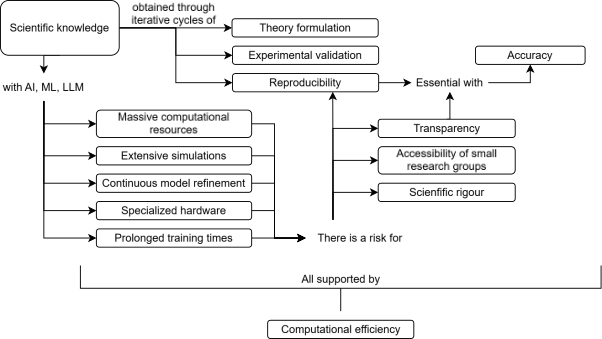
Figure 1: Scientific knowledge, AI and computational efficiency.
For AI to function as a genuinely scientific instrument, evaluation criteria must extend beyond predictive accuracy. Scientific AI systems must be stable, verifiable, analyzable, and transparent, enabling independent replication and critical scrutiny. As shown in Figure 1, computational efficiency plays a central role in supporting these classical scientific virtues: it enables faster experimentation cycles, broader accessibility for smaller laboratories, and greater robustness through simpler, more tractable models. When efficiency is treated as a first-class scientific requirement, reduced energy consumption and environmental impact follow naturally. In this sense, efficiency is an epistemic virtue of AI for science, while sustainability is its systemic by-product.
Links:
https://rescience.github.io/
https://pmc.ncbi.nlm.nih.gov/articles/PMC5016202/
References:
[1] E. Barbierato and A. Gatti, "Toward Green AI: A Methodological Survey of the Scientific Literature," in IEEE Access, vol. 12, pp. 23989-24013, 2024, doi: 10.1109/ACCESS.2024.3360705.
[2] E. Barbierato and A. Gatti, The Challenges of Machine Learning: A Critical Review. Electronics 2024, 13, 416. https://doi.org/10.3390/electronics13020416.
Please contact:
Enrico Barbierato
Catholic University of the Sacred Heart, Italy