






by Luca Ciampi, Ludovico Iannello, Giuseppe Amato (CNR-ISTI), Federico Cremisi and Fabrizio Tonelli (Scuola Normale Superiore Pisa)
Can living neurons compute? Researchers from CNR-ISTI, CNR-IBF, and Bio@SNS introduce a pioneering approach in which cultured neuronal networks act as reservoirs for pattern recognition. This bio-hybrid paradigm aims to bridge neuroscience and machine learning, opening new pathways towards interpretable and energy-efficient AI.
Artificial Intelligence (AI) has achieved remarkable progress through deep learning, yet most current models remain abstract approximations of biological neural systems. This gap has inspired growing interest in biologically grounded approaches that combine machine learning principles with the intrinsic dynamics of living neurons. Our work explores this frontier by introducing Biological Reservoir Computing (BRC)—a paradigm in which a network of cultured neurons serves as the computational substrate for AI tasks. The project brings together computer scientists and biologists from CNR -ISTI, CNR-IBF, and Bio@SNS in Pisa, Italy, combining expertise in machine learning, electrophysiology, and stem cell biology to explore this innovative direction. These activities have been carried out within the framework of the NRRP project THE: Tuscany Health Ecosystem.
What is Biological Reservoir Computing?
Reservoir Computing (RC) is a machine learning framework that projects input data into a high-dimensional space through the nonlinear dynamics of a recurrent system. This transformation makes patterns easier to separate, so that even a simple linear classifier can achieve good performance without training the reservoir itself. Traditionally, RC implementations rely on artificial units, such as Echo State Networks or Liquid State Machines. In contrast, BRC replaces these artificial reservoirs with real neuronal networks cultured in vitro, leveraging their natural complexity and nonlinear dynamics to process information.
How does it work?
The system interfaces with a high-density multi-electrode array (HD-MEA), which enables both electrical stimulation and high-resolution recording of neural activity. Input patterns—such as digit-like configurations—are encoded as spatial stimulation sequences and delivered to the neuronal culture. The evoked spiking responses are captured across thousands of electrodes and transformed into high-dimensional feature vectors. These representations are then classified using a simple linear readout layer. This approach effectively turns a living neural network into a biologically instantiated feature extractor. Unlike conventional artificial reservoirs, the biological substrate operates with intrinsic variability and rich dynamics, offering a unique perspective on neuromorphic computation. The overall framework is shown in Figure 1.
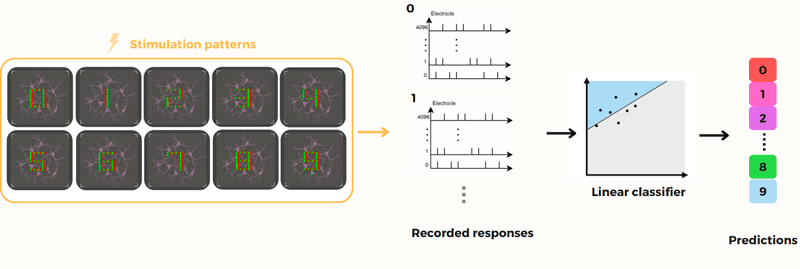
Figure 1: Overview of the Biological Reservoir Computing (BRC) concept. A multi-electrode array (MEA) acts as a two-way interface to a cultured biological neural network, allowing us to both stimulate the living neurons and record their responses. Inputs are represented by activating specific electrodes, which deliver controlled electrical pulses to the network. The resulting neural activity is captured through other electrodes and converted into rich, high-dimensional patterns that encode the input in a latent computational space. Because the network’s dynamics are complex and adaptive, this transformation is highly nonlinear. Finally, a simple linear model is trained to classify the original input based on these patterns.
Why is this important?
Modern AI systems face challenges related to energy consumption, interpretability, and biological plausibility. By offloading part of the computation to a physical neural substrate, BRC offers potential advantages in energy efficiency and adaptive behavior, while providing insights into how real neural networks process information. This line of research also contributes to the broader effort of bridging neuroscience and AI, in line with the European vision of trustworthy and sustainable AI.
Experimental Results
To validate the feasibility of BRC, we conducted experiments on pattern recognition tasks of increasing complexity. Starting from simple geometric patterns, we progressed to clock-digit-like configurations and finally to real handwritten digits from the MNIST dataset. Despite the inherent variability of biological responses, the system consistently produced discriminative representations that enabled accurate classification. In our tests, BRC achieved performance levels comparable to those of an artificial reservoir with similar dimensionality, demonstrating its potential as a viable computational paradigm.
Conclusions
This work demonstrates that living neuronal networks can serve as effective computational substrates within a reservoir computing framework. By leveraging the intrinsic dynamics of biological systems, we open a promising pathway towards neuromorphic architectures that combine energy efficiency, adaptability, and biological plausibility. Our experiments on static pattern recognition tasks confirm the feasibility of this approach and highlight its potential for future applications in AI and neuroscience. Notably, our preliminary study on this topic, presented at the ICCV 2025 Workshop “2nd Workshop on Human-inspired Computer Vision”, received a Best Paper Award, and subsequent work was published at ICONIP 2025, underscoring the originality and scientific relevance of this research. Moving forward, we aim to extend BRC to more complex tasks and explore learning mechanisms within the biological reservoir, paving the way for adaptive bio-hybrid system.
References:
[1] L. Iannello et al., “From Neural Activity to Computation: Biological Reservoirs for Pattern Recognition in Digit Classification,” Int. Conf. on Computer Vision (ICCV) 2025 - Workshops, pp. 4771–4780.
[2] L. Iannello et al., “From Neurons to Computation: Biological Reservoir Computing for Pattern Recognition,” Neural Information Processing, pp. 114–131, Nov. 2025, doi: 10.1007/978-981-95-4100-3_9.
Please contact:
Luca Ciampi
CNR-ISTI, Italy
Giuseppe Amato
CNR-ISTI, Italy