







by Anaëlle Martin (CCNEN – French National Digital Ethics Advisory Committee)
The fourth edition of the ERCIM Forum “Beyond Compliance” [L1] was held from 29 to 31 October 2025 at the Inria Centre in Rennes. Returning to France after the inaugural edition in Paris in 2022 [L2], the Forum once again provided an international platform for discussion on ethical issues in digital research and innovation.
The three-day programme addressed five key themes: security in the digital society; geopolitics of digital ethics; data altruism and open academic resources; generative AI in research, teaching and publishing; and AI’s impact on behaviour and cognition. Hosted by the Inria Centre at Rennes University and IRISA, the 2025 edition reaffirmed ERCIM’s commitment to debate, critical reflection and interdisciplinary collaboration.
The three-day programme addressed five key themes: security in the digital society; geopolitics of digital ethics; data altruism and open academic resources; generative AI in research, teaching and publishing; and AI’s impact on behaviour and cognition. Hosted by the Inria Centre at Rennes University and IRISA, the 2025 edition reaffirmed ERCIM’s commitment to debate, critical reflection and interdisciplinary collaboration.
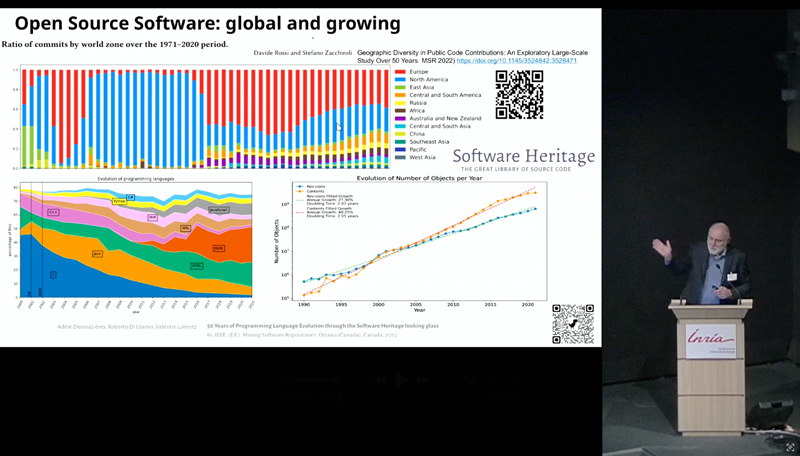
Roberto Di Cosmo from Inria and University Paris Cité, presenting “No science without source: collecting, preserving and sharing software in a risky world” during the session “Data altruism and open academic resources” on Thursday, 30 October 2025.
Wednesday, 29 October
The Forum opened with a joint round table with the Ethics Working Group of Informatics Europe, held in connection with the Informatics Europe ECSS event in Rennes [L3]. Presentations addressed the responsible development and application of information systems, with particular attention to accountability, misinformation, ethical awareness and best practices in digital security. Discussions focused on compliance and accountability in AI development, the impact of design choices on user autonomy, and ethical risks related to generative AI, misinformation and deepfakes.
The day concluded with a keynote by Catherine Tessier on ethical issues in AI research and education. The keynote examined how the rapid diffusion of generative AI challenges fundamental notions of learning, writing, responsibility and scientific practice, and called for a rethinking of research and educational practices rather than simple adaptation to AI tools.
Thursday, 30 October
The day began with a strategy meeting of the ERCIM Digital Ethics Working Group, followed by a tutorial by Alexei Grinbaum on AI’s impact on human behaviour and cognition, drawing on results from the AIOLIA project [L4]. The tutorial highlighted both potential cognitive benefits and risks such as automation bias and overreliance, stressing the importance of operationalising ethical principles through actionable, context-sensitive guidelines.
The late morning session focused on data altruism and open academic resources. Contributions examined free and open-source software as a form of digital altruism, large-scale preservation infrastructures such as Software Heritage [L5], and the role of legal and governance constraints, including GDPR [L6]. The discussion also highlighted the European Open Science Cloud (EOSC) [L7] and its relationship to FAIR data practices [L8]. Speakers emphasised that openness alone does not guarantee trustworthiness and that responsible data sharing requires contextualisation, transparency and human-centred design. The session also referenced recent recognition of work in this area [L9].In the afternoon, a keynote by Afonso Seixas-Nunes addressed the moral and legal responsibilities associated with autonomous systems, particularly autonomous weapons, highlighting challenges related to accountability, proportionality and the opacity of AI-based systems.The day concluded with a session on the geopolitics of digital ethics in academia, analysing how power, sovereignty and international tensions shape ethical practices in universities and research institutions. Speakers referred to major international and European policy developments, including the Council of Europe’s framework convention [L10], the EU AI Act [L11], and relevant UN-level discussions [L12].
Friday, 31 October
The final day focused on the integration of generative AI in academic practices. Speakers critically examined the largely unreflective adoption of generative AI in research and education, highlighting pedagogical, scientific, social and environmental costs, and questioning which intellectual tasks should remain protected from automation.The Forum concluded with a keynote by Mihalis Kritikos on ethical considerations in EU-funded digital projects under Horizon Europe [L13]. The keynote presented the Commission’s approach to embedding ethics as a learning-oriented, ongoing process rather than a purely compliance-driven exercise, while warning against fragmentation and “ethics washing”.
Outlook
Videos of the Forum talks will be made available online soon. Readers interested in being notified when the recordings are published, and in future Beyond Compliance activities, are invited to subscribe to the Beyond Compliance mailing list [L14].
Links:
[L1] https://www.ercim.eu/beyond-compliance
[L2] https://www.ercim.eu/beyond-compliance/beyond-compliance-2022
[L3] https://www.informatics-europe.org/ecss/2025/home
[L4] https://aiolia.eu/index.php/partners/
[L5] https://www.softwareheritage.org/author/roberto/
[L6] https://eur-lex.europa.eu/eli/reg/2016/679/oj/eng
[L7] https://research-and-innovation.ec.europa.eu/strategy/strategy-research-and-innovation/our-digital-future/open-science/european-open-science-cloud-eosc_en
[L8] https://www.eoscobservatory.eu/explore/open-science-by-area/fair-data
[L9] https://ercim-news.ercim.eu/en142/joint-ercim-actions/miriam-santos-wins-the-2025-cor-baayen-award
[L10] https://www.coe.int/en/web/artificial-intelligence/the-framework-convention-on-artificial-intelligence
[L11] https://eur-lex.europa.eu/eli/reg/2024/1689/oj/eng
[L12] https://docs.un.org/en/A/79/l.118
[L13] https://research-and-innovation.ec.europa.eu/funding/funding-opportunities/funding-programmes-and-open-calls/horizon-europe_en
[L14] https://lists.ercim.eu/wws/subscribe/beyondcompliance
Please contact:
Anaëlle Martin
CCNEN – French National Digital Ethics Advisory Committee, France