


ERCIM News 69

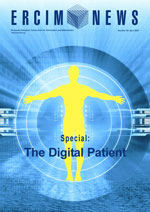
Image ERCIM News 69 cover page

April 2007
Special theme:
The Digital Patient

This issue in pdf
(68 pages; 4.5 Mb)
Next issue
July 2013
Next special theme:
Intelligent Cars
Call for the next issue
Get the latest issue to your desktop
RSS Feed

R&D and Technolgoy Transfer

R&D and Technology Transfer

Semantic Interoperability in the Structured Electronic Health Record

by Petr Hanzlíček, Petra Přečková and Jana Zvárová

The electronic health record (EHR) is defined as a repository of information regarding the health of a subject of care, which exists in computer-processable form, stored and transmitted securely, and accessible by multiple authorized users. Its primary purpose is the support of efficient, high-quality integrated health care, independent of the place and time of health care delivery. To achieve these objectives, the semantic interoperability between information systems of different health care providers is a key issue.

Read more: Semantic Interoperability in the Structured Electronic Health Record

Adaptive Patient Scheduling with Dynamic Resource Usage

by Ivan B. Vermeulen, Sander M. Bohte and Han La Poutré

Can patient planning be more efficient? The Computational Intelligence and Multiagent Games (SEN4) research group at CWI uses software agents and smart, adaptive algorithms to improve hospital patient scheduling and to better match patients’ appointments to their own preferences.

Read more: Adaptive Patient Scheduling with Dynamic Resource Usage

Technology to Assist the Sick, the Elderly and People with Disabilities

by Loriano Galeotti, Matteo Paoletti, Andrea Vannucci, Stefano Diciotti, Massimo Carradori, Massimo Pistolesi and Carlo Marchesi

We consider a digital patient to be a person who is part of a community that is well acquainted with advanced technology, and is open also to medical applications. This project aims to make such patients capable of managing assistive technology devices for monitoring their health conditions, and also to train and improve their opportunities for social contact.

Read more: Technology to Assist the Sick, the Elderly and People with Disabilities

OLDES: A Low-Cost System for Caring for the Elderly

by Massimo Busuoli

With the number of senior citizens in the EU dramatically increasing, the burden in terms of public expense rises concomitantly. This is the motivation behind OLDES (Older peoples’ e-services at home), a three-year project funded by the Information Society Technologies Programme of the European Union.

Read more: OLDES: A Low-Cost System for Caring for the Elderly

Mobile Health Assistant

by Christian Weigand and Janina Schmidt

The Mobile Health Assistant has been developed by Fraunhofer researchers to provide support for patients with chronic illnesses. Comfortable and easy to use, the Assistant is designed to aid patients 24/7 a week.

Read more: Mobile Health Assistant

Research Institute Supporting Electronic Governance

by Zoltán Tóth

Promoting the fast and efficient development of the Information Society is a major objective of the Hungarian Academy of Sciences (HAS). Accordingly, in January 2006 SZTAKI, the Computer and Automation Research Institute of the HAS, established the E-governance Competence Centre (ECC), dedicated to developing and promoting applications for e-administration.

Read more: Research Institute Supporting Electronic Governance

The Bridge Project: Cooperation between Europe and China to Develop Grid Applications

by Gilbert Kalb

Launched with a kick-off meeting in Southampton on 25 January, the Bridge Grid Project is designed to encourage bilateral research and industrial development that will enhance and integrate Grid-enabled technology for industrial cooperation between Europe and China.

Read more: The Bridge Project: Cooperation between Europe and China to Develop Grid Applications