



Special Theme
Introduction to the Special theme
by Rüdiger Dillmann, Tamim Asfour and Antonis Argyros
Truly intelligent technical cognitive systems should be able to operate autonomously, interact naturally with their environment and the humans therein, and be adaptive to changing situations and contexts, including the user’s preferences and needs. Currently, an encouraging spectrum of many isolated elements in the area of cognitive systems is realizable, including vision, speech, learning, decision making, planning and motor control. Nevertheless, the focus of these developments is mainly on performance in well defined, narrow domains. Successful attempts in building artificial, intelligent cognitive systems are still mostly restricted to systems designed for ‘sunshine’ environments having limited scope and performing simple tasks. The transferability of the developed skills and abilities to varying contexts and tasks without costly redesign of specific, ad hoc solutions is still impossible. In the future, research efforts must be devoted to rich cognitive challenges which are measurable and scalable in open ended scenarios under changing conditions, and to the development of measures, metrics and benchmarks that highlight and focus on both transferability and performance.
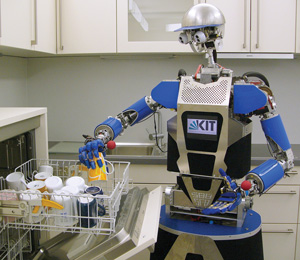
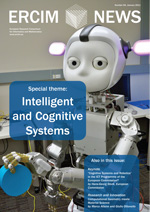
Image: ARMAR-III, a humanoid robot of the Karlsruhe Institute of Technology developed by the Collaborative Research Center on humanoid robots (SFB 588), funded by the German Research Foundation (DFG), as assistance robot in human-centered environments.
Cognitive Systems – From Internet to Robotics
invited articleby Henrik I Christensen
Over the last two decades the Internet has been a game changer. It has changed how we interact with people, the world is becoming flat in the sense that we can easily access people and resources across the world. It is, however, characteristic that so far the internet has primarily been used for exchange of information. The premise here is that the next revolution will happen when the internet is connected to the physical world, as typically is seen in robotics.
The Cognitive Robotics behind Human-Robot Interaction
by Tony Belpaeme
Currently, most cognitive and social robots only operate in the here and now, but the ALIZ-E project aims to change this, moving human-robot interaction from the range of minutes to the range of days. The project develops the theory and practice behind embodied cognitive robots capable of maintaining social interactions with a young user over an extended period of time.
Read more: The Cognitive Robotics behind Human-Robot Interaction
R3-COP - Resilient Reasoning Robotic Co-operating Systems
by Wolfgang Herzner
The ARTEMIS-project R3-COP will provide European industry with new leading-edge methodology and technologies to enable production of advanced robust and safe cognitive, reasoning autonomous and co-operative robotic systems at reduced cost in terms of time and money in different application domains. It will establish an environment for their design, development, assessment and validation and develop a high-performance and fault-tolerant processing platform. R3-COP is the first ARTEMIS project addressing this area.
Read more: R3-COP - Resilient Reasoning Robotic Co-operating Systems
AIsoy 1: A Robot that Perceives, Feels and Makes Decisions
by D. García, C. Pallardó, D.Ríos Insua and R. Moreno, A. Redchuk
We have recently developed AIsoy 1, a robot that is capable of inferring the current state of its environment and what its user is doing, through voice, vision and a system of sensors. As a consequence, it modifies its emotional state and makes decisions aimed at attaining its objectives. With numerous functionalities, AIsoy 1 is a social emotional bot with enormous potentiality as an edutainment tool, as a cognitive personal assistant and as a therapeutic means.
Read more: AIsoy 1: A Robot that Perceives, Feels and Makes Decisions
Long-term Evaluation of a Mobile Remote Presence Robot for the Elderly
by Amedeo Cesta, Gabriella Cortellessa, Lorenza Tiberio
We are currently working on a project, named ExCITE, the goal of which is to intensively evaluate a tele-presence robot against a wide spectrum of requirements of the elderly. This work is at the intersection of two emerging fields, Human-Robot Interaction (HRI) and Ambient Assisted Living (AAL), and involves both long term and cross-cultural user evaluation.
Read more: Long-term Evaluation of a Mobile Remote Presence Robot for the Elderly
Designing an Air to Ground Robot Team using Agent-based Technology
by Cai Luo and Alessandro De Gloria
Robot team work is typically a collaborative activity. Organising a robot team to undertake a search and rescue mission is an important and complex task. Agent-based technology provides a solution. We present preliminary work aimed at developing distribution strategies for a robot team using an agent-based model (ABM).
Read more: Designing an Air to Ground Robot Team using Agent-based Technology
Evolving Autonomous Mars Rovers
by Angelo Cangelosi, Christos Ampatzis and Dario Izzo
The innovative contribution of this collaborative project between the University of Plymouth Robotics groups and the ESA Advanced Concepts Team was to successfully test the hypothesis that the island model paradigm permits the autonomous design of complex controllers for Mars rover robots, for navigation and active vision strategies, thus overcoming some of the current limitations of evolutionary robotics.
Next Generation Bio-inspired Vision
by Christoph Posch
At AIT, the Austrian Institute of Technology, we have developed the next generation of biomimetic, frame-free vision and image sensors. Based on the seminal research on neuromorphic electronics at CalTech in the 1990’s and further developed in collaboration with the Institute of Neuroinformatics at the ETH Zürich, ATIS is the first optical sensor to combine several functionalities of the biological ‘where’- and ‘what’-systems of the human visual system. Following its biological role model, this sensor processes the visual information in a massively parallel fashion using energy-efficient, asynchronous event-driven methods.
Bioinspired Robot Homing using ALV and Visual Features
by Arnau Ramisa, Alex Goldhoorn, David Aldavert, Ricardo Toledo and Ramon Lopez de Mantaras
There is significant research in robotic navigation using methods based on animal navigation techniques. For example, some work has drawn inspiration from biological studies of the navigation techniques of the ant species Cataglyphis. The main advantage of such techniques is that they use simple sensors and are also computationally simple, which makes them applicable to inexpensive robots.
Read more: Bioinspired Robot Homing using ALV and Visual Features
Time, Language and Action - A Unified Long-Term Memory Model for Sensory-Motor Chains and Word Schemata
by Fabian Chersi, Marcello Ferro, Giovanni Pezzulo and Vito Pirrelli
Action and language are known to be organized as closely-related brain subsystems. An Italian CNR project implemented a computational neural model where the ability to form chains of goal-directed actions and chains of linguistic units relies on a unified memory architecture obeying the same organizing principles.
Challenges for the Design of Intelligent and Multimodal Cognitive Systems
by José Rouillard, Jean-Claude Tarby, Xavier Le Pallec and Raphaël Marvie
With the MINY (Multimodality Is Nice for You!) project, our goal is to propose some novel possibilities to take many modalities of interaction into account. Using a model-driven engineering approach we present some suggestions in order to tackle the challenges around the design of intelligent and multimodal cognitive systems.
Read more: Challenges for the Design of Intelligent and Multimodal Cognitive Systems
DECKT: Epistemic Reasoning for Ambient Intelligence
by Theodore Patkos and Dimitris Plexousakis
The intriguing objective of AI - to create intelligent autonomous agents that exhibit commonsense behavior in the real world - forces research to go beyond many deep-rooted simplistic assumptions and to acknowledge the restrictions and complexity of our surroundings. The nascent field of Ambient Intelligence (AmI), that formulates current trends and challenges in Europe, opens new avenues of research for AI. Intelligent and usable computing devices need to prove their cognitive skills in environments that involve dynamically changing context, where information quickly becomes obsolete as a result of context-dependent occurrences or actions performed by users. Reasoning under partial knowledge is intended to promote run-time decision-making based on knowledge about the effects of events and their ramifications and on causal relationships among different components of the world, even when information about the components is incomplete.
Read more: DECKT: Epistemic Reasoning for Ambient Intelligence
Comparative Cognition: Animals and Robots
by Vicente Matellán
One of the major scientific contributions of CompCog has been to provide a unified system to collate research methods and results across various animal species, including humans, and also artificial creatures (robots). The systematic collection of data produced by different research groups would enhance the study of social cognition in an operationally comparative way. In the project an on-line video tagging system has been developed. Another contribution has been the use of mobile robots to test the abilities of ethologists.
Executive Control in Artificial Agents
by Michail Maniadakis and Panos Trahanias
Self-referential cognitive control is a fundamental capacity of animals and humans. Ongoing research in FORTH-ICS focuses on implementing this high-order cognitive skill in the domain of artificial autonomous agents, aiming to accomplish an important milestone for the development of the seamless integration of robots into human societies.
Conscious-like Bot wins the 2K BotPrize
by Raúl Arrabales and Jorge Muñoz
CCBot-2, a software agent based on the CERA-CRANIUM cognitive architecture, was the winner of this year’s edition of the BotPrize. This contest is an adaptation of the Turing test for a first person shooter video game. Although CCBot-2 could not pass the Turing test, she narrowed the gap with human players, being considered the most human bot, and achieving a humanness ratio of almost 32% (while the “less human” human player scored around 35%).
An Intelligent System for Decision Support in Bioinformatics
by Antonino Fiannaca, Massimo La Rosa, Daniele Peri and Riccardo Rizzo
The enormous array of computational techniques and data available due to today’s use of high-throughput technologies can be quite overwhelming for researchers investigating biological problems. For any problem, there are many possible models and algorithms giving different results. We present a new Intelligent System that supports the selection, configuration and operation of strategies and tools in the bioinformatics domain.
Read more: An Intelligent System for Decision Support in Bioinformatics
Learning from Experience to Anticipate Domestic Needs
by Vittorio Miori, Dario Russo and Alessandro Pulidori
With the increasing influence of technology on our lives, it is becoming ever more important to offer new ambient intelligence solutions which enable humans to adapt and organize their lives around computational technologies and technologies that adapt to meet user behaviour. We apply machine learning techniques to demonstrate how user needs can be satisfied and anticipated by adding Ambient Intelligence solutions to any environment equipped with well-established commercial domotic systems.
Read more: Learning from Experience to Anticipate Domestic Needs
A Self-Healing Approach to Risk Management in Work Environments
by MariaGrazia Fugini and Claudia Raibulet
A significant number of accidents still occur in the work-place. We describe the WIRI project which investigates how such accidents can be prevented by the employment of user-friendly IT technologies aimed at identifying risky situations.
Read more: A Self-Healing Approach to Risk Management in Work Environments
Knowledge and Interaction in Social and Economic Networks
by Jan van Eijck and Floor Sietsma
When you send an email message to more than one address using the Cc: field, all recipients see the same message, including the To: and Cc: fields. Sending a message to undisclosed recipients (using Bcc) has a quite different communicative effect: no common knowledge about the recipient list is created. If a communication network is complex and lots of messages pass through it, it becomes a real challenge to trace who has learnt what from the communication. This challenge is taken up in a project at CWI that started recently.
Read more: Knowledge and Interaction in Social and Economic Networks


