


ERCIM News 71

Image ERCIM News 71 cover page

October 2007
Special theme:
Technology-Enhanced Learning

This issue in pdf
(68 pages; 7.5 Mb)
Next issue
July 2013
Next special theme:
Intelligent Cars
Call for the next issue
Get the latest issue to your desktop
RSS Feed

Special Theme

Introduction to the Special Theme

by Peter Scott and Christine Vanoirbeek

Initially known as 'computer-assisted learning' and later e-learning, the study of improving learning processes by the use of technology has evolved into the research domain known as 'Technology-Enhanced Learning'. Its objective is to encourage the emergence of new learning models that are sustained by the context-aware use of technology and anchored in the practices of users.
Technology-Enhanced Learning
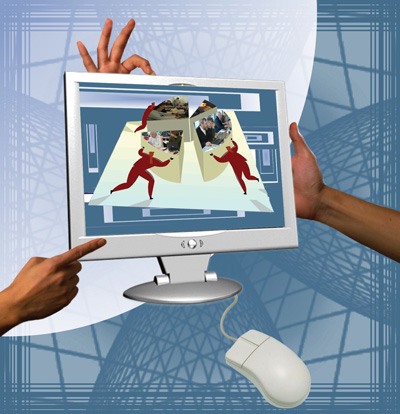
Technology-Enhanced Learning. Illustration by Gorel Gorga.

Read more: Introduction to the Special Theme

Developing Products and Services for E-learning

by Sybille Hambach

People no longer need to be convinced that e-learning is up to date. However, they still need to know how to develop good e-learning products and services. Researchers at the Fraunhofer Institute for Computer Graphics (IGD) Rostock have developed the process model ROME. It helps experts from different disciplines to understand the process, methods and tools involved in developing e-learning products and services.

Read more: Developing Products and Services for E-learning

Collaborative and Engaging Online Learning

by Gavin McArdle, Teresa Monahan and Michela Bertolotto

The provision of learning facilities online is a convenient way for students to partake in education. This form of e-learning is currently in widespread use and is continually growing in popularity. The CLEV-R research group within the School of Computer Science and Informatics at University College Dublin, Ireland, are examining ways of enhancing students' e-learning experiences by providing interactive methods for accessing e-learning material. Of particular interest is support for a learning community, which permits collaborative learning techniques and fosters social interaction between students. A combination of 3D multi-user environments and instant communication techniques are employed to achieve this.

Read more: Collaborative and Engaging Online Learning

HyLearn: Cooperative M-Learning in Hybrid Networks

by Matthias R. Brust, Adrian Andronache and Steffen Rothkugel

In retrieving information, today's mobile devices are able to connect directly the Internet via UMTS/GSM links, allowing them to consult neighbouring devices by using free-of-charge Bluetooth or Wi-Fi links. Increasing numbers of students are taking advantage of these mobile devices in order to advance in their studies faster and more efficiently. The HyLearn application supports the student in the use of any possible wired or wireless communication link to search for teaching material, and fosters cooperation between students.

Read more: HyLearn: Cooperative M-Learning in Hybrid Networks

The MOSEP E-Portfolio Course: A New Didactic Concept for Teachers and Vocational Trainers

by Wolf Hilzensauer

Some hail e-portfolios as the answer to their prayers for a method of competence-oriented learning. This is because e-portfolios combine classical (course-oriented and/or blended) e-learning with self-organized, self-oriented and lifelong learning. What competencies do teachers need in order to support learners in their individual learning processes? The European project MOSEP (more self esteem with my e-portfolio) tries to come up with some of the answers.

Read more: The MOSEP E-Portfolio Course: A New Didactic Concept for Teachers and Vocational Trainers

Open Educational Resources: Features, Trends and Implications

by Guntram Geser and Sandra Schaffert

Open content in education and learning has increasingly gained attention in recent years. Its importance has been acknowledged by stakeholder organizations, and recent international initiatives are fostering the creation and sharing of such resources. The EU-project OLCOS observes the trends and implications of open content for learning and education, and offers guidelines and resources for teachers, learners, educational institutions and decision makers.

Read more: Open Educational Resources: Features, Trends and Implications

User-Centred Learning Object Metadata for Effective and Efficient E-learning Environments

by Anne Morris, Ann O'Brien and Panos Balatsoukas

Research conducted in the Department of Information Science at Loughborough University in investigating the evaluation and design of usable schemes for learning object metadata.

Read more: User-Centred Learning Object Metadata for Effective and Efficient E-learning Environments

InterEDU: Supplying Teachers and Students with Educational Resources

by Erich Gams and Georg Güntner

Intelligent Edumedia Repository (InterEDU), a project conducted at Salzburg NewMediaLab (SNML), is developing a framework for an online platform for educational multimedia content. This is based on semantic Web and social software technology which is applied in the project to improve searchability (eg by semantically interrelating content) and to enhance the usability and attractiveness of content by combining the collective expertise of the learning and teaching community.

Read more: InterEDU: Supplying Teachers and Students with Educational Resources

The Web Geographic Information System for Culture as Preliminary Learning Phase

by Carola Salis and Eva Lorrai

Among its several branches, the Centre for Advanced Studies, Research and Development in Sardinia has a department which focuses on the research and development of remote tools for e-learning. The aim of the Web Geographic Information System (Web-GIS) for Culture (WGC) project is to create a database of Sardinian museums that will provide school teachers with useful and detailed information about the nature of the exhibit characteristics and the related activities, thereby helping students to derive the greatest benefit from their museum visits. The WGC is a methodological and technological framework that, once established, will enable access to and updates of museum activities.

Read more: The Web Geographic Information System for Culture as Preliminary Learning Phase

Supporting Organizational Learning: AnaXagora

by Sandrine Reiter, Brice Bucciarelli and Luc Vandenabeele

Several surveys conducted in Luxembourg by the CRP Henri Tudor have found that poor or limited use of e-learning occurs in business and commerce when training is inadequate for the needs of small and medium enterprises (SMEs). Nowadays, companies ask for tools that give their employees the opportunity to develop their competencies in relation to their specific business. To satisfy such requests, training tools should be designed to reflect the core business processes of the relevant firm, and should be adapted to cope with different skill levels. CRP Henri Tudor is currently developing AnaXagora, an open-source platform consisting of four modules that can be used to design business processes, manage knowledge and competencies and follow e-learning courses.

Read more: Supporting Organizational Learning: AnaXagora

The KP-Lab Framework for Knowledge Creation Practices

by Dimitris Kotzinos, Vassilis Christophides and Liisa Ilomäki

KP-Lab (Knowledge Practices Laboratory) is an EU-funded project involving 22 partners from 14 countries. It focuses on studying learning practices in professional and educational environments, cross-fertilizing them, and creating the necessary tools to support emerging practices through sharing and collaboration.

Read more: The KP-Lab Framework for Knowledge Creation Practices

The SISINE Project: Developing an E-Learning Platform for Educational Role-Playing Games

by Orazio Miglino

Role-playing games are commonly used to teach negotiation skills. In traditional practice, learners in a small group act out roles assigned by the trainer. The SISINE project will make it possible to conduct this kind of role-playing game at a distance.

Read more: The SISINE Project: Developing an E-Learning Platform for Educational Role-Playing Games

Bringing Together Knowledge Management and E-Learning in Software Engineering: The Software Organiza

by Eric Ras and Jörg Rech

The integration of knowledge management and e-learning has been a frequent topic of discussion in recent years, but the idea has rarely been implemented. The Software Organization Platform (SOP) project is a technology-based approach to bringing the two streams of research closer together. SOP enables software engineers to act as both consumers and producers of information on projects, roles, processes, products, or other learning content. With a focus on the domain of software engineering and by using a semantic Wiki as a technical basis, SOP has recently been made open source.

Read more: Bringing Together Knowledge Management and E-Learning in Software Engineering: The Software Organiza

CoPe_it! - Supporting Incremental Formalization in Collaborative Learning Environments

by Nikos Karacapilidis, Dora Nousia and Manolis Tzagarakis

CoPe_it! is a tool of the Web 2.0 era. It complies with collaborative learning principles and practices, and provides members of communities engaged in argumentative discussions and decision-making processes with the appropriate means to collaborate towards the solution of diverse issues. It builds on an incremental formalization approach, which is achieved through the consideration of alternative projections of a collaborative workspace, as well as through mechanisms supporting switches from one projection to another.

Read more: CoPe_it! - Supporting Incremental Formalization in Collaborative Learning Environments

TAO: An Open and Versatile Computer-Based Assessment Platform Based on Semantic Web Technology

by Thibaud Latour and Romain Martin

Computer-Assisted Testing (CAT) is gaining increasing interest from professional and educational organizations, particularly since the dramatic emergence of the Internet as a privileged communication infrastructure. In a similar fashion to e-learning technology, the generalized use of computers has made possible a wide range of new assessment modalities, as well as widening the range of skills that can be assessed.

Read more: TAO: An Open and Versatile Computer-Based Assessment Platform Based on Semantic Web Technology

Context-Based Adaptive and Responsive Authentication

by Gabriele Lenzini and Bob Hulsebosch

The Dutch Telematica Instituut has designed adaptive, location-based, and responsive authentication solutions for pervasive, ubiquitous, intelligent environments. This idea is validated with an intelligent coffee corner, where users can see - depending on their identity and authentication tokens - the position of their colleagues on a wall screen.

Read more: Context-Based Adaptive and Responsive Authentication

Turning Web 2.0 Social Software into Collaborative Learning and Knowledge Management Solutions

by Denis Gillet, Chiu Man Yu and Sandy El Helou

After years of quest by the computer-supported collaborative work community for true user satisfaction, social software and communities of practice turn out to be the enabling frameworks for natural and effective collaborative learning and knowledge management. In the framework of the European Integrated Project PALETTE, the École Polytechnique Fédérale de Lausanne (EPFL) is developing the eLogbook Web 2.0 social software (http://eLogbook.epfl.ch). The purpose of eLogbook is to support tacit and explicit knowledge management in communities of practice (CoPs). It can be customized by users to serve as an asset management system, a task management system or a discussion platform. It will also be deployed as a general-purpose collaborative workspace for project-based learning activities at the EPFL.

Read more: Turning Web 2.0 Social Software into Collaborative Learning and Knowledge Management Solutions

Interactive Games in Multi-Device Environments to Enhance the Learning Experience of Museum Visitors

by Giuseppe Ghiani, Fabio Paternò, Carmen Santoro and Davide Spano

Recent technological advances have led to novel interactive software environments for edutainment, such as museum applications. These environments provide new interaction techniques for guiding visitors and improving their learning experience. We propose a multimodal, multi-device and location-aware museum guide, able to opportunistically exploit large screens when they are nearby the user. Various types of game are supported in addition to the museum and artwork descriptions, including games involving multiple visitors.

Read more: Interactive Games in Multi-Device Environments to Enhance the Learning Experience of Museum Visitors

Interactive Educational Play with Augmented Toy Environments

by Steve Hinske and Matthias Lampe

Enhancing traditional toys with pervasive computing technology yields a mixed-reality platform that combines the best of the real and virtual worlds. Such augmented toy environments can be used in providing multimedia and educational content to children to increase the entertainment value on the one hand and, on the other, to playfully support informal learning.

Read more: Interactive Educational Play with Augmented Toy Environments

BabyTeach: Using Ambient Facial Interfaces for Interactive Education

by Barnabás Takács

By merging the power of animation, virtual reality, artificial intelligence and perception to create a novel educational content delivery platform, researchers at the Virtual Human Interface Group of SZTAKI are raising the experience of learning to a new level.

Read more: BabyTeach: Using Ambient Facial Interfaces for Interactive Education

Interactive Correction and Recommendation in the Learning of Computer Languages

by Claire Kenny and Claus Pahl

Active learning and training is an effective form of education. Here we discuss an automated learning and skills training system for database programming that promotes procedural knowledge acquisition. Automated tutoring can provide meaningful feedback, such as correction of student solutions and personalised guidance through recommendations. Automated synchronous feedback and accumulative recommendations based on personalised performance assessment are central features here. At the core of this tutoring system is an error correction component that analyses student input and diagnoses student weaknesses.

Read more: Interactive Correction and Recommendation in the Learning of Computer Languages

Client-Side Scripting in Blended Learning Environments

by Torsten Ullrich and Dieter W. Fellner

The computer graphics tutorial CGTutorial was developed by the Institute of Computer Graphics and Knowledge Visualization at Graz University of Technology in Austria. It combines a scripting engine and a development environment with Java-based Web technology. The result is a flexible framework which allows algorithms to be developed and studied without the need to install libraries or set up compiler configurations. Together with already written example scripts, the framework is ready to use. Each example script is a small runnable demonstration application that can be started directly within a browser. Using a scripting engine that interprets Java and JavaScript on a client, the demos can be modified and analysed by the user and then restarted. This combination of scripting engines and Web technology is thus a perfect environment for blended learning scenarios.

Read more: Client-Side Scripting in Blended Learning Environments

GVT: Virtual Training in Maintenance Procedures

by Stéphanie Gerbaud, Bruno Arnaldi and Jacques Tisseau

While the use of real equipment for training in maintenance procedures imposes many constraints, these can be alleviated by the use of virtual reality. The GVT (General Virtual Training) project, developed in a research-industry collaboration, provides a full platform that can be used to build virtual training environments.

Read more: GVT: Virtual Training in Maintenance Procedures

OSLab: An Interactive Operating System Laboratory

by Markus Wulff and Torsten Braun

The Operating System Laboratory (OSLab) project promoted by the Swiss Virtual Campus (SVC) is an online course that will teach the learner about the principles of computer operating systems using a progressive approach and problem-oriented learning. OSLab focuses on a hands-on training experience for the learner.

Read more: OSLab: An Interactive Operating System Laboratory

Technology-Enhanced Learning on Industrial Automation Solutions Development

by Emanuele Carpanzano and Andrea Cataldo

A mechatronic laboratory integrated with an innovative factory has been set up by the Institute of Industrial Technologies and Automation of the Italian Research Council (ITIA-CNR). This infrastructure is strongly exploited for technology-enhanced learning designed for industrial production engineers.

Read more: Technology-Enhanced Learning on Industrial Automation Solutions Development

Contents